GTM strategies fail because of poor planning, yes. But, they also fail because of the gaps between teams. And this is something I’ll be focusing on here.
The misalignment, the miscommunication, the lack of trust that quietly erodes execution… It’s a silent culture ‘killer’.
I’ve been sitting with this observation for a while now, by running roundtable discussions with fellow PMMs and living it firsthand across marketing and PMM functions I’ve built.
These have been completely different companies, industries, products, and cultures, but with the same breakdowns, again and again, always in the seams between teams.
Why GTM breaks where it does
First off, when a launch goes wrong, the instinct is to look at the strategy, the hypothesis, the understanding of the market, and the clients.
But sometimes it’s not the right time to focus on this, due to too much competition or other elements that impact the success of a launch. More often than not, the strategy was fine. What broke was the system of people trying to execute it together.
Three questions reveal where most PMM and GTM teams are actually struggling:
- Do we have clarity?
- Do we understand the same thing?
- Do we trust each other enough to move?
These sound simple, yet they’re not. In my experience, most PMM and GTM teams haven’t explicitly answered any of them. Yet we act as if we have a shared understanding.
The 3 trust gaps
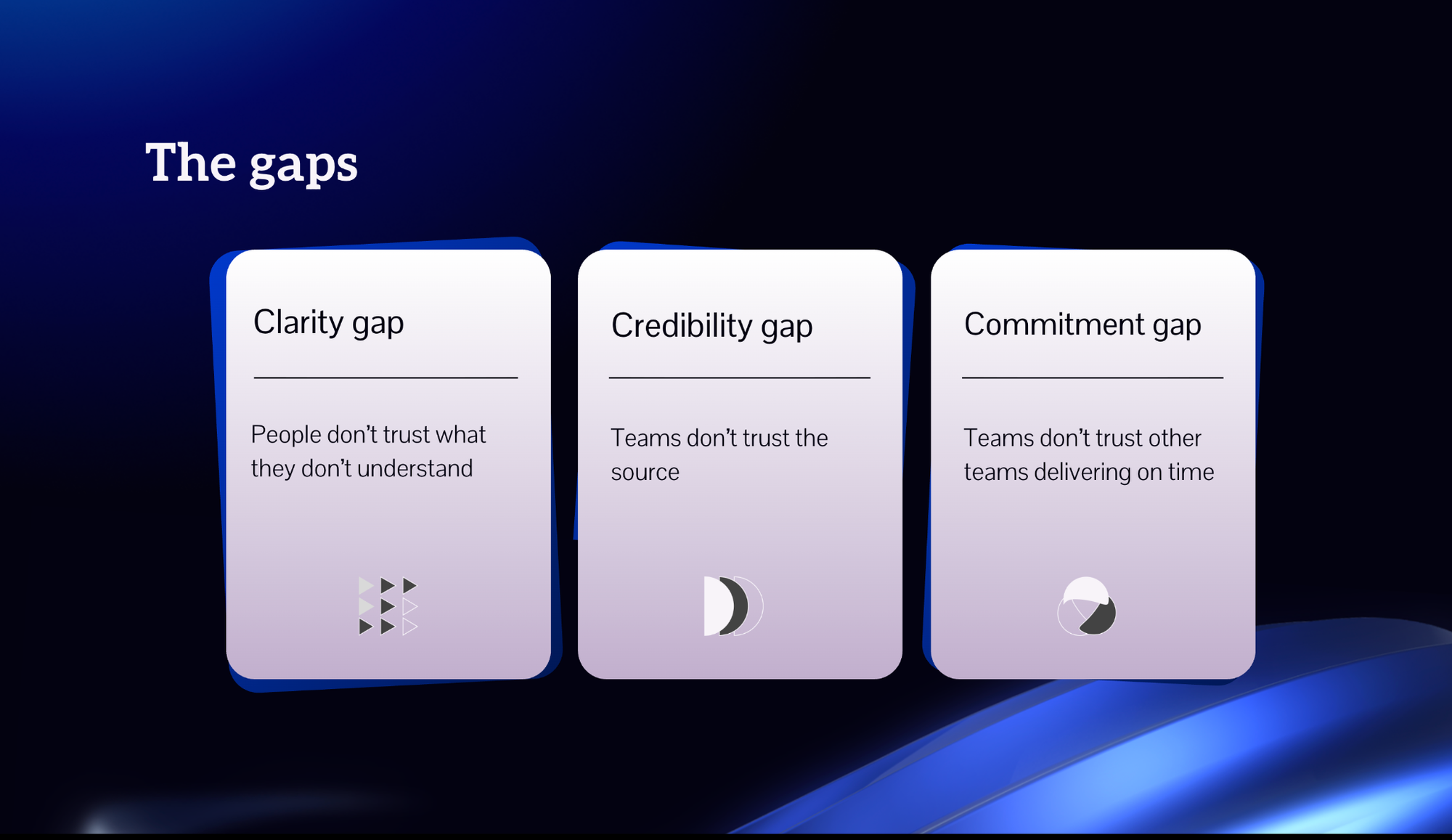
There are three specific places where trust breaks in GTM plans. I call them the trust gaps, and in every launch that I’ve been part of or witnessed, at least one of them was present.
Gap 1: The Clarity Gap
People don’t trust what they don’t understand.
The Clarity Gap is the most common and the most invisible. You’ve joined the team, working in the same company, and you ask what our product is about. Who are we targeting? And you hear 3-5 different perspectives.
For example, some say SMEs, some Enterprises, and some agencies. The product vaguely sounds like the same thing, and the mission is loosely understood. You realize you and the most significant stakeholders are not on the same page.
The solution is that you need to:
- Build a shared narrative,
- Align on the vision and mission of the product,
- Talk with your potential clients, and
- Understand the market needs.
Ask yourself: could every person on your GTM team explain your positioning the same way?
If the answer is no, you have a Clarity Gap.
Gap 2: The Credibility Gap
Teams don’t trust the source. There’s no buy-in.
This one is personal for PMMs; you’ve done the research, you know the product roadmap, you know where you want to take the launch, and what needs to happen. Yet, somehow, there are crickets in the crowd.
The gap isn’t the quality of the work. It’s whether the people on the receiving end trust the person delivering it. And that trust isn’t given by title or tenure; it must be earned by bringing your stakeholders together and building relationships with them. Here, you can then understand what’s important to them and address it, bringing valuable insights and really knowing the product and the market.
When people get to know you and vice versa, it’s easier to collaborate and prioritize because you have the why behind the decisions.
Ask yourself: Does your GTM counterpart see you as a strategic partner or a support function?
If it’s the latter, you have a Credibility Gap.
Gap 3: The Commitment Gap
People don’t trust that others will follow through.
This is the gap that creates what I call ‘Shadow GTM’: teams that have quietly stopped trusting the shared plan and started building their own parallel effort. There are missed deadlines with no early warning and disengagement that only becomes visible at launch, when it’s far too late.
The root cause is weak ownership and unclear accountability. When everyone is responsible, no one is. When accountability is fuzzy, you end up with low commitment.
Ask yourself: when something slips, do you hear about it early, or do you find out at launch?
If it’s the latter, you have a Commitment Gap.
What low trust actually costs
When teams have low trust, launches slow down. Every time. The costs show up in four ways:
Misalignment: Everyone is working from a slightly different version of the plan. Decisions get made in isolation.
Confusion: Messaging and priorities are inconsistent. No one is sure what the actual source of truth is.
Friction: Unhealthy conflict fills the space where collaboration should be. Energy goes to defending rather than building.
Ego: Teams protect their function instead of driving the shared outcome. ‘Shadow GTM’ becomes the default.
The combined result is slower launches, weaker positioning, and missed revenue because the system that was supposed to execute it couldn’t hold.
Closing the gaps
Bridging the clarity gap communication
It is not enough to share a report once. Leaders must over-communicate the plan, the goals, and the “North Star” constantly. You can do this by conducting workshops and checking in with your team to ensure the ideas have actually landed.
Earning credibility through insight
Own your strategy by being the most informed person in the room. Bring real customer insights and avoid solely using AI-generated data by joining sales calls and interviewing clients.
Basically, authenticity is key. This means being willing to flag what won’t work, which then builds more credibility than blind optimism.
Driving commitment through ownership
Assign clear ownership and make all decisions visible. Reach explicit agreements with stakeholders regarding scope and deadlines, and be the person who removes obstacles to help the team move faster.
The 3 A’s: AAA Model
In short, the answer isn’t a better Excel spreadsheet or more alignment meetings. It’s bringing more trust into your domain and your leadership style. And the way I think about building that trust structurally is through three moves.
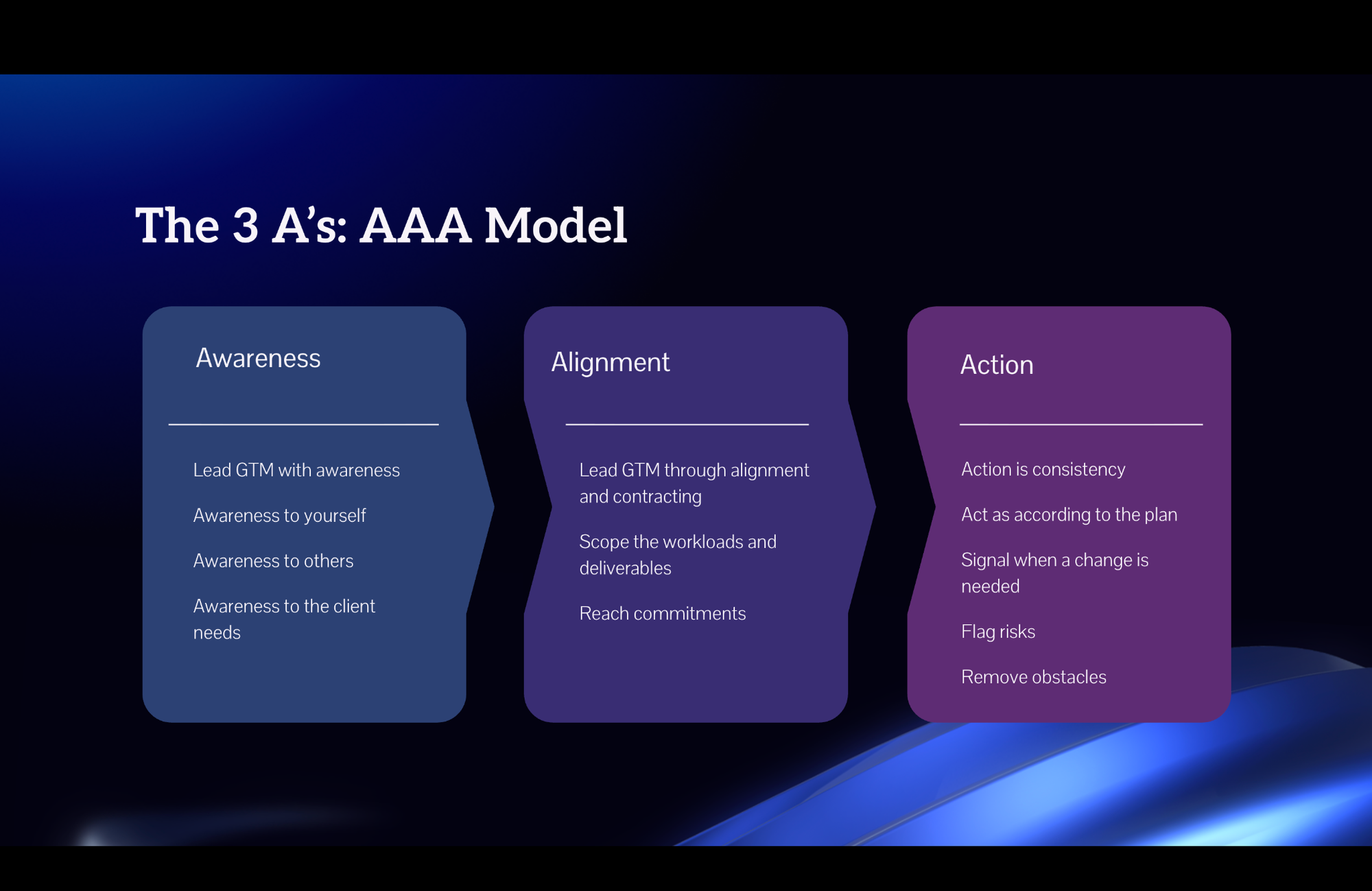
Meet the AAA Model to bring leadership trust…
Awareness
Lead GTM with awareness. Awareness of yourself, awareness of others, and awareness of what the client actually needs.
Self-awareness means knowing:
- How you show up under pressure
- How you communicate when things are unclear
- Where your assumptions live, and
- What your defaults are under stress.
This is the foundation of effective cross-functional leadership. Leaders who lack it don’t know when they’re creating the friction they’re trying to solve.
Awareness of others means genuinely understanding why sales is under pressure to deliver, what product is optimizing for, and what your stakeholders are worried about. Not assuming. Actually understanding, which requires conversations and relationship building.
Awareness of customer needs means staying close enough to the market that you’re bringing insight in, not just executing outward. PMMs who are trusted are PMMs who know the customer better than anyone else in the room. Run feedback sessions, create a proper Beta plan, interact, test, and iterate. Bring valuable knowledge to the launch.
Alignment
Stop assuming alignment. Make commitments explicit.
Most GTM misalignment isn’t disagreement but assumption. People think they’re aligned because they’ve avoided the conversation that would have revealed the gap. Alignment means scoping the work clearly, contracting around who owns what, and making it explicit what success looks like and what happens when things change.
This is where cross-functional trust is built or broken. A clear agreement creates the container for accountability. Without it, accountability is just a word in the launch plan.
Action
Consistency is key. Act according to the plan. Flag risks early. Remove obstacles before they become blockers.
Action is where trust gets demonstrated, not in the strategy document, but in the daily behavior. Doing what you said you’d do. Signalling early when something needs to shift. Creating psychological safety for problems to surface before they become crises.
This is what trust-led GTM execution actually looks like in practice.
Trust is the operating system
I want to say this as clearly as I can, because I think it still gets filed under “nice to have”:
Trust is not a soft skill. It is not cultural work. It is not the thing you focus on after the real work is done.
Trust is the operating system every high-performing GTM team runs on. And when it breaks, in any of the three gaps, everything downstream slows down.
The good news: all three gaps are diagnosable. You don’t need a team offsite or a culture initiative. You need the right question for the right gap:
- Clarity Gap → Do we actually understand the same thing?
- Credibility Gap → Do they see me as a strategic partner or a support function?
- Commitment Gap → When things slip, can I influence and make a change?
Pick the gap that’s costing you most and ask yourself: where do you stand now? How should you address this?
Start building not only your visibility, but also your leadership style. Build trust through real relationships, care, compassion, involvement, and co-creation. Bring awareness to your GTM and product launch.