Understanding what developers need is the foundation of any great developer product or marketing strategy – but getting meaningful feedback from a technical audience isn’t always easy.
That’s where this developer survey template comes in.
It gives you a ready-made framework to gather the insights that matter most, so you can spend less time building questions from scratch and more time acting on the answers.
What is a developer survey template?
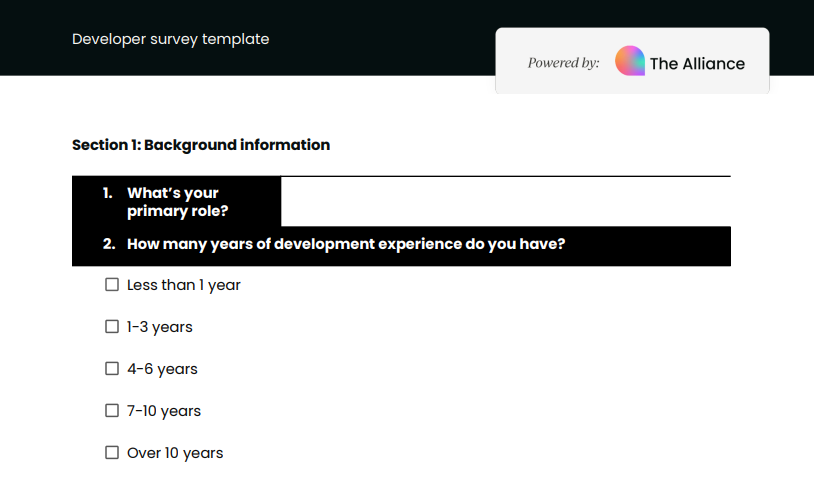
A developer survey template is a pre-built set of questions designed specifically to help you collect structured feedback from a developer audience. Rather than starting with a blank page, you get a ready-to-use framework that covers the key areas you need to understand – from your respondents’ technical background and experience level to how they’re using your product and what they’d like to see improved.
This particular template is organized into three core sections: background information, product/service usage, and overall satisfaction. Together, these sections give you a well-rounded picture of who your developers are, how they interact with your product, and how likely they are to recommend it to others.
Who is it for?
This template is built for product marketers and developer marketers who need a reliable, repeatable way to gather feedback from a technical audience. You’ll find it especially useful if you’re:
- Launching or iterating on a developer tool, API, or platform and want to validate your direction
- Running a developer relations or community program and need to track sentiment over time
- Building out a go-to-market strategy and want real data to inform your positioning and messaging
- Looking to prioritize your product roadmap based on actual developer pain points and preferences
Whether you’re running your first developer survey or looking to standardize an existing process, this template gives you a solid starting point.
How to use the template
Getting started is straightforward. Here’s how to make the most of it:
- Customize the introduction: The template includes a placeholder for your estimated completion time – fill that in before you send it out. You’ll also want to tailor the intro text to reflect your brand’s voice and any specific context your respondents might need.
- Adapt the questions to your product: The questions in Section 2 (Product/service usage) are written as general placeholders. Replace references to “our product/service” with your actual product name, and adjust any answer options that don’t quite fit your context.
- Choose your distribution method: Once you’ve made your edits, you can share the survey directly with your developer community, embed it in a developer portal or newsletter, or use it as the basis for a survey in your preferred tool (like Typeform, Google Forms, or SurveyMonkey).
- Analyze and act on the results: The template is designed to give you a mix of quantitative data (ratings, multiple choice) and qualitative insights (open-ended questions). Use the ratings to track trends over time, and pay close attention to the open-ended responses – that’s often where the most valuable feedback lives.
- Run it regularly: A one-off survey gives you a snapshot; running it on a regular cadence gives you a trend line. Consider making this part of a quarterly or biannual feedback cycle to keep a consistent pulse on your developer community.
Get your developer survey template