Templates, frameworks, and AI skills to pair with this playbook
- The product marketing skills pack – learn more here
- Customer journey template
- Time to value (TTV) framework
- Segment hypothesis worksheet
- A guide to churn reduction
Related certifications
How much of your time goes into preparing for launches, compared with thinking about what happens to the customer six months later?
If you’re like B2B most product marketers, the honest answer is a lot more on the launch. That habit is baked into how we work, and it pulls our attention away from the part of the customer relationship where value compounds.
I’m a Lead Product Marketing Manager at AT&T, working on customer growth and omnichannel optimization. I’ve worked on plenty of programs where the real measure of success was the direction customers moved after we shipped.
B2C teams have already rebuilt the PMM rulebook around that idea, and B2B teams can borrow it without reorganizing the company. That’s what we’re going to explore in this piece. Here’s what we’ll cover:
- Why the launch is the starting line for your customer
- Five shifts B2C made in how it plans, measures, and works across teams
- What those shifts look like on a real customer moment
- The customer growth operating system that ties them together
- Three moves you can take back to your team on Monday
No single moment makes the experience
A while back, I travelled through Thailand with a friend. We had 18 days, three stops, and one journey. We fed elephants at a sanctuary in Chiang Mai, rode mopeds around Koh Samui, and ate our way through Bangkok; I even tried fried scorpion (not my best moment).
But why am I telling you about a trip to Thailand in an article about product marketing? Because in those 18 days, no single moment made the experience; the whole journey did. The same is true for our customers.
That idea sits at the heart of how B2C has rebuilt the PMM rulebook. I think about it as five shifts, starting with the thing we spend the most energy on: the launch.

For expert insights like this, in full, every Friday, sign up for Pro+ membership.
You’ll also get access to 30+ certifications, a complimentary Summit ticket every year, and 130+ product marketing templates.
This Black Friday weekend, get 15 percent off with code CYBER2026. Offer ends November 30.
So, what are you waiting for?
Shift one: From launches to journeys
The traditional PMM playbook is built around the launch. We research the customer and the market, position the product to find where it fits and wins, and build messaging that translates the value into a story for that audience. Then we launch, and we enable our sales teams so they can get the product in the customers’ hands.
So much of our energy is focused on launch day. But customers don’t experience launches; they experience journeys. For our customers, launch is the starting point, not the finish line, so we need to step back and ask what happens after it.
B2C teams built their framework around the launch too, with a focus on driving growth through acquisition. However, over time, their expertise has stretched across the entire life cycle of the product. Launch has become one moment in a much bigger journey.
Here’s how that journey looks now:
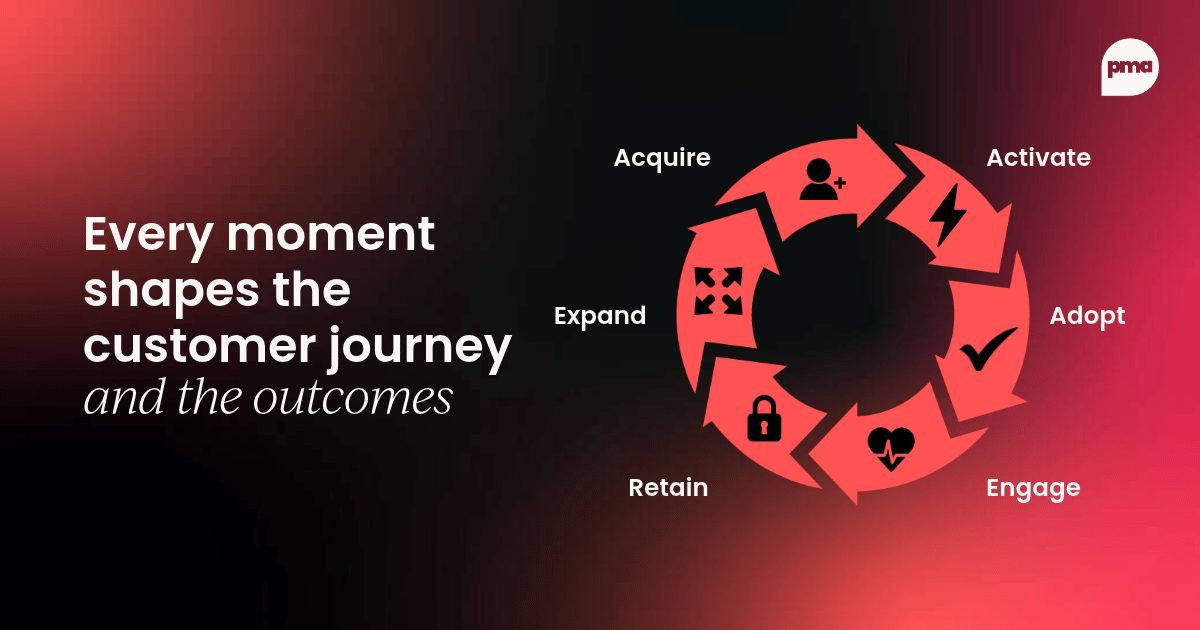
- Acquire: Focus on acquisition and driving revenue growth.
- Activate: Pick up right after the relationship with the customer begins to build.
- Adopt: Drive value through the features we actually offer.
- Engage: Reinforce positioning and personalization, maybe through a communication or a feature update.
- Retain: Keep the customer and reduce churn.
- Expand: Add value-added services and new products to that person’s portfolio.
What the numbers say
McKinsey’s research backs this up. Companies get more from improving the whole customer journey than from fixing individual touchpoints. Keeping customers matters just as much: around 80% of value creation comes from the core business, and it can take three new customers to make up for one you lose.
Companies that prioritize the customer experience also grow faster. In the U.S., McKinsey found that CX leaders achieved more than double the revenue growth of CX laggards between 2016 and 2021. Every improvement to the customer experience, however small, is a step toward growth.
What Spotify does after the first listen
Spotify, a brand we all know, keeps reinforcing value, rather than focusing on a single conversion moment. It starts with onboarding, where it learns your taste, your behaviors, and what you do best with the app. Then it moves to discovery, with Discover Weekly recommendations built around the behaviors that make your listening unique.
Daily Mixes and new releases keep you engaged, and everybody’s favorite time of year, Spotify Wrapped, brings you back with a summary of your favorite music and events. Once the relationship is solid, Spotify offers Premium, Duo, and Family plans. Spotify markets the next moment of value, again and again.