There’s a version of the story I’m going to tell that sounds very clean in hindsight:
We adopted AI, measured the results, proved its value, and everyone lived happily ever after.
Unfortunately, that’s not quite how it went for us at ConnectWise. What actually happened was messier, more iterative, and a lot more instructive.
I think the version with all the rough edges is the one worth sharing, because it’s probably closer to what you’re living right now.
So, here’s what I want to walk you through in this article:
- How we proved AI’s value early on, and what “using it well” really means
- Why comparing yourself to LinkedIn’s AI influencers is a trap, and what to focus on instead
- The five-step system that took us from ad hoc prompting to agentic workflows
How it started: Defending AI spend
Late last year, our CMO convinced the business that we should get AI access. He gave it to a small pilot group, which included my team of around 16 people.
Almost immediately, I started worrying about losing it.
That might sound like an odd first reaction, but if you’ve ever been inside a large, established company trying to justify a new tool spend, you’ll understand the anxiety. So, I got to work figuring out how to prove the value of AI before anyone could pull the plug.
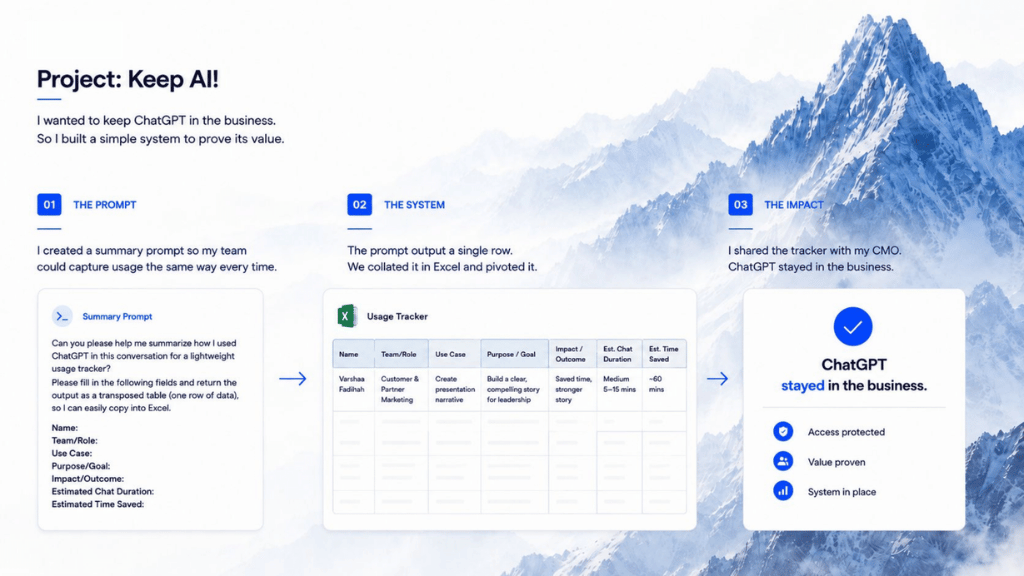
The solution I landed on was a summary prompt. It was a simple idea; I asked my team to run a short prompt at the end of their AI conversations that would capture the use case, the goal, the estimated time saved, and the chat duration. The output was a single row of data, clean enough to paste straight into a spreadsheet.
Across the team, we started building a picture of what we were doing with AI and how much time it was saving us. The business manager took that data and went to town on it – pivot tables, Gantt charts, pie charts, the works.
We kept our AI access, which felt like a win. But here’s the thing I quickly realized: keeping AI isn’t the same as using it well.
For expert insights like this, in full, every Friday, sign up for Pro+ membership.
You’ll also get access to 30+ certifications, a complimentary Summit ticket every year, and 130+ product marketing templates.
So, what are you waiting for?
The 70% problem: Why AI drafts feel generic
Once AI was in everyone’s hands, something interesting happened. We started shipping things faster – a lot faster. But when I looked at the actual outputs, something felt off. The work looked polished, the documents were fluent and readable, but they were also kind of generic.
This is what I’ve started calling the 70% problem. AI is very good at getting you to a competent first draft. It’ll produce something that looks like a messaging doc, or reads like an email, and has all the structural hallmarks of professional work.
However, if you squint at it and ask yourself, “Could I swap my company’s name for a competitor’s and have this read exactly the same?” and the answer is yes, then you’ve got a 70% document.
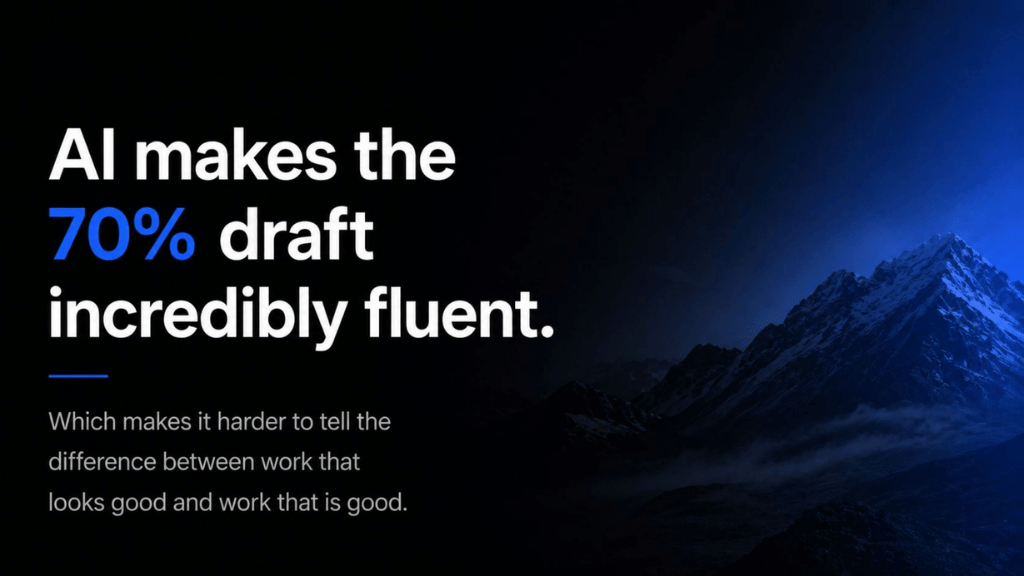
The remaining 30% is where your judgment lives. That’s the nuance, the specificity, the strategic thinking that makes a document actually yours. AI doesn’t add that for you. You have to.
So, I started paying less attention to what my team was producing and more attention to how they were producing it. If you’re a PMM leader, I strongly recommend that you do the same.
Ask your team to share links to their conversations with ChatGPT and Claude. Reading through them is quite revealing. You can see whether they outsourced their thinking entirely or whether they used the tool to sharpen and extend ideas they’d already started forming.
Three types of prompters
By looking at how my team uses AI, I found that people broadly fall into three categories:
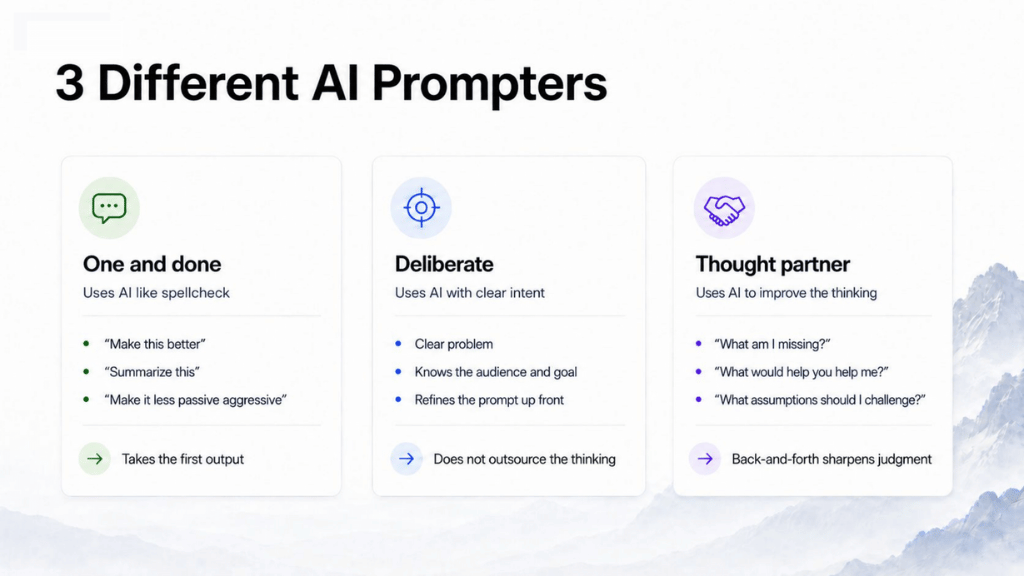
1. The one-and-done
Speed is the priority for this type of prompter. They take a brief, drop it into the chat, take the first response, and ship it. For low-stakes tasks, that’s okay. For high-stakes work, it’s a liability.
2. The deliberate crafter
This person thinks carefully about the prompt, considers what a good output looks like, and structures their input accordingly.
This works well if you already know what good looks like. The catch is that, depending on where you are in your career or how unfamiliar you are with a particular domain, you might not have that context yet.
3. The thought partner
This is the approach I’ve come to believe in most. The key move is simple: somewhere in the initial prompt, you ask the AI, “Is there anything else you need from me to help you give me the best answer?”
That one question changes the shape of the conversation. It lets the AI surface assumptions you hadn’t considered, flag gaps in your brief, and essentially prompt you rather than the other way around. This is what some people call reverse prompting, and it’s where the judgment starts to get baked in rather than bypassed.
The thought partner approach takes longer (sometimes you’re looking at 30 minutes instead of 10), but the output quality is miles better. That matters when the stakes are high.
What we built with AI
Once we had a better handle on how to use AI, we started pushing into more ambitious territory: