Raise your hand if any of this sounds familiar.
“Our target customer is everyone.”
“We don’t need marketing yet. Stay tuned.”
“We launch in a month. What’s the plan?”
If you’ve been in product marketing for more than five minutes, you’ve heard some version of these. Product marketing is the most cross-functional team in the building, yet we’re often the last ones invited to the party.
But something dangerous happens when we aren’t at the table with product management on day zero. We lose our ability to influence the product. We’re left marketing something we had no hand in shaping. That’s not a marketing problem; it’s a structural one. That’s what we’re going to dig into in this article.
Here’s what we’ll cover:
- Why the traditional PMM–product handoff model fails both teams
- A wake-up call from a real product launch gone wrong, and what it reveals about the cost of late involvement
- The PMM influence engine: three pillars for repositioning yourself as a strategic partner
- Practical steps you can put to work this week
How I ended up on the other side of the table
I spent over 10 years as a product marketing manager at Verizon, and I loved it. I loved translating complex technical requirements into customer outcomes. I loved watching a master plan come together. There’s nothing quite like seeing an ad you helped create staring back at you from an airport wall.
But what I loved most was figuring out how to influence the product roadmap. So I slowly started infiltrating the product team, and eventually I did something a little crazy… I became a product leader.
Moving into product management gave me a perspective I never had as a PMM. Now I’m the one fielding sales escalations, last-minute requirement changes, and an email inbox full of “when is the launch date?” and “Kristine, you’re overspending on your budget!” That’s not just my husband – that’s also finance.
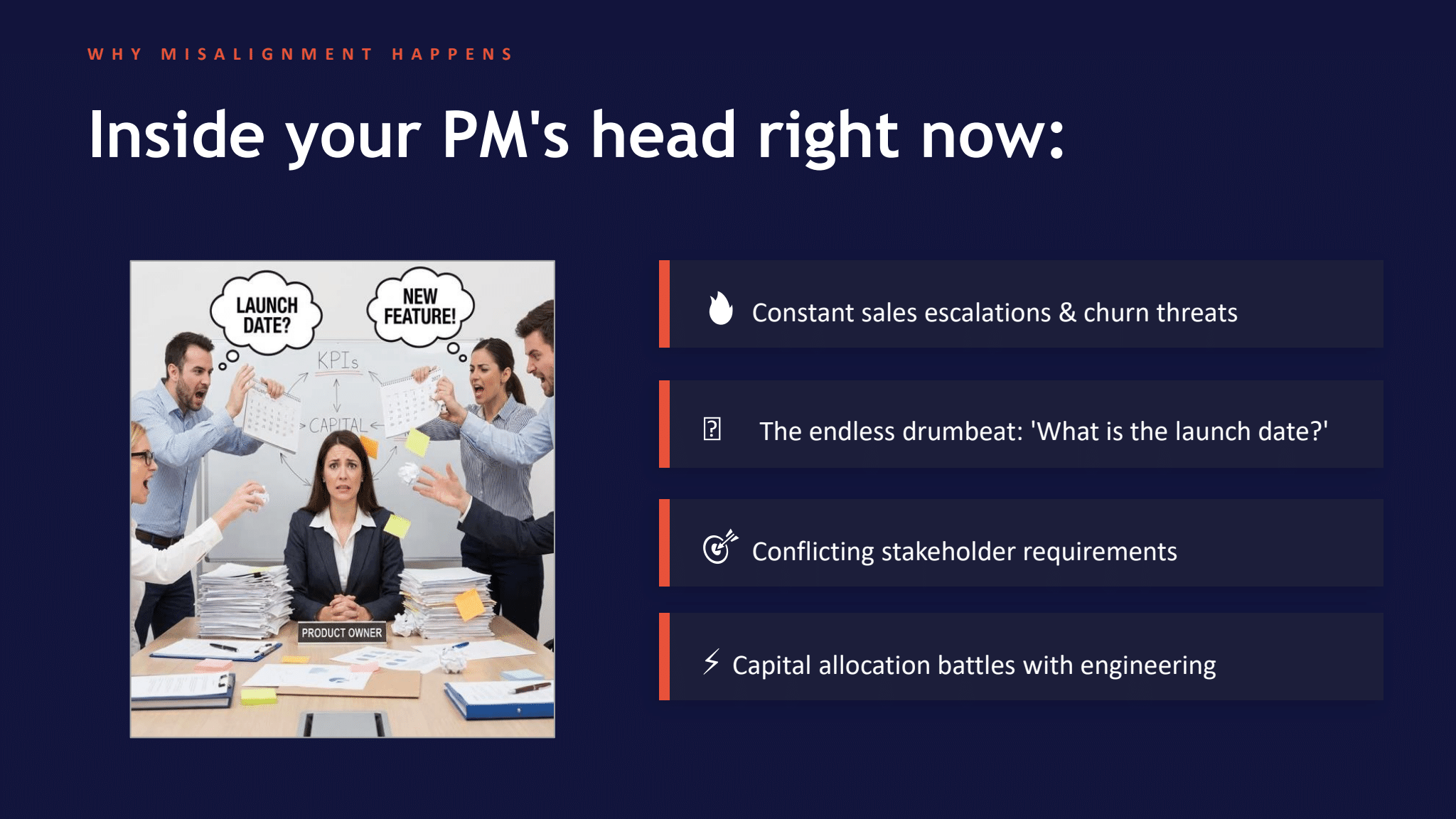
What I realized in all that noise is something important: product managers aren’t ignoring you because they don’t value you. They’re ignoring you because they have complete tunnel vision. When you’re deep in a build cycle, the horizon disappears.
Your job as a PMM isn’t to add to that noise. Your job is to add velocity.
The handoff model most companies operate on isn’t a partnership. It’s a system that creates rework, missed launches, and frustrated teams on both sides.
For expert advice like this straight to your inbox every Friday, sign up for Pro+ membership.
You’ll also get access to 30+ certifications, a complimentary Summit ticket, and 130+ tried-and-true product marketing templates.
So, what are you waiting for?
The alignment hall of shame
A few years ago, I was PMM’ing a network security product for businesses at Verizon. It was a significant investment – tens of millions of dollars, long development cycles, and some of our best engineers on the project. I was brought in three months before launch with a tidy little priority list: full go-to-market plan, sales enablement, and a launch strategy. At a company like Verizon, three months feels like three days.
So, I dug in and started asking the basic questions any marketer needs to answer before they can actually sell something.
- Who are our competitors, and what gap do we fill? (Meaning, how should we understand our value proposition and our right to play?)
- How does this interact with the existing security infrastructure on a customer’s network? (In other words, is this a complement or a substitute?)
- How does a customer actually get this security embedded on their device? (Translation: What does onboarding look like?)
Blank stares.
Nobody could tell me how this product interacted with other security tools. The onboarding flow hadn’t even been designed. The questions I was asking – the ones I needed answered to market the thing – were enough to force a launch delay. And when it finally did launch, it flopped. Eventually, we pulled the product off the shelves.
You’ve probably got your own version of this story. It makes you feel any better, so do a lot of corporate giants:
- Google Glass: A feat of engineering that launched without anyone properly answering the most basic marketing question: who is actually going to wear these? The product found no audience, not because the technology was wrong, but because the customer question was never asked.
- Cyberpunk 2077: A hugely hyped game that shipped broken, with no apparent alignment between what the product could deliver and the expectations marketing had spent years building. The fallout was severe – a wave of refunds, removal from the PlayStation Store, and years of brand damage that took considerable effort to undo.
- Crystal Pepsi: A product built on an identity crisis rather than a clear value proposition. The questions that should have shaped it – who is this for, why does it exist, what does it offer that nothing else does – were never properly answered. By the time that became obvious, it was already on shelves.
The PMM influence engine
In every one of these examples, the right cross-functional voice could have raised a hand earlier and changed the outcome. The reason that often doesn’t happen comes down to influence.
So, ask yourself: are you perceived as a speed bump or an accelerant? In most organizations, PMMs are treated as a speed bump – something product has to slow down for on the way to launch – when they should be the accelerant.
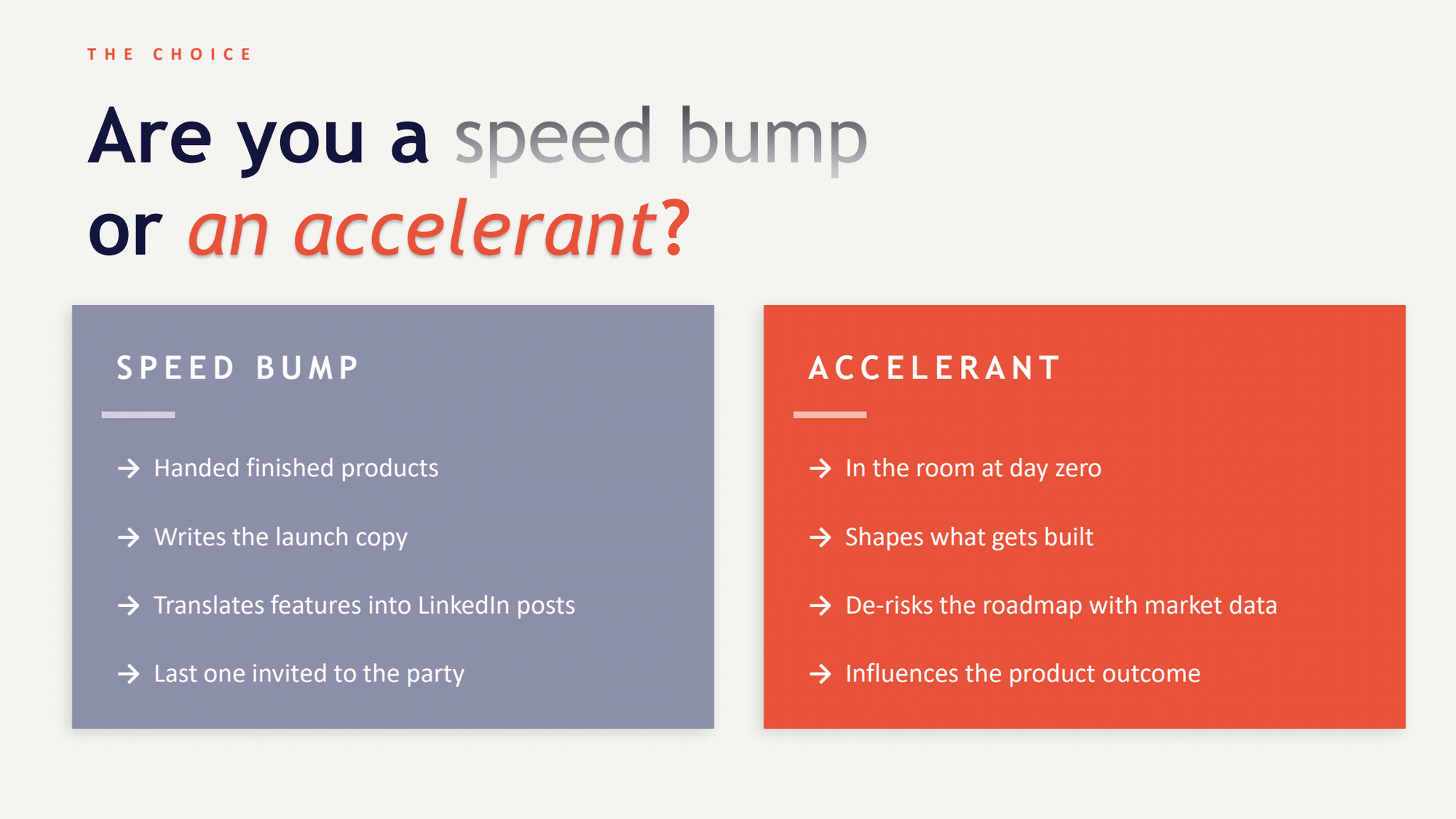
To help you change that, let me walk you through what I call the PMM influence engine: three pillars that will change how you operate.
Pillar 1: Operational overhaul
This pillar is simple but not easy. You need to go from being perceived as an editor to being seen as an architect, and that starts with a complete operational reset with your product managers.