Product marketing leadership in 2026 is fundamentally about influence. Not just over campaigns or messaging, but over the decisions that shape a company’s direction – market positioning, product roadmaps, go-to-market strategy, and resource allocation. The question is whether organizations are actually letting it play that role.
The evidence suggests many aren’t, at least not yet.
When PMM changes the outcome
The clearest sign of a mature PMM function is when it changes a major decision that had already been made.
Erin Stephan, Head of Product Marketing at Aqua Security, did exactly that following an acquisition. The default plan was to bundle the new product with an existing one – a reasonable assumption, but an untested one.
Erin led a voice-of-customer initiative that exposed the flaw: customers valued the new capability but were at vastly different maturity levels, and forcing a bundle created friction rather than value. She took the findings to the C-suite and recommended a phased launch instead. The shift, she says, materially improved product-market fit and the overall customer experience.
It’s a pattern that Katie Miller, a Developer Marketing Advisor, recognizes as characteristic of PMMs with genuine organizational standing. “In companies in which PMMs have a seat at the table from the first steps of product development, they’ve been influential in ensuring feature prioritization maps to ICPs,” she says, describing cases where that influence meant slowing a launch, shifting to beta, or changing a release date entirely.
Amit Alagh, Head of Product Marketing at RWS, points to a different kind of pivot – one of narrative rather than product. Early in his career, the product team was focused on feature parity with competitors.
Drawing on win/loss analysis and customer advisory boards, Amit redirected the company’s messaging away from features entirely, toward the problems the product actually solved.
The result was the business doubling down on “why we win” messaging instead of playing catch-up on a competitor’s terms.
 Charley Gale
The collaboration gap
The data from the latest State of Product Marketing report paints a picture of a function that’s everywhere, but not always heard.
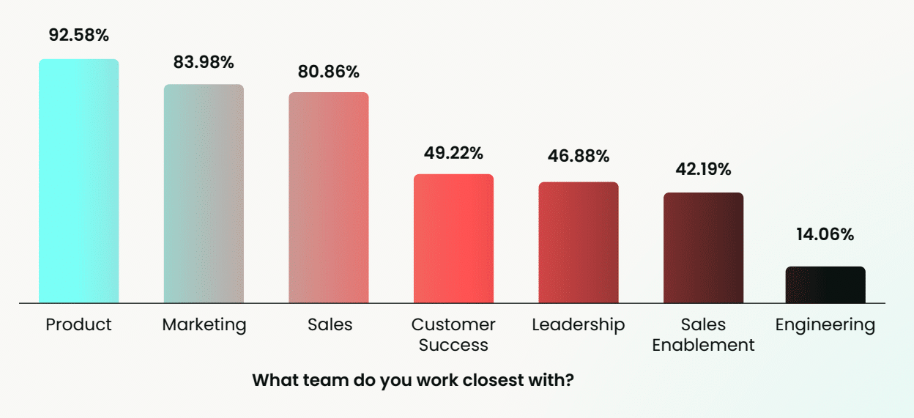
PMM teams collaborate most closely with product (93%), marketing (84%), and sales (81%), with lower but still meaningful engagement across customer success, leadership, and sales enablement. Engineering sits at the bottom at just 14%.
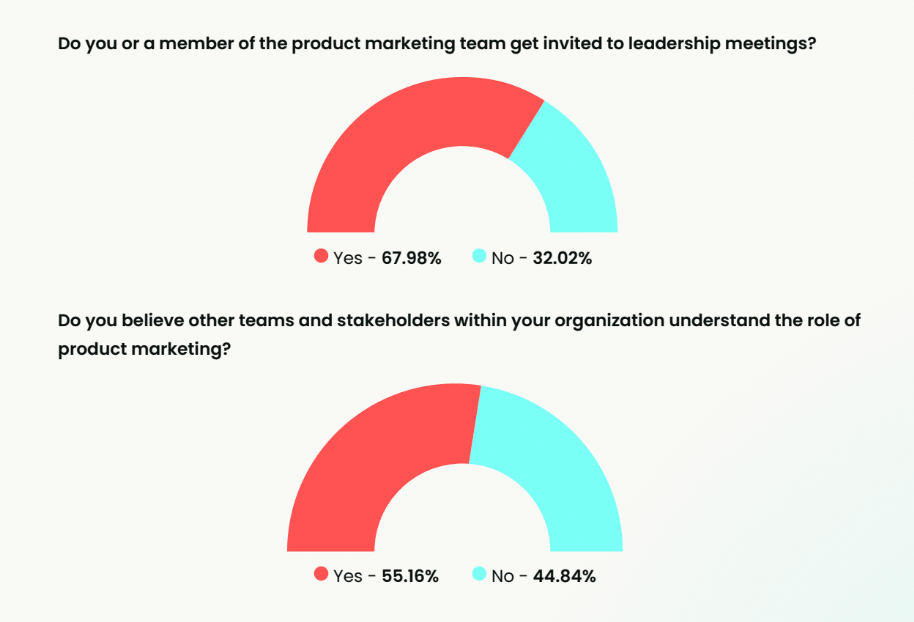
Yet collaboration isn’t the same as strategic authority. Only 68% of PMM teams are invited to leadership meetings – meaning roughly a third are excluded from the rooms where decisions get made.
More striking still: 55% of product marketing leaders say other teams still don’t fully understand what their function does.
That’s a significant disconnect. Product marketing is woven into most workflows, but its potential as a strategic driver is regularly underutilized.
Earning credibility at the executive level
Closing that gap starts with how PMMs frame their own value. Erin is direct about what the C-suite actually needs: “They need conviction, judgment, and clarity. The C-suite does not need a list of assets produced.”
In her view, PMM’s role is to be the expert on the customer, the market, and the competitive landscape – and to connect that expertise to the outcomes executives track: pipeline performance, win rates, product adoption, sales efficiency.
The translation layer matters enormously. Marketing metrics like share of voice or campaign attribution rarely move executives the way revenue, margin, risk, and market share do.
A PMM leader who reframes an internal messaging problem as a $12M pipeline gap blocking mid-market growth is having a different conversation than one presenting it as a communications issue. One is a business priority; the other is someone else’s problem.
Amit puts it more bluntly: “Learn to manage up effectively. Focus on the most salient information executives want to hear – metrics and what you are doing to pull the lever on accelerating those metrics. They don’t care about the latest piece of collateral your team produced.”
Katie adds a dimension that’s easy to lose in the push for commercial credibility: the confidence not to be diminished by the process of building relationships. “Empathy, curiosity, and collaboration does not mean sacrificing our value,” she says, quoting Taylor Swift: “Never be so kind, you forget to be clever / Never be so clever, you forget to be kind.”
Tom Crist, Principal and Head of Consulting Practice at Fluvio, points to executive sponsorship as a structural mechanism for scaling influence. Rather than relying on individual relationships, creating designated champions who proactively cascade decisions and priorities ensures that PMM-led initiatives translate across the full organization.
Small teams, high stakes
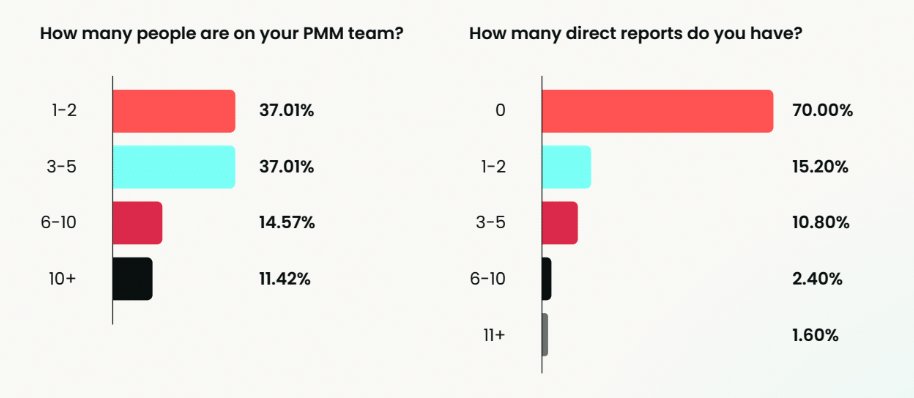
Most PMM teams are working with limited resources. Around 74% have five or fewer people, and 70% of PMM leaders manage no direct reports at all. That makes personal credibility the primary currency – influence has to come from the quality of the work and the clarity of the communication, not from organizational scale.
The same logic applies to budget conversations. Erin Stephan’s approach is to make tradeoffs explicit: without sufficient PMM investment, she argues, sales teams lack consistent enablement, messaging drifts from customer reality, competitive positioning weakens, and pipeline quality suffers.
“Framing the conversation around execution quality and business impact, rather than headcount alone, is what consistently earns executive support.”
Tom connects resource requests directly to revenue: tight win-rate goals for individual go-to-markets, research spend justified by new market discovery. Amit Alagh’s version is similar – show the data chain from messaging to MQL to conversion to win rate, and make the investment case from first principles.
Katie Miller offers a more lateral strategy: find teams trying to accomplish the same goals, and approach collaboration as a way to elevate their impact, not add to their burden.
Shifting the perception
Repositioning PMM from a tactical service desk to a strategic function requires sustained, deliberate behavior – not a single initiative. A few practices tend to move the needle more than others.
Create regular touch points
Quarterly insight reports that lead with external intelligence – shifts in customer behavior, competitive moves, analyst sentiment, category trends – do more to establish PMM’s market expertise than any internal wins recap. When the executive team starts referencing those reports in board prep, the function’s identity starts to shift.
Be intentional with strategy briefings
Competitive briefings are most effective as live sessions rather than static decks – creating space for discussion and strategic implication rather than just information transfer. The goal, as the best PMM leaders describe it, is to be seen as the person who helps leadership think, not just the person who delivers research.
Go-to-market retrospectives are perhaps the most underused lever available. Leading formal post-launch reviews that connect GTM decisions to business outcomes reinforces strategic ownership and builds credibility through accountability – showing what worked, what didn’t, and what the function would recommend doing differently.
Underpinning all of it is a mindset shift about how PMM leaders show up. Arriving with a perspective, not just a project update, is what gradually redefines what the function is for. Done consistently, it moves product marketing from a passenger in someone else’s decisions to the primary navigator of a company’s direction.
Final thoughts
Product marketing’s influence problem is a visibility problem.
The leaders driving the most impact in 2026 aren’t necessarily doing more; they’re doing a better job of connecting what they do to the outcomes that matter to the people with decision-making power.
That means speaking the language of revenue and risk, showing up with perspective rather than updates, and building credibility through consistency rather than a single high-profile win.
For PMM leaders still fighting for a seat at the table, the path there is less about proving the function’s worth in the abstract and more about making it impossible to ignore in practice.