
As a PMM, you’re probably working on a product launch right now. Maybe you’re even juggling several. But do you feel like you have enough time, budget, and buy-in from leadership to get everything done? I’m guessing not.
I’ve been doing product marketing for over a decade, and I’ve learned the hard way that launches should come with a warning label. Sleepless nights, headaches, night sweats, nausea, heart palpitations – I’ve experienced most of those symptoms during the bigger launches I’ve worked on.
If you’re managing multiple launches at once without enough resources or support, you’re probably living that reality right now, too. So, let’s talk about why it feels this way, and more importantly, what we can do about it.
Why launches feel harder than ever
Launch days used to feel triumphant. You’d be a little bleary-eyed, sure, but proud. You made it. The team was celebrating. You felt like you’d just run a marathon and crossed the finish line. It was a real product marketing superhero moment.
Many of us aren’t feeling that anymore. That’s not because we’ve gotten worse at our jobs. The pressure on launches has increased, especially over the last two or three years. I’m seeing it with clients I work with now, across early-stage startups and mature companies alike. Whether you have a ton of funding or none, everyone seems to be in the same boat.
So, what’s driving this? I see three root causes, and they’re all connected to how AI is reshaping our industry.
1. Product and engineering teams are shipping faster than ever
AI-assisted development, vibe coding, low-code tools – all of it is enabling product and engineering teams to ship features at a pace that simply wasn’t possible before. Anthropic did a study on their own engineers and found they’re shipping code eight times as fast in 2026 compared to the 2021–2025 average.
Even if you’re not working on an AI product, you’re feeling this pressure. It’s not just about how you launch. It’s about how many things you’re expected to launch, and how quickly. The six-to-nine-month runway we used to have to prepare for a major product launch? That’s largely gone.
And who’s responsible for sorting through all those upcoming features, tiering them, understanding how they’ll land in the market, and building the go-to-market strategy around them? You are.
For expert insights like this, in full, every Friday, sign up for Pro+ membership.
You’ll also get access to 30+ certifications, a complimentary Summit ticket every year, and 130+ product marketing templates.
So, what are you waiting for?
2. Usage-based pricing has changed the revenue model
Usage-based pricing isn’t new, but it’s becoming far more common. As companies try to recoup the cost of delivering AI capabilities, more of them are moving away from the traditional per-user, per-month model toward consumption or credit-based structures.
This creates confusion at every level. For your customers, for your selling teams, and for the people managing pricing and packaging. If you’ve ever worked with a deal desk team, you probably already know they’re feeling as much pressure as product marketing right now.
3. Feature adoption has become a revenue driver
If you’re charging by token, credit, or usage, you need people to actually use what you’re launching. Otherwise, no one makes money.
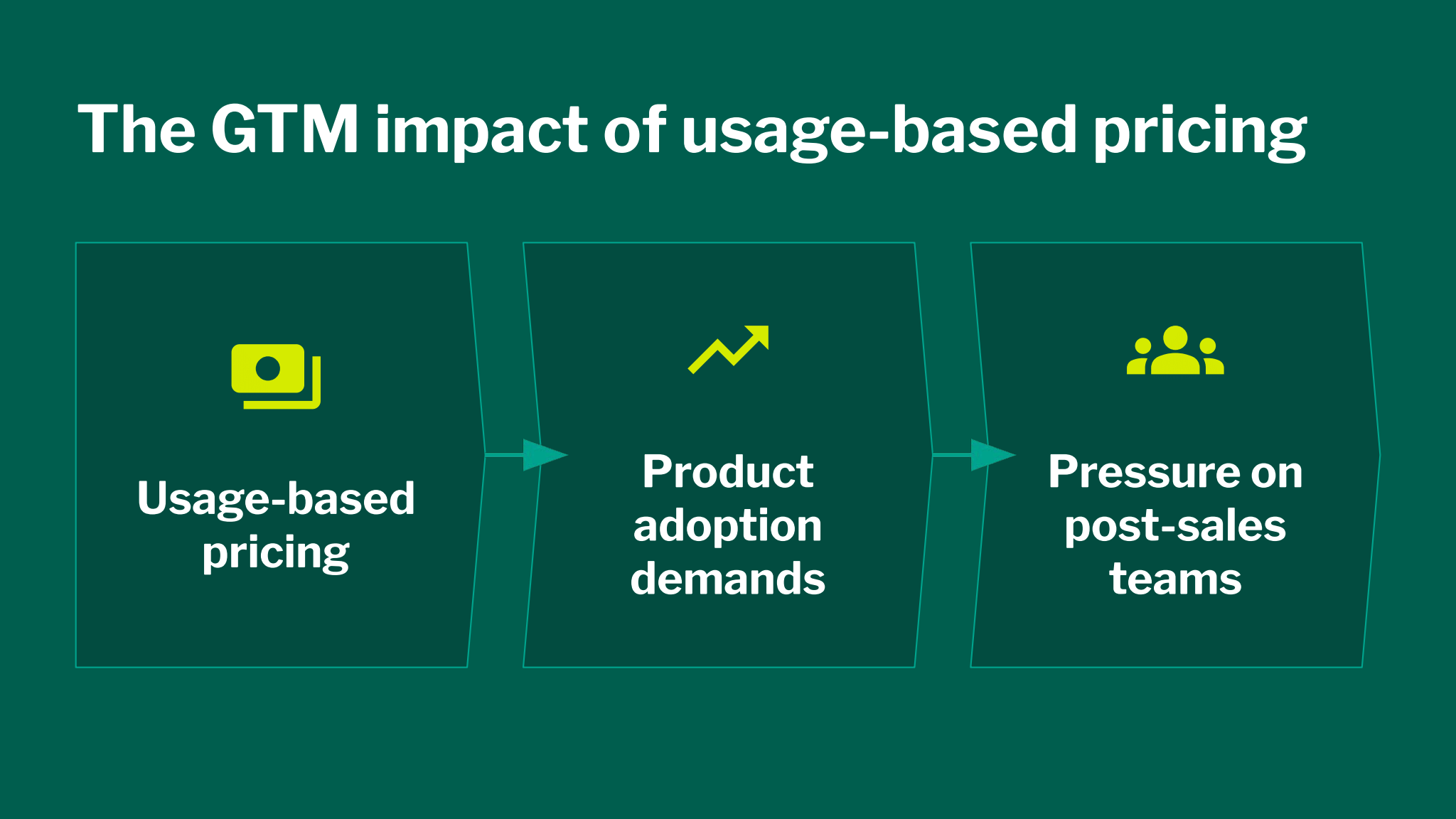
This puts enormous pressure on post-sales teams. Customer success managers, account managers, support teams, and anyone accountable for driving adoption or expansion are operating under a new kind of scrutiny.
A recent Gainsight study found that 94% of organizations are actually decreasing their headcount investments in customer success, even as 88% of CS teams are now accountable for driving product adoption. Those two things are moving in opposite directions, and the math doesn’t work.
For teams running product-led growth motions, this pressure shows up differently, landing on growth product, growth marketing, or lifecycle marketing functions. But the core problem is the same: adoption is now directly tied to revenue, and the teams responsible for it are under-resourced.
The three things that aren’t working anymore
With all of this change, it’s worth taking a hard look at how we run launches, because a lot of us are still using playbooks that were built for a different era. Specifically, I want to look at how we prioritize, how we enable, and how we measure.
How we prioritize: The two-by-two tier model
Most of us have used some version of a tiering framework, a two-by-two matrix where tier-one items are the most innovative and targeted at new customer acquisition, while features for existing customers or lower-innovation updates get fewer resources.
You’ve probably also got a document that maps deliverables to each of these tiers. The problem is that this list only tells you how much you should be delivering. It doesn’t tell you where or how to focus your effort.