Google is hiring someone to own the global narrative for Google Ads. They’ll sit between product, sales, and global insights, turn technical product detail into a positioning framework, and refresh the whole story three times a year. Base pay goes up to $305,000.
Anthropic’s GTM Narrative Lead pays up to $570,000.
Neither title mentions product marketing. Read the briefs, though, and the work is familiar: positioning, competitive claims, sales messaging, executive communication, getting every team to tell the same story. It’s the PMM remit, written at Director and VP level.
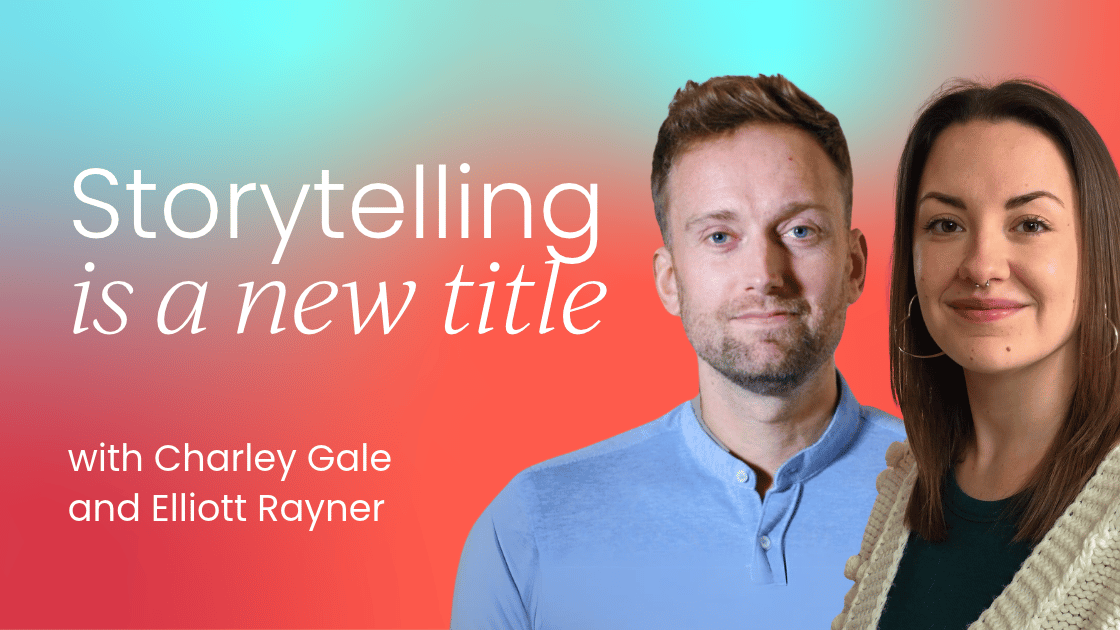
Elliott Rayner, a fractional Head of Storytelling and founder of Product Narratives, started tracking these roles after a Miro listing for a Head of Storytelling caught his eye.
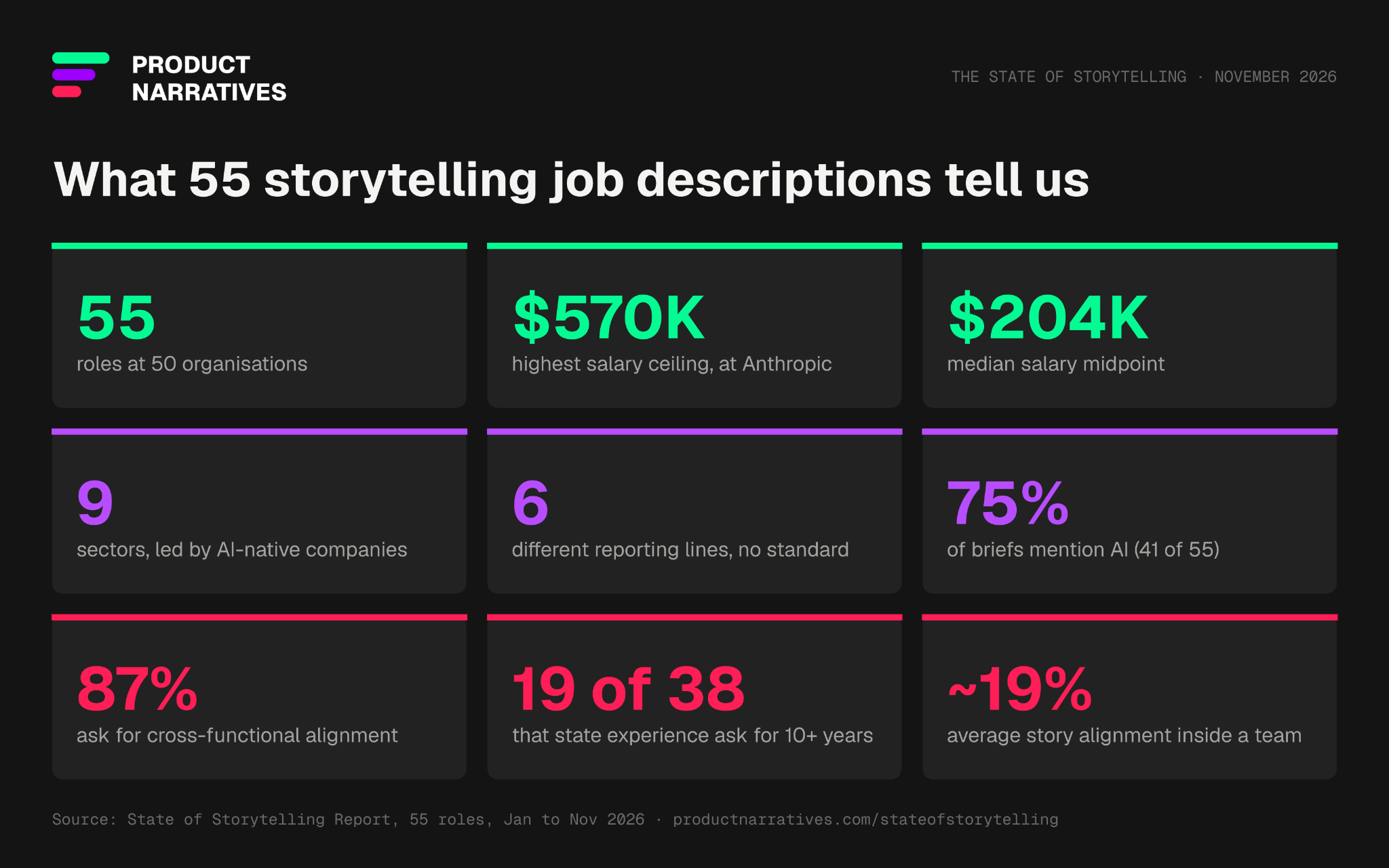
The first edition of his State of Storytelling 2026 report analyzed 25 job descriptions. The live dataset now covers 55 roles at 50 organizations, from Google, OpenAI and Microsoft to Eli Lilly, Best Buy and a US credit union, and it’s free to explore in his interactive report.
In the report, Elliott sums up what he found in two short sentences: “This is not a creative hire. It is a structural one.”
“For years, storytelling was a skill we all put on our CV and hoped nobody asked us about. Now it’s got serious. It’s no longer just a skill; it’s becoming a function, with a budget, a reporting line and a seat in the strategy conversation. The work isn’t new, but the job title is, and product marketers are closer to it than anyone.”
For product marketers, that raises a question worth answering properly. If companies are paying up to $570K for someone to own positioning, messaging, and cross-functional narrative, is the Head of Storytelling a Chief Product Marketing Officer under a different name? And if so, should PMMs be going after these roles?
Elliott will be presenting his findings at the Product Marketing Summit in London on December 2–3. Don’t miss out; grab your ticket.
Can’t make London? He’s also doing a keynote on Dec 9 at the virtual Product Marketing Festival. Sign up here.
What 55 job descriptions tell us
The short version: these are senior, well-paid roles that barely existed three years ago, and companies still can’t agree on what they are.
The pay
The top of the range belongs to Anthropic, whose GTM Narrative Lead lists $400,000 to $570,000. GitHub has the widest single band, $142,000 to $376,000, a spread of roughly $234,000 for one role. The floor has dropped as the dataset has grown. GuideWell, a health insurer, lists its Senior Enterprise Storytelling Lead at $109,000.
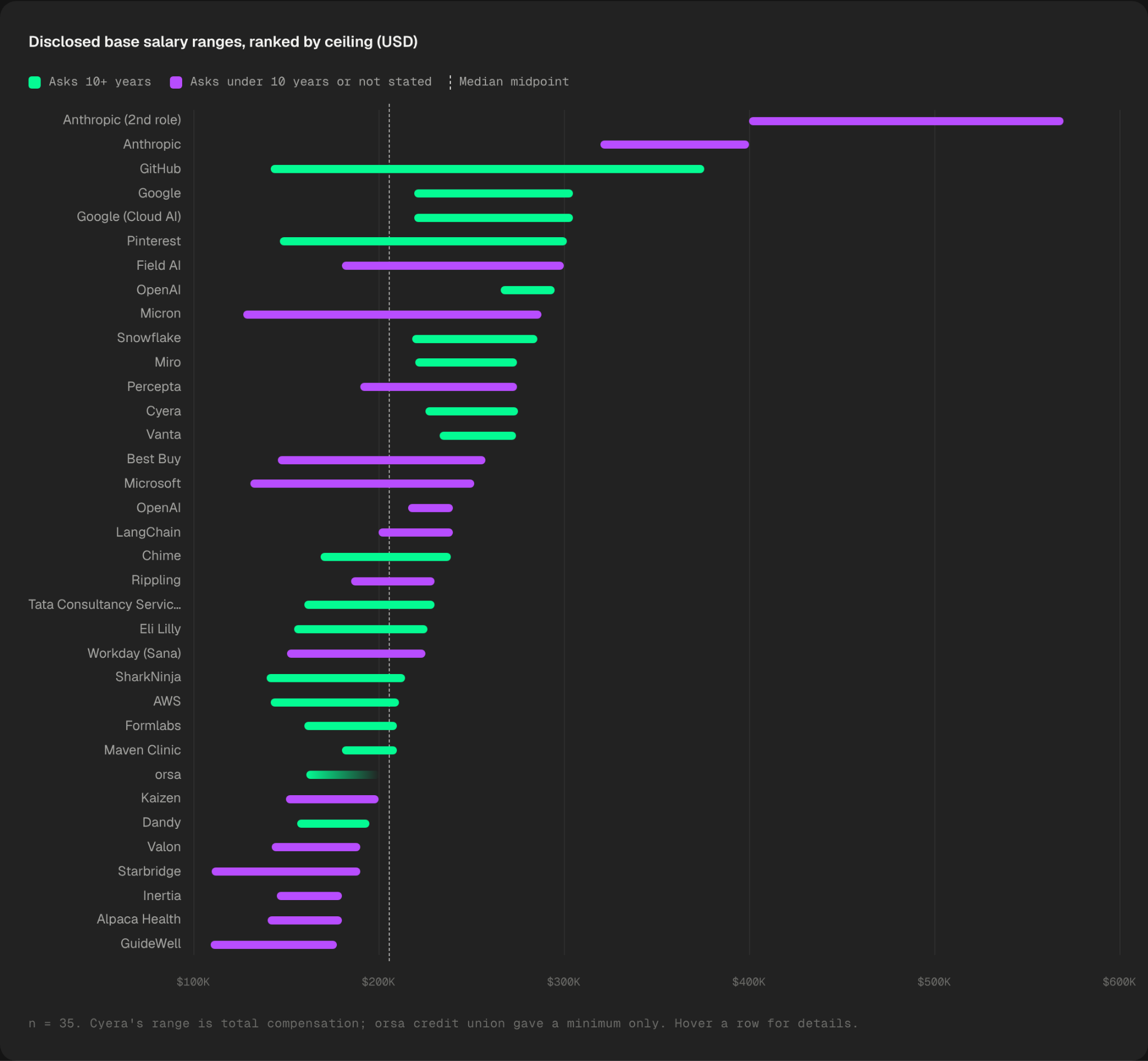
Elliott doesn’t read that spread as noise. In the report, he says a range that wide at one company is “not a compensation band.” It shows an organization that hasn’t decided what this work is worth.
Taking the midpoint of each of the 33 disclosed ranges, the median role pays about $204,000 and the average about $213,000. Fifteen of the 33 bands top out above $250,000, including Pinterest, Micron, Snowflake, and both Google roles.
For context, PMA’s Product Marketing Salary 2026 report (launching in full on December 3, 2026) puts the global median base salary for a Senior PMM at $138,000, and $198,000 for senior directors and above. The median storytelling role, at about $204,000, pays about the same as the most senior product marketing leaders. Roles reporting into marketing, at $252,000, go well past it.
The gap is wider at the same level of experience. Product marketers with 10 to 19 years’ experience earn a median of $166,250. Storytelling roles asking for 10+ years have a median midpoint of $224,000. Product marketers with up to six years’ experience earn between $79,488 and $91,425, while storytelling roles asking for five years or fewer sit at $163,000.
The seniority
In the first 25 roles, every brief that listed an experience requirement asked for at least a decade. At 55 roles, the picture is wider. Of the 38 briefs that state a minimum, 19 ask for 10 years or more and 10 ask for five or fewer. GovWell’s Narrative and Content Lead asks for one year; Snowflake’s Director of Brand Voice and Story asks for 15.
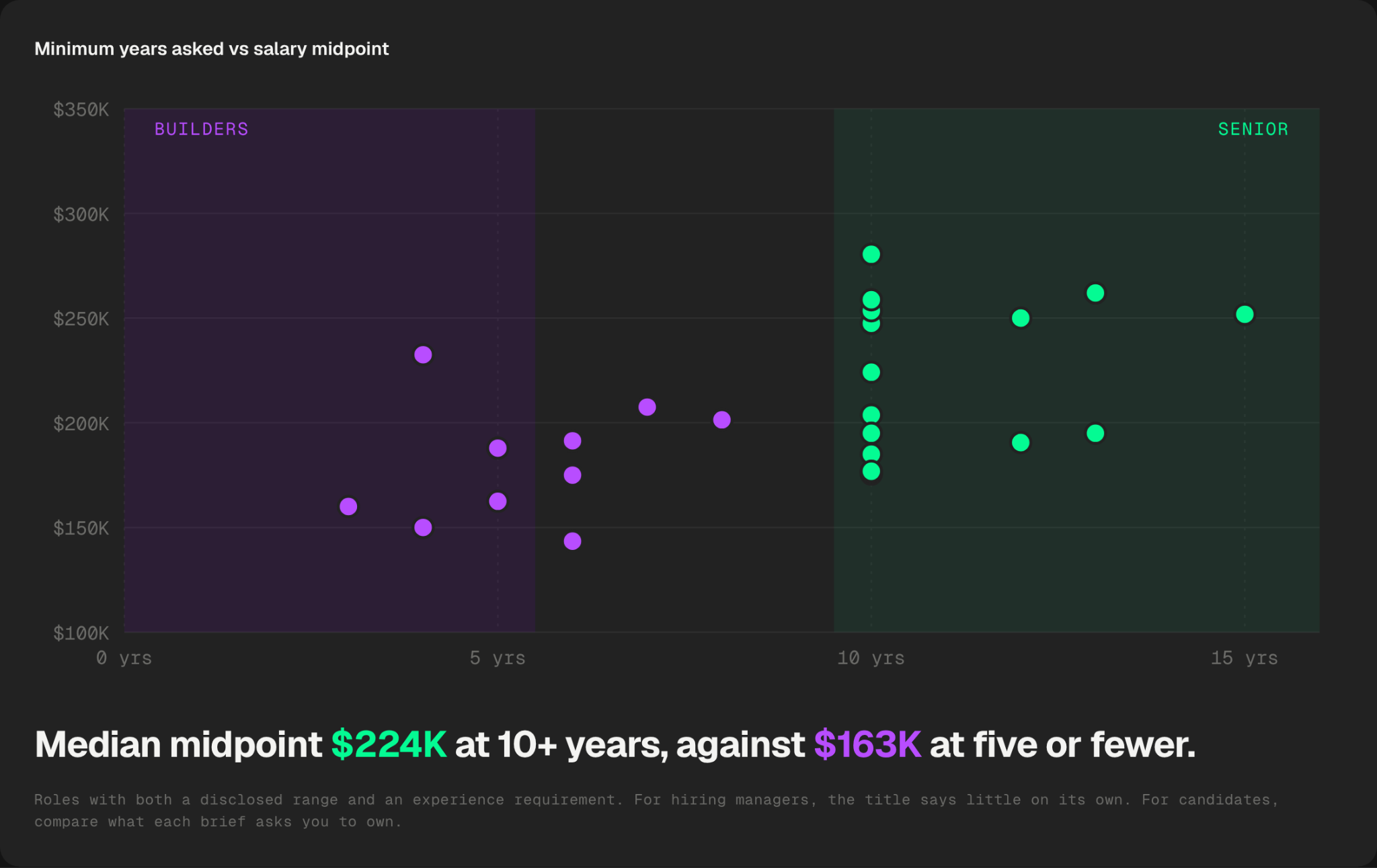
Experience shows up in the pay. On Elliott’s site, the median midpoint is $224,000 for roles asking 10+ years, against $163,000 for those asking five or fewer. He labels the two groups senior roles and “builders.”
For PMMs, that means two ways in: senior narrative leadership at an established company, or an earlier-career storytelling role at a startup where the function is being built from scratch.
The 19%
The number that gets quoted most comes from Elliott’s fractional work rather than the job descriptions. Over 18 months, teams at around 50 organizations answered three questions on their own:
- What value does your product create?
- Who cares most about that value?
- Why are you the best at creating it?
On average, about 19% of the answers lined up. Elliott is clear that this is practitioner observation, not a controlled study.
Park Howell picked up on the same figure in his write-up of the report for Business of Story, describing the fragmentation that follows when no one governs the brand story.
PMMs will recognize that 19%. It’s the sales deck that drifted from the website, the onboarding flow that describes a different product, and the founder pitch that nobody else can repeat.
Six reporting lines, no standard
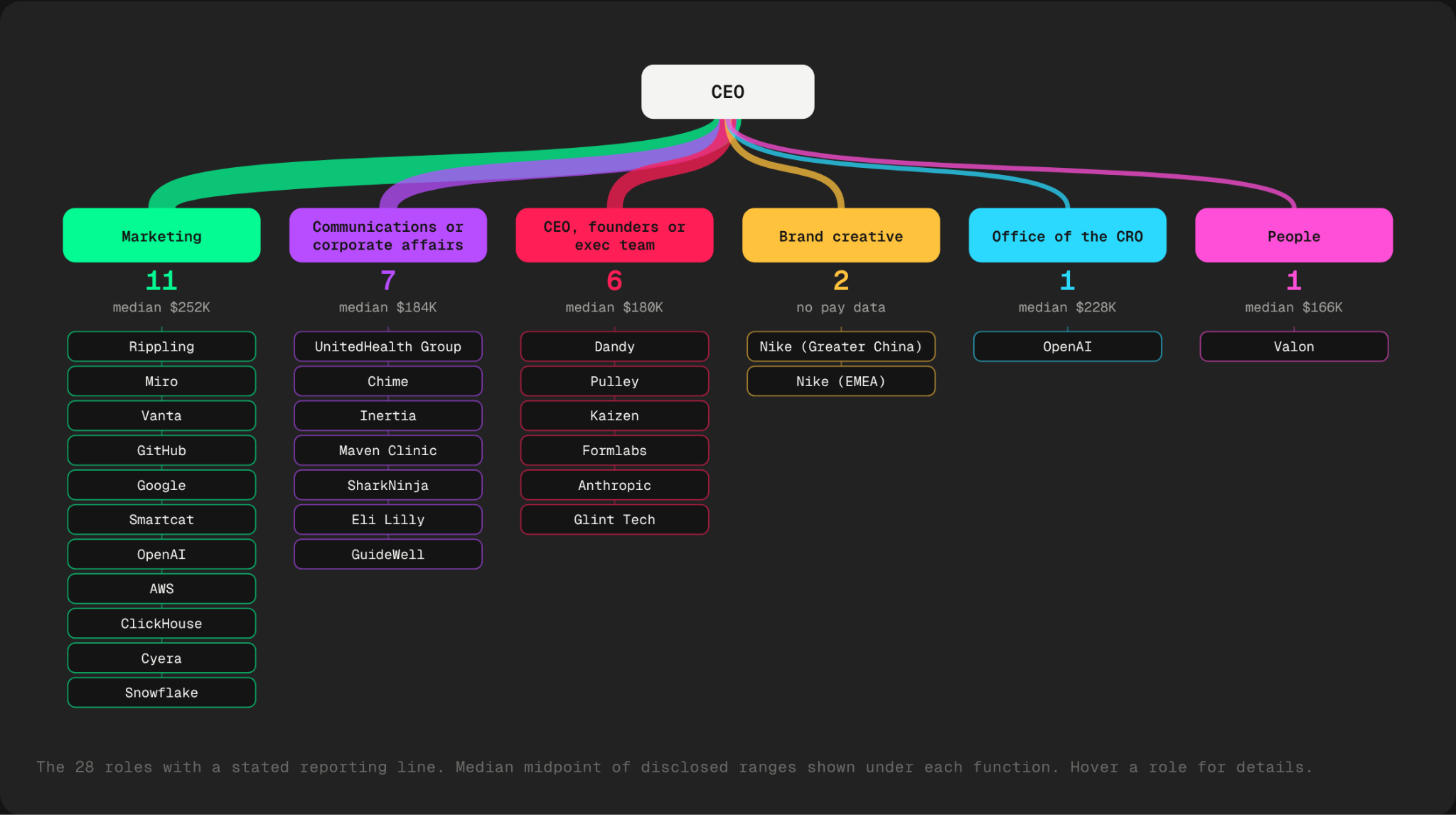
The same role reports into six different places across the dataset: the CRO, the C-suite or founders, marketing, communications, people, and the office of the CRO.
Elliott argues the reporting line tells you what each company thinks storytelling is for:
- Under the CRO (OpenAI), narrative is a revenue tool.
- Under communications (UnitedHealth Group, Chime, Eli Lilly, SharkNinja), the brief is reputation.
- Under marketing (Miro, Vanta, GitHub, Google, Snowflake, AWS), it’s brand.
- Under the CEO or founders (Dandy, Anthropic, Formlabs), it’s market creation.
Valon even puts the role close to hiring, with a brief to turn founder credibility into proof that wins candidates.
Marketing is the most common home, at 11 of the 28. It’s also where the pay is highest. The median midpoint for roles reporting into marketing is $252,000, against $184,000 under communications and $180,000 under the CEO or founders. In Elliott’s words, “the absence of a standard home is itself a finding.”
PMMs have been here before. Product marketing has sat under product, under marketing, and occasionally under sales, and where it sits has always shaped whether PMM gets treated as strategy or as launch support. The storytelling role is having the same argument, a few levels higher.
“It seems everyone is still working out where to house this role, and there’s a reason for that: the right home depends on the problem you’re solving,” Elliott says. “If deals are being lost to a muddled story, put it near the CRO. If trust is the issue, put it in communications. What matters most is access: the role has to be in the room when strategy is set, because that’s where the story either holds together or falls apart.”
The skills list reads like a PMM job spec
Elliott tagged all 55 briefs against 15 skills:
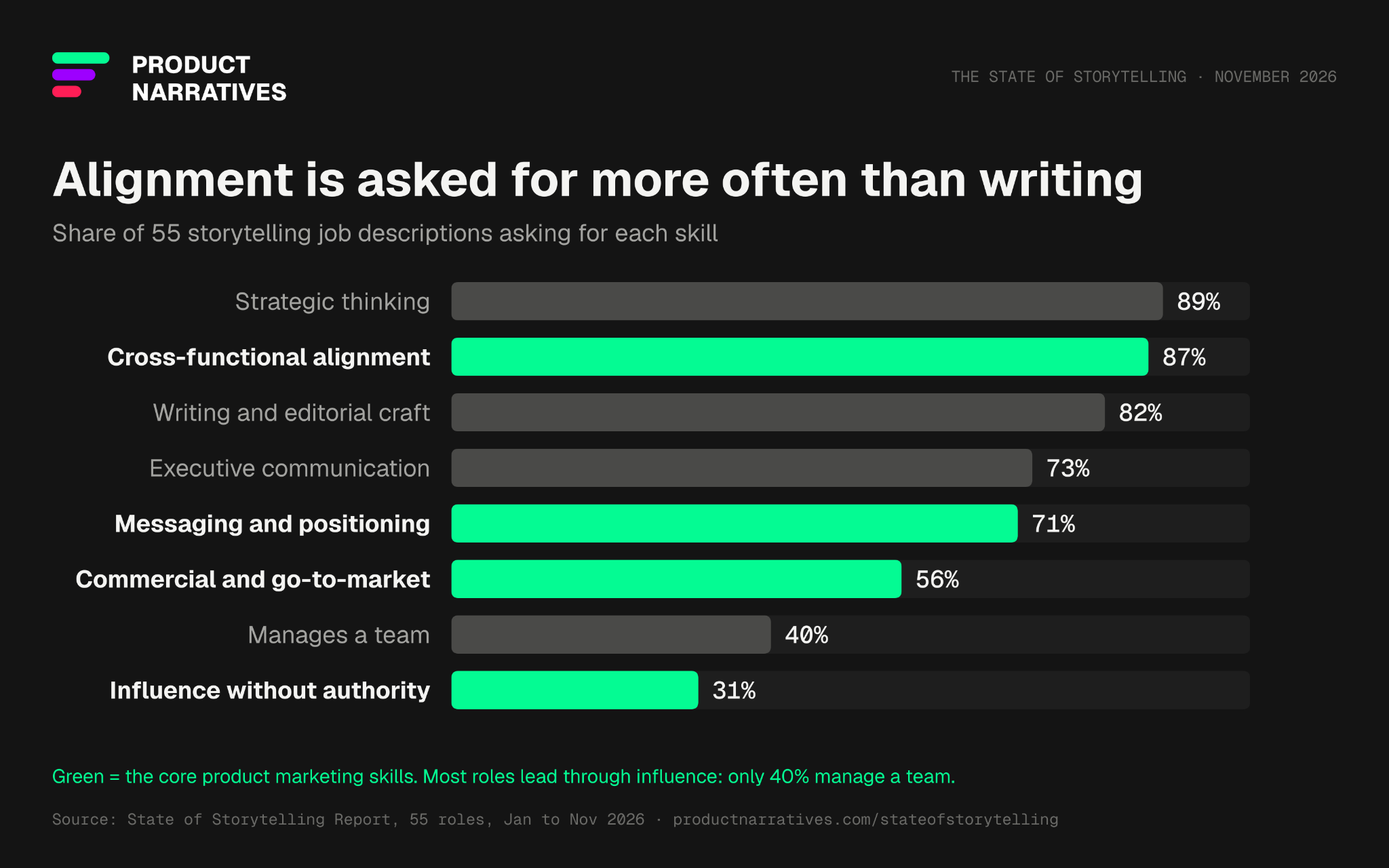
The full list reads like a product marketing job spec:
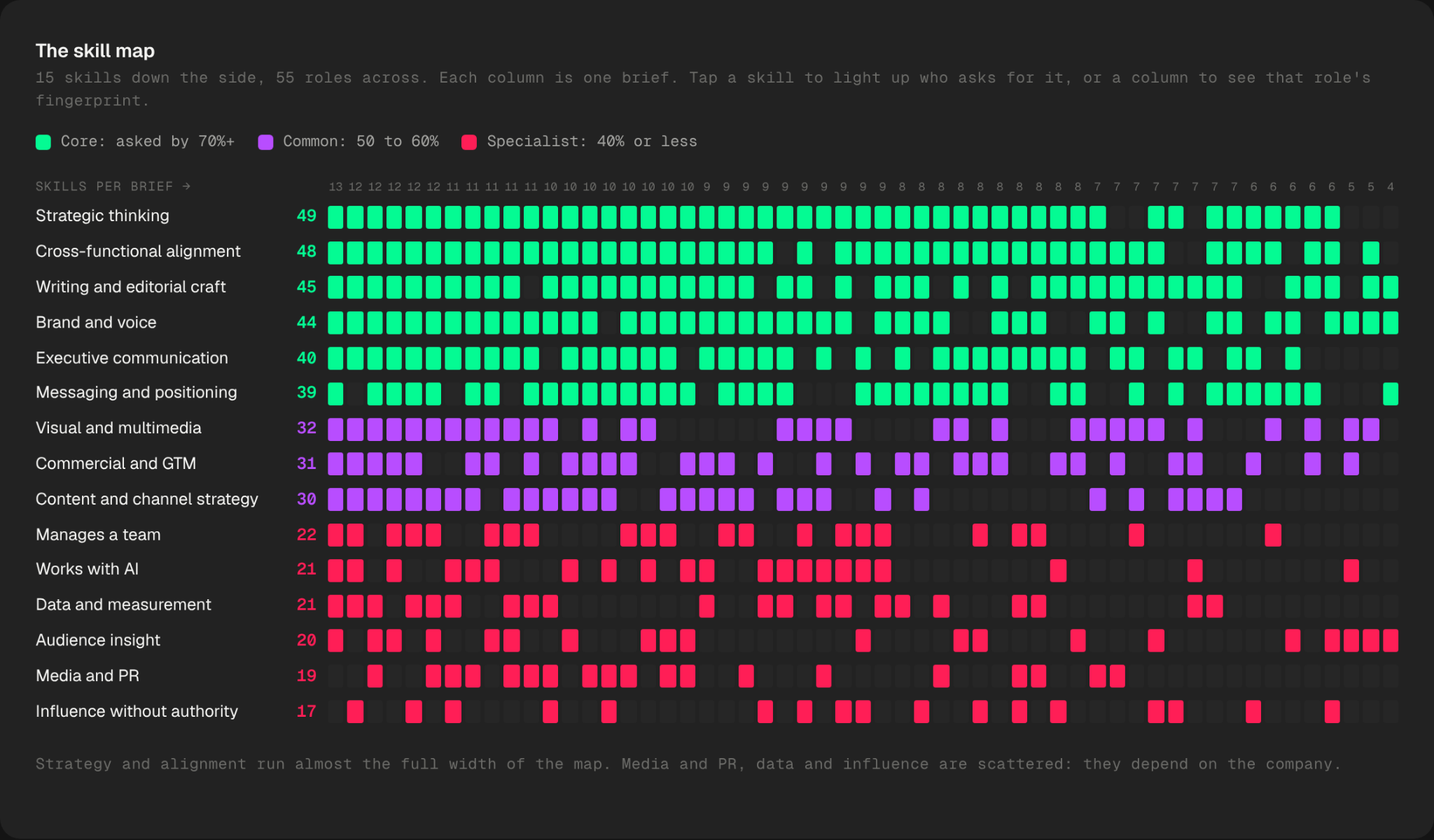
Messaging and positioning, the core of the PMM job, appears in 39 of 55 briefs. Commercial and GTM skills appear in 31.
Content and channel strategy, the skill you’d expect to dominate a storytelling role, sits at 30. Managing a team appears in only 22, so many of these are senior roles that lead through influence, without a team of their own.
Look at what the spotlight roles ask for, and the overlap with PMM gets even clearer:
- Google wants someone to identify competitive claims in the market and find the data to counter them. Elliott describes it as “a competitive intelligence function with a narrative output.”
- Amazon (AWS) wants a Principal to build the messaging framework that field teams around the world adapt for executive conversations. That’s sales enablement at scale, with no direct reports.
- Miro puts brand marketing, content, social, PR, and influencer under one narrative owner, and asks for experience leading communications through repositioning and multi-product evolution.
- Vanta wants someone who can tie storytelling to pipeline and to visibility in AI search.
Positioning, competitive intelligence, sales enablement, messaging frameworks, launches, repositioning. PMMs do this work every week. The difference is the level it’s being hired at.
So, is it a Chief Product Marketing Officer in disguise?
Mostly, yes. With two important differences.
Some companies have already said so in the job title. Four of the 55 name product marketing outright: Microsoft’s Director of Product Marketing, Copilot Narrative & Storytelling; Google Cloud’s Group Narrative Product Marketing Manager; Glint Tech’s Head of Product Marketing (Narrative & Storytelling); and Workday’s Storytelling Marketing (Product Marketing) role at Sana. Fal and Substack are both hiring a Product Storyteller.
The overlap is real. Elliott made the connection himself in his February newsletter, where he wrote that in most organizations the weakest story is the product story: what the product does for people, how it changes their situation, and why it’s the right choice. Fixing that has always been the PMM job.
The first difference is scope. A PMM usually owns the product story. Many of these roles own the company story, which stretches to PR, social, employer brand, and investor messaging. Miro’s version manages five teams. Valon’s reaches into recruitment.
The second difference is authority. Elliott’s report explains why existing roles couldn’t fix the 19% problem. The CMO would have had to go upstream into product and sales territory. The content team couldn’t override other departments. The PR agency was managing external perception, so internal alignment wasn’t its job.
Most PMMs will know the feeling. They write the positioning, then watch sales, product, and leadership each rewrite it. The Head of Storytelling role is what that job looks like when someone is finally given the access and seniority to make the positioning stick.
That makes it the natural next step for senior PMMs, and one they’re well prepared for.
“PMMs already do most of this job,” Elliott says. “They write the positioning, they enable sales, they know the competition. Writing is the medium, but alignment is the mandate.
“When I ask a team what their product does, who it’s for, and why they’re the best at it, on average only about 19% of the answers line up. So the skill to build is influence: getting leadership, sales and product to take the story on as their own, and then checking whether they actually do.”
AI makes the role more valuable
41 of the 55 briefs mention AI. In 20, AI is only the subject: the storyteller explains an AI product. The other 21 ask the storyteller to work with AI, and they say what for:
- Make content. Chime names the tools it expects: ChatGPT, Sora, Runway, Synthesia, and ElevenLabs.
- Build AI systems. Google Cloud wants a “machine-readable messaging source of truth” that keeps people and AI agents consistent. OpenAI’s Visual Storytelling and Innovation Lead acts as “customer zero” inside the CRO’s office, prototyping custom GPTs and internal apps.
- Be found by AI. Vanta, Dandy, GovWell and Canonical want stories that show up in AI search. Vanta names GEO (generative engine optimization) as a direct responsibility.
- Research and think. Google Ads wants AI used for research, data synthesis and narrative iteration.
- Teach the team. Snowflake, OpenAI and Workweek want the storyteller to help colleagues work with AI.
The obvious worry is that AI will make narrative roles cheaper. Elliott predicts the reverse. When content costs almost nothing to produce, the advantage moves to whether it says the right thing. Companies that skip the strategic layer, he writes, will “automate their way into more efficient incoherence.”
There’s a practical lesson here for PMMs. Building AI systems is the second most common ask, ahead of research or GEO. A messaging framework that an AI agent can use is quickly becoming part of the job. In Elliott’s own client work, one deliverable was a custom AI messaging agent trained on the finished narrative.
What the work looks like in practice
The report includes a case study from Elliott’s three-month fractional engagement with Ingrid, a delivery platform covering everything from checkout to tracking and returns. Head of Marketing Joyce Kremer had a major conference launch on the calendar and wanted a product narrative every team could use long after the event.
The work ran in three one-month stages:
- Discover. Elliott ran 12 interviews across the founder, VP of Growth, sales leadership, customer success, product, and marketing. He reviewed existing decks, positioning, and research first, so every question covered something the documents couldn’t answer.
- Define. He presented three narrative directions, and each department scored them independently before comparing results. The gaps showed where the real disagreements were. Because the right people were involved early, feedback and iteration took two to three weeks instead of two to three months.
- Deliver. He turned the narrative into tools: value-based messaging for ten product areas, a sales message house with opening hooks and objection handling, a brief for the website redesign, and an AI messaging agent.
One result stood out. Ingrid had long called itself a delivery experience platform. The work moved it to “delivery intelligence platform,” and people across the company started using the new phrase before it had been officially adopted. Elliott calls organic use the most reliable sign that a narrative is working.
Kremer was blunt about the impact: “I’m pretty confident we would not have made the deadline if we did not bring you in on a fractional role.”
Every deliverable on that list is a PMM deliverable. What changed was the mandate to take them across every team.
What PMMs can do now
Measure your own alignment gap
Ask five leaders from different teams what the company does, who it’s for, and why it wins. Compare the answers. If they don’t match, you have your business case.
Treat sign-off as the start
Elliott’s report is clear that the most common failure comes after approval, when the narrative gets filed away, and nothing changes. Judge your work by whether sales, product, and the website are using it.
Build systems, not documents
The AWS role is defined by the frameworks and templates that let thousands of people tell one story. Park Howell makes a similar point in his response to the report: a storytelling leader without operational infrastructure ends up correcting drift by hand.
Learn GEO
Vanta already lists it as a requirement. Expect more briefs to follow.
Tie narrative to revenue
Roles under the CRO, and Vanta’s link to pipeline, show where the budget comes from. Report on narrative in commercial terms.
Use the right language
If you’re doing this work today, describe it as narrative ownership across teams, not campaign or launch support. The titles in this dataset tell you which words hiring managers are searching for.
Where this goes next
Some companies have stopped experimenting. Nike and Microsoft (including its subsidiary GitHub) have each posted three narrative roles, and OpenAI and Google two each, across different regions and business units. That’s narrative being built into the org structure.
The first edition of the report made six predictions. With 55 roles in the data, we can check how they’re holding up.
Three look right so far. More industries are hiring, with the role spreading into pharma, finance, and energy. AI is adding to the job: 21 briefs ask the storyteller to work with AI, and eight want them to build AI systems. And the briefs are shifting from creative to alignment, with cross-functional alignment now asked for more often than writing.
Two haven’t held. The salary floor was expected to rise. Instead, it fell from $139,600 to $109,000, mainly because the dataset now includes more junior roles asking for five years’ experience or fewer.
The titles were expected to settle into a small set. Instead, they’re spreading out. “Narrative” and “Storytelling” are almost tied, at 28 and 27 uses across 55 titles, and new variants such as Product Storyteller keep appearing.
The sixth, that the role would move up the org chart, is still open. Marketing remains its most common home, and it’s the best paid.
Elliott adds another prediction: more of these roles will be filled from inside, often by product marketers.
“The person who already knows the product, the customer, and the sales team starts with a real advantage,” he says. “I expect more companies to look inside first, and often the best candidate is already sitting in product marketing.”
The four job titles that already name product marketing suggest it’s starting to happen.
And don’t forget…
Explore the latest salaries, experience levels, skills, and reporting lines in Elliott’s free interactive State of Storytelling report. The full PDF is available via his Substack, Narratives and Neuroscience.
Elliott will be presenting his findings at the Product Marketing Summit in London on December 2–3. Don’t miss out; grab your ticket.
Can’t make London? He’s also doing a keynote on Dec 9 at the virtual Product Marketing Festival. Sign up here.