
When an Ideal Customer Profile (ICP) is too broad or a value proposition too generic, teams compensate by doing more – more emails, more outreach, more content. But volume can’t fix broken positioning.
The most effective GTM strategies begin somewhere quieter: with sharp, intentional decisions about who the product is actually for, and why this particular company is the right one to solve a specific, urgent problem.
For product marketing leaders, the job is to build a commercial system rigorous enough to scale and flexible enough to experiment. That tension between predictability and bold moves is where GTM leadership gets interesting.
 Charley Gale
The retention play that outperformed the newsletter
Not every GTM motion needs a product launch to justify it. Erin Stephan, Head of Product Marketing at Aqua Security, learned this during a stretch when the roadmap was relatively quiet.
Rather than wait for new features, she built a recurring program around customer value and competitive differentiation – every touchpoint framed around a single customer problem and why the product solved it better than the alternative. This was without release notes or feature announcements.
The results were significant:
- Contact engagement rose 179% compared to the traditional customer newsletter,
- Account engagement climbed 137%, and
- The engagement rates for both jumped by 116% and 132%, respectively.
Customers reengaged with features they’d been underusing, and go-to-market teams picked up the content for renewal and competitive conversations.
“This approach reinforced retention, strengthened differentiation, and proved that GTM impact does not depend on constant new launches,” Erin says. It’s a useful reminder that GTM motion can generate commercial momentum from existing capabilities, if the framing is right.
Cross-functional alignment as a competitive advantage
Amit Alagh, Head of Product Marketing at RWS, describes a pattern he’s seen repeatedly across his career: product teams “throwing the launch over the fence” to marketing, with little shared ownership of what comes next.
His response has been to build a GTM framework that travels with him – one that pulls key information from product teams in advance, defines success metrics clearly, establishes ownership and accountability, and includes retrospectives after every launch.
“Cross-functional alignment brings everybody along for the journey,” he says. In practice, that’s meant eliminating silos, tightening messaging, and focusing on market segments in ways that have improved lead quality, increased average order value, and accelerated deal velocity.
Erin Stephan frames it similarly from a strategic perspective: “GTM becomes a growth engine rather than a series of disconnected launches” when product, sales, and marketing are operating from the same understanding of the customer and the value proposition.
What gets measured
One of the more uncomfortable truths in product marketing is how easy it is to report on the wrong things. Email open rates, webinar registrations, and content downloads are trackable and presentable, but they tell you almost nothing about whether your GTM is working commercially.
The metrics that matter connect directly to revenue: pipeline generation by segment (which markets is the GTM motion actually penetrating?), win rates within the target ICP (is positioning resonating where it counts?), and shifts in average deal size following a repositioning effort.
Sales cycle velocity indicates whether messaging clarity is accelerating decisions. Competitive displacement rates show whether the market narrative is creating genuine differentiation.
Tom Crist, Principal and Head of Consulting Practice at Fluvio, puts the leadership stakes plainly: “The value to the business needs to be clearly explained, defended, and measurable on a single executive summary slide. If your effort isn’t going to be covered in a board meeting or executive offsite, imagine that it is.”
Reported consistently, these commercial metrics are what elevate the PMM function from support role to strategic driver – legible to finance, sales leadership, and the C-suite.
Innovation without overcomplication
Once a repeatable system exists, the question becomes how to experiment within it without destabilizing the whole thing.
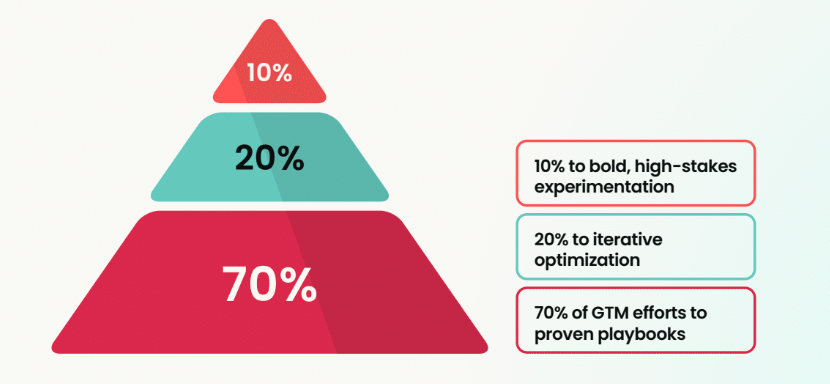
A useful framework is portfolio thinking: roughly 70% of GTM effort dedicated to proven playbooks, 20% to iterative optimization, and 10% to genuinely bold experiments. The structure preserves revenue confidence; the 10% creates room to differentiate.
Erin Stephan’s approach to innovation is notably grounded. She points to tools like Wynter for testing messaging directly with target ICPs, peer review sites for competitive intelligence, and internal voice-of-customer sessions when direct customer access is limited.
“Innovation in GTM is not about doing more,” she says. “It is about being resourceful, decisive, and grounded in real signal so execution stays simple and focused.”
Amit Alagh emphasizes a culture of iteration over perfection: his teams run retrospectives after every launch, asking what worked, what didn’t, what can be scaled, and what can be eliminated. “In previous roles, I have found we have lost market opportunity by prioritizing perfection over progress” – a cost of excessive caution that rarely appears on the spreadsheet, but is real nonetheless.
Tom Crist adds a pragmatic note on momentum: “Stay on top of industry trends, identify new channels and evolving watering holes for buyers, and build them into your plans. The more you innovate and share, the longer your lead.”
The underlying logic
What connects these perspectives is a view of GTM leadership as something more than launch management.
It’s the design and maintenance of a commercial system; one grounded in genuine market clarity, aligned across functions, measured against outcomes that actually matter, and periodically disrupted by experiments that competitors aren’t structured to follow.
The goal should be to achieve a sustained revenue impact, clear differentiation, and a team that continually improves at all of these aspects over time.