You’ve felt it before: you walk into a room with engineering, pitch your messaging, and watch as eyebrows raise. Maybe someone pushes back on a word choice. Maybe no one says anything at all, which is somehow worse. Either way, you leave the room wondering why a group of smart, reasonable people won’t just trust what you’re telling them.
Here’s the thing: it’s not you. The relationship between PMMs and engineering teams is one of the most important – and most underestimated – dynamics in any go-to-market function. Get it wrong, and it costs you a lot more than one bad launch.
I’ve seen this from both sides. My career path into product marketing wasn’t exactly conventional; I spent the first half of my career – well over two decades – at GE doing everything on the IT side you can possibly imagine. Writing code. Building products. Fixing bugs. Keeping servers alive at 2 am. Then something shifted, and I found myself on the other side of the table, in product marketing.
So, let’s talk about it: why trust between PMMs and engineers matters, where it breaks down, and what you can actually do about it on Monday morning.
From absolute truths to value frameworks
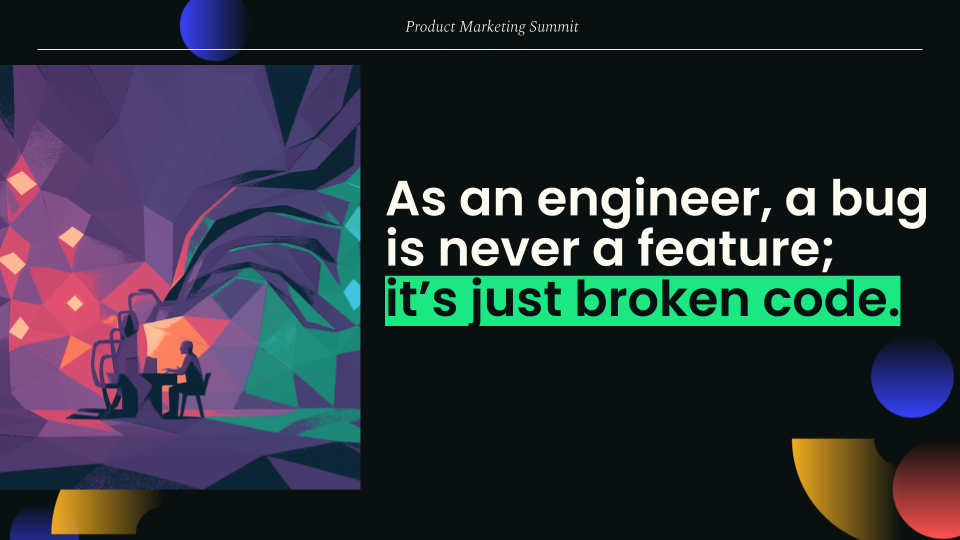
When you spend years as an engineer, you develop a very particular way of seeing the world. Everything is binary. The script either completes the task, or it doesn’t. The server is up, or it isn’t. A bug is never a feature. It’s just broken code.
There’s no spin in that world. Just technical truth.
But then I started asking why. Why are we fixing this particular thing? Why are we building this tool? Why aren’t we prioritizing that other feature that seems far more important to the customer? I became, by all accounts, extremely annoying to my colleagues. But those questions eventually led me somewhere important.
I realized that nobody cared about my beautifully structured code. Nobody cared about the tool I’d spent three years developing. What they cared about was what problem it solved. That epiphany pushed me toward product marketing. Suddenly, I understood that this was the function that connected technical reality to customer value.
The transition was exciting. I moved from binary truths to value frameworks, visionary roadmaps, and value alignment. The whole panorama of business opened up. I loved it.
And then someone asked me for a value proposition.
I remember the moment clearly. I was sitting with the engineering team, feeling confident, thinking I was still one of them. They asked me what value proposition we were going to take to market. I don’t remember what I blurted out, but I remember what happened next: they looked at me like I had two heads.
That was the moment I understood that credibility with engineering teams doesn’t come automatically – not even when you used to be one of them.
For expert insights like this, in full, every Friday, sign up for Pro+ membership.
You’ll also get access to 30+ certifications, a complimentary Summit ticket every year, and 130+ product marketing templates.
So, what are you waiting for?
Why engineers don’t trust marketing by default
If you’ve ever felt like you’re fighting for your engineering or product teams to take you seriously, you’re not imagining it. This is a common dynamic, and it has very little to do with how smart or capable you are.
Here’s where it usually starts. Product marketing is often asked (or required) to launch a product well ahead of actual delivery. We’re telling the visionary story, painting the picture of where the product is going, and that means writing forward-looking content and tucking a future-tense caveat into the fine print.
The problem is that the caveat rarely gets read. What sticks is the headline claim, and if that claim is ahead of the product’s current capabilities, the engineer who built it notices immediately.
And here’s the part that really costs you: once that happens, the engineer doesn’t just distrust that one claim. They distrust the source. If that source is your marketing content, you’ve burned credibility with the buyer, and with your own engineering team, who can see exactly what you published and know it doesn’t match reality.
That’s the cycle we need to break.
Trust is a revenue strategy
This isn’t just about internal harmony. It’s about revenue.