
What is market segmentation?

Market segmentation is the process of dividing a broad target market into subsets, or cohorts, of customers who share common characteristics, needs, priorities, and behaviors. The advantage of segmenting the market is that marketing teams can create tailored messaging that aligns with the distinct characteristics of each group.
Traditional market segments are identified using the following characteristics:
- Demographics
- Psychographics
- Geographics
- Behavioral
- Values
- Product usage
Once your market segments are defined, marketing teams can select the clusters that represent the best opportunities to win. From there, you can develop strategic, targeted marketing campaigns that speak directly to the core needs and interests of a specific cohort.
Understanding the difference: Market segmentation vs. target marketing
Think of market segmentation and target marketing as two distinct but connected steps in finding your ideal customers. As Patricia Bleiker, Go-to-Market Consultant and Founder of GTM Point, explains it well:
“Go-to-markets are very much about matchmaking… finding the perfect product target market for a product and marrying them.”
But here’s where many marketers get confused. Segmentation and targeting aren’t the same thing.
Market segmentation is the analytical process of dividing your entire potential market into distinct groups based on shared characteristics. It’s like looking at all the possible matches in your dating pool and organizing them by common traits.
Target marketing is the strategic decision of which segments you’ll actually pursue. It’s choosing who you’ll ask on that first date.
Here’s a detailed comparison to make the distinction crystal clear:
|
Aspect |
Market Segmentation |
Target Marketing |
|---|---|---|
|
Definition |
Process of dividing the total market into distinct groups |
Process of selecting specific segments to focus on |
|
Purpose |
To identify and understand all potential customer groups |
To choose the most valuable segments for your business |
|
Timing |
Happens first – it’s the research phase |
Happens second – it’s the decision phase |
|
Scope |
Broad and comprehensive |
Narrow and focused |
|
Output |
Multiple defined segments with characteristics |
Selected segment(s) with tailored strategies |
|
Example |
Identifying segments: budget travelers, luxury travelers, business travelers, adventure seekers |
Choosing to target only business travelers and luxury travelers |
|
Resources needed |
Research, data analysis, customer insights |
Strategic planning, resource allocation, campaign development |
|
Risk level |
Low – you’re just organizing information |
Higher – you’re committing resources to specific groups |
As Patricia notes, from a product marketer’s perspective, “you have a gazillion different or endless options of target segments target markets you could go to market to.” That’s exactly why this two-step process matters. Segmentation gives you the map; targeting decides your route.
The key takeaway? You can’t effectively target without first segmenting. But segmenting without targeting is just an academic exercise. Both are essential, but they serve different purposes in your go-to-market strategy.
What are the different types of market segmentation?
Next, let’s delve a little deeper into the different types of segmentation listed above and throw in a few examples of segmentation in practice to give you a clearer picture.
Demographic segmentation
Demographic segmentation is defined by age, education, occupation, income, gender, race, sexuality, family size, interests, and more.
It’s the most commonly used form of segmentation because it’s essentially the root of all of our spending habits. Where we live defines where we buy things, where we work has a huge influence on what we buy, and how much we spend is heavily dependent on how much we earn.
A good example of this is T-Mobile’s 2019 campaign targeting baby boomers – the company’s strategists pinpointed what older adults were looking for when buying a phone; which they found was the ability to connect with family and friends.
In response to these findings, the company unveiled a new data plan targeted towards customers 55+ which eradicated all of the unnecessary added extras you might find in a millennial’s plan who, for instance, streams an inordinate amount of content via TikTok or Spotify.
Psychographic segmentation
While demographics tell us who the customer is, psychographics tell us why the customer buys a product. Psychographics categorizes customers by factors relating to personality and characteristics, like lifestyle, values, opinions, and hobbies.
For example, a company like Mercedes Benz focuses on customers who value luxury and status, while Volkswagen, which literally translates to ‘the people’s car’ in German targets an audience who value affordability and reliability.
Geographic segmentation
Geographic segmentation categorizes customers based on geographic boundaries. For example;
- Country
- State
- City
- Zip Code
- Climate
- Urban or rural
For example, a company that sells only waterproof outerwear would have an easier time targeting markets in Seattle than say, Arizona.
Behavioral segmentation
Behavioral segmentation divides consumers by behavior patterns as they interact with a business – their knowledge of a product, what they like or dislike about a product or a service, how often they interact with a certain area of your app, and so on.
Netflix has the perfect model of behavioral segmentation, with each user receiving recommendations completely unique to them and based purely on their viewing behaviors. The data doesn’t lie, around 80% of Netflix views come from the recommendation feature.
Firmographic segmentation
Firmographic segmentation groups businesses rather than individual consumers. It’s the B2B equivalent of demographic segmentation, using traits like:
- Industry
- Company size (employee count or revenue)
- Annual revenue
- Growth stage (startup, scale-up, enterprise)
- Ownership structure (public, private, VC-backed)
A project management tool might use firmographic data to separate a 15-person startup from a 5,000-employee enterprise. The startup needs a fast setup and a low price point. The enterprise needs SSO, admin controls, and a dedicated account manager. Same product, two firmographic segments, two different sales motions.
For any B2B company, firmographic segmentation is usually the starting point before layering in behavioral or psychographic data.
Market segmentation vs. customer segmentation
These two terms get used interchangeably, but they’re not the same thing.
Market segmentation looks outward. It divides the entire market, including people who aren’t your customers yet, into groups based on shared traits like demographics, behavior, or need. The goal is to map opportunity: where does demand exist, and which parts of it can you realistically serve?
Customer segmentation looks inward. It takes your existing customer base and splits it by traits like purchase history, product usage, lifetime value, or support activity. The goal is to manage and grow revenue from people you already have.
Here’s the practical difference:
|
Feature |
Market segmentation |
Customer segmentation |
|---|---|---|
|
Scope |
Total market, including prospects |
Existing customers only |
|
Data source |
Market research, surveys, third-party data |
CRM, product usage, billing data |
|
Main use |
Go-to-market strategy, new product decisions |
Retention, upsell, churn prevention |
|
Example |
Grouping all small business owners by industry |
Grouping your current users by plan tier and login frequency |
A SaaS company might use market segmentation to decide which industry to target next. It would use customer segmentation to work out which of its current accounts are at risk of churning.
Most teams need both. Market segmentation shapes where you compete. Customer segmentation shapes how you grow once you’re there.
How to implement market segmentation
Knowing the types of segmentation is one thing. Putting one together is another. Here’s the process.
1. Define your objective
Get specific about why you’re segmenting before you touch any data. “Understand our customers” is too broad. “Find which segments to prioritize for our Q3 product launch” gives you something to build toward.
2. Gather your data
Combine sources rather than relying on one. Pull from customer surveys, CRM records, website analytics, and sales conversations. Demographic and firmographic data tells you who’s in the market. Behavioral and usage data tells you what they actually do.
3. Choose your segmentation variables
Pick the variables that matter for your objective, not every variable available. A B2B SaaS company launching an enterprise tier might segment by company size and industry. A DTC brand launching a new flavor might segment by purchase frequency and geography.
4. Build and validate the segments
Group your data against the variables you chose, then check each segment against the five requirements: measurable, accessible, substantial, differentiable, actionable. A segment that fails any of these isn’t worth building a strategy around.
5. Test and refine
Run a small campaign or pilot against one or two segments before committing full budget. Segmentation isn’t a one-time exercise. Markets shift, and a segment that made sense 18 months ago might not hold up today.
Common market segmentation challenges
Segmentation goes wrong in a few predictable ways.
Over-segmentation
Splitting the market into so many micro-groups that no single segment has enough scale to justify a dedicated strategy. If you can’t write a distinct value proposition and campaign for a segment, it’s too small. Consolidate until each segment is worth the resource.
Working from insufficient data
Segmenting on assumptions instead of evidence produces segments that look tidy on a slide but don’t hold up in the market. If you’re relying on a single data source, or none at all, your segments are guesses. Pull from multiple sources before you commit.
Segments too small to monetize
A segment can be well-defined and still not be worth pursuing if the revenue potential doesn’t cover the cost of reaching it. Check the segment against your TAM/SAM/SOM numbers before building a campaign around it.
Static segments
Building segments once and never revisiting them. Customer behavior, market conditions, and competitive pressure all change. Segments should get reviewed on a set cadence, not left to run indefinitely.
Ignoring internal alignment
Marketing builds one set of segments, sales works from a different customer list, and product roadmaps a third. Segmentation only works as a shared reference point across teams. Agree on the segments once, then use them everywhere.
Market segmentation requirements
Once you’ve finished the market segmentation study, your results should be:
- Measurable
- Accessible
- Substantial
- Differentiable
- Actionable
Let’s unpack each in a little more detail…
Measurable
Segments should be easily measurable so that marketing strategists can decide whether, and to what extent, they should focus their efforts and resources. If you can’t measure your rate of growth then how will you know the segment is valuable?
Accessible
There’s no use selecting a market segment you can’t reach, whether that means geographically, or psychologically. After all, you wouldn’t market a software solution specifically for a doctor and try and sell it to a police officer, would you?
Substantial
The market segment must have the ability to buy your product. For example, almost everyone would like to own a private jet but can most of us actually afford it? Not in this lifetime!
Differentiable
Differences between market segments should be clearly defined so that your campaigns, products, and marketing tools can be used as effectively as possible without overlap.
Actionable
The market segment needs to provide supporting data for a marketing position or sales approach so that your intended marketing targets actually purchase a product.
What are the benefits of market segmentation?
- Stronger marketing messages. You can write direct, specific messaging instead of generic copy that tries to speak to everyone.
- Clearer view of what works. Testing against defined segments shows you which tactics perform, instead of guessing across an undifferentiated audience.
- Hyper-targeted ad campaigns. You can build ads around age, location, purchasing habits, and interests rather than broad targeting.
- Differentiation from competitors. Specific messaging and value propositions for each segment set you apart from competitors running generic campaigns.
- Identification of niche opportunities. Segmenting surfaces underserved parts of the market you can build new products or services around.
- Better resource allocation. Once you know which segments matter most, you can direct budget and headcount toward them instead of spreading effort thin.
- Improved customer retention. Messaging and product decisions that reflect a segment’s actual needs reduce churn within that group.
Using market segmentation for strategic business decisions
Market segmentation isn’t just about organizing customers. Rather, it can be a strategic tool for making critical business decisions about where to expand, what to build, and how to grow.
Jan Hofmann, Head of Product Marketing at TikTok, has developed a strategic segmentation framework to support in making these critical business decisions – and it rests on two related concepts: The size of the prize, and the right to win.
Let’s break them down.
Jan Hofmann’s strategic segmentation framework
Size of the prize
This evaluates the market opportunity for each potential segment:
- How large is the total addressable market?
- What’s the budget allocation in this segment?
- What’s the growth trajectory?
In other words, the size of prize is the external market size for the market, and the budget types that you should go after.
Right to win
This assesses your competitive advantage in each segment:
- Do we have unique capabilities for this segment?
- Can we differentiate effectively?
- What’s our credibility and track record?
Applying TAM, SAM, and SOM to segment decisions
For each potential segment, calculate:
- TAM (Total Addressable Market): The entire revenue potential if you had 100% market share
- SAM (Serviceable Addressable Market): The portion you could realistically serve with your current model
- SOM (Serviceable Obtainable Market): What you can capture considering competition
To see what this might look like in practice, consider this example Jan shares from the gaming industry:
- TAM: All board game players globally ($12B market)
- SAM: English-speaking markets with distribution ($4B)
- SOM: Strategy game enthusiasts we can reach ($400M)
Strategic segmentation transforms expansion from guesswork into data-driven decision making. Instead of asking “Should we expand?” you’re asking “Which segment offers the best combination of market opportunity and competitive advantage?”
That’s how segmentation becomes a boardroom tool, not just a marketing tactic.
What’s the relationship between market segmentation, targeting, and positioning?
Segmentation, Targeting, and Positioning (STP) is one of the most popular marketing models out there. In fact, Smart Insights conducted a survey where STP was revealed as the second most popular marketing model, behind the classic SWOT / TOWs matrix.
The STP model is useful for creating marketing communications strategies because it helps marketers prioritize propositions and develop and deliver personalized, relevant messages to different audiences.
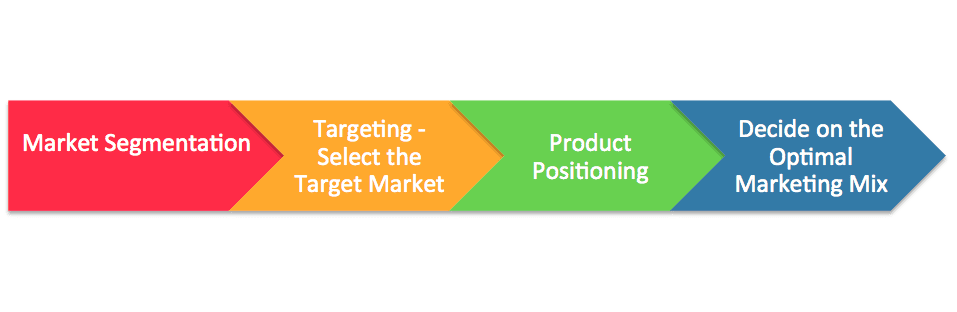
STP is essentially the journey you take to position your brand in the minds of consumers, it’s the difference between yours and your competitor’s products.
Targeting
Once you’ve collected the relevant data through market segmentation, you can then use it to identify your target market.
Product positioning
When you have a target audience in your sights you can then work to present your product and all of its benefits, tailored specifically to the needs of your target market.
Combining segmentation approaches: Demographic and behavioral data
Single-type segmentation is like trying to understand a person by looking at just their job title or just their shopping habits. You get a piece of the puzzle, but not the whole picture.
The real magic happens when you combine segmentation types (particularly demographic and behavioral data). This hybrid approach reveals not just who your customers are, but why they act the way they do.
Why hybrid segmentation works
Consider how leading SaaS companies approach this. Effective segmentation creates a clear segment and associated value proposition that helps prospects understand exactly how the product or solution is going to meet their specific needs.
Take this real-world example: A finance professional who needs support in budget management and automation. This combines:
- Demographic data: Job function (finance professional)
- Behavioral need: Specific use cases (budget management, reporting automation)
The combination creates a much richer understanding than either data type alone.
A practical framework for combining segmentation data
- Start with demographics as your foundation
- Industry and company size
- Job title and department
- Seniority level
- Geographic location
- Layer in behavioral patterns
- Feature usage and preferences
- Purchase triggers and timing
- Support ticket themes
- Engagement frequency
- Create hybrid segments
Instead of “Finance professionals” or “Heavy report users,” you get:- “Finance executives at mid-market companies who run weekly automated reports”
- “Marketing managers at startups who collaborate on campaigns daily”
- “IT directors at enterprises who prioritize security features”
- Map value propositions to each hybrid segment
Each combined segment should have a clear, specific value proposition that speaks to both who they are and what they need.
Hybrid segmentation implementation tips
- In your product: Design navigation and onboarding flows that adapt based on both demographic inputs and observed behaviors.
- In your marketing: Create landing pages that speak to role-specific pain points with use-case-driven solutions.
- In your sales process: Equip teams with talk tracks that connect job responsibilities to product capabilities.
The payoff
When you combine demographic and behavioral data effectively, you can:
- Predict needs before customers articulate them
- Reduce churn by addressing role-specific frustrations
- Increase conversion rates with hyper-relevant messaging
- Guide product development with clearer use-case priorities
Remember, your customers aren’t just “directors” or “power users”. They’re “directors who need to present monthly metrics to the board” or “power users who manage complex multi-team workflows.” That level of understanding is what separates good segmentation from great segmentation.
Want to learn more?
Market research is an invaluable part of not just product marketing, but the overall organizational function. It helps us to understand what prompts the customer to purchase products within the market and, ultimately, identify how we can position our products in such a way that they stand out from the crowd.
Our Market Research Certified: Masters course has been designed to help you streamline your approach for success. By the end of this course you’ll:
🧠 Understand the importance and benefits of research for making the most impactful and strategic decisions.
🧐 Know about the different types of data and where best to source it.
🔬 Be aware of the best research methods available for conducting valuable data for your company.
✌️ Be able to consider the ethical implications of market research and data collection.
So what are you waiting for?