Let me set the scene.
You’re in a meeting preparing for a high-visibility launch. Everyone involved is smart. They have business acumen. They understand what needs to happen to drive the business forward.
And yet, somehow, you’ve ended up with three different messages. The CEO has their favorite. Sales has theirs. Product has a third.
Then someone asks a question that makes your stomach drop: which one actually resonates with the customer?
Silence.
I’ve been in that room, face flushed, without the data that would allow me to answer confidently. We’d done everything right – workshops, frameworks, alignment sessions – and still couldn’t answer the one question that mattered: which message should we bet the launch on?
The launch date wasn’t moving, the budget wasn’t growing, and the clock was ticking.
So, we did something scrappy. We built two landing pages with two different messages and ran traffic to both for two weeks. One message generated almost three times as many demo requests as the other.
Was it hard science? No. But it gave us something more valuable than a perfect research study: a directional signal. Something we could actually act on.
That experience changed how I approach message testing entirely. The framework I’m going to walk you through in this article came directly from that pressure-cooker moment, not from theory.
The message testing gap
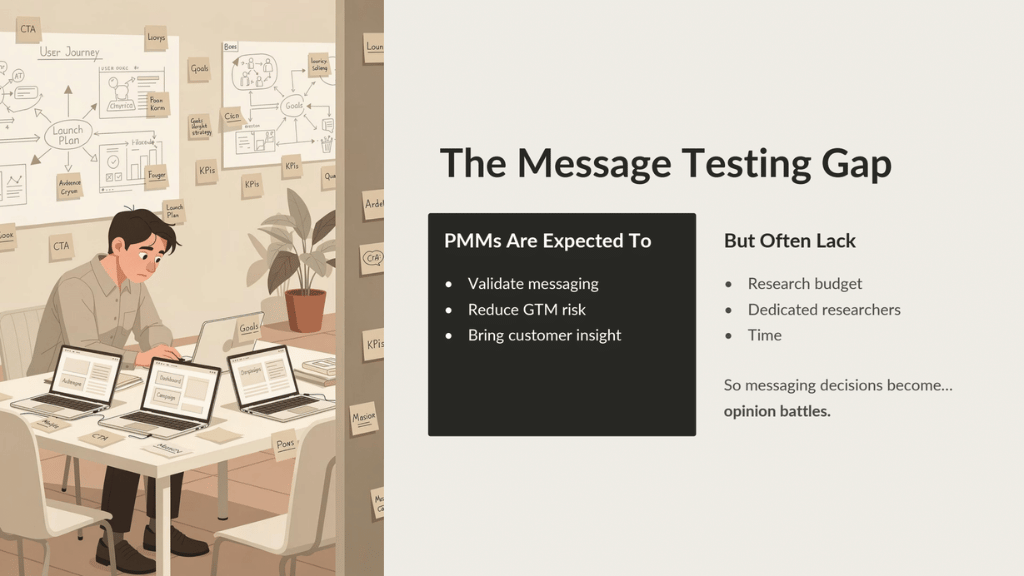
Here’s the reality of product marketing. You’re expected to validate messaging, reduce go-to-market risk, and bring customer insight to every launch conversation. But you often don’t have a research budget, a dedicated insights team, or the luxury of time.
So what fills that gap? Opinion battles.
More often than not, the HiPPO (Highest Paid Person’s Opinion) wins. When there’s no customer data in the room, the person with the most seniority and the loudest voice tends to carry the day. That’s a problem because their opinion, however well-intentioned, isn’t a substitute for market signal.
The expectations-versus-resources gap hasn’t narrowed over time. If anything, expectations have grown. We’re supposed to know the market, know the customer, know the message, validate it, and move fast. Unfortunately, depth and speed don’t naturally coexist, and pretending otherwise doesn’t help anyone.
If you want to close that gap, here’s the shift I’d encourage you to make: stop looking for perfect research. Instead, seek directional signal. Those are two very different things, and confusing them is what keeps product marketers stuck.
Perfect research is often too slow to be useful when a launch is bearing down on you. Directional signal, on the other hand, is actionable. It’s not flawless, but it moves things forward. And in most real-world go-to-market situations, moving forward with a well-informed hypothesis beats waiting for certainty that may never come.
Where AI fits into message testing
AI has transformed how quickly you can develop messaging hypotheses. Not because it replaces real customer validation (it doesn’t), but because it gives you a laboratory to experiment in before you spend a single dollar on ads or a single minute on a customer call.
I want to be clear about what AI is good at here, because it’s easy to either over-rely on it or dismiss it entirely.
AI is strong at pattern recognition. It can review customer call transcripts or chat logs far faster than any human could skim through them, surfacing recurring themes and language patterns that would otherwise take hours to identify.
It’s also useful for simulating reactions – you can ask it to respond as a skeptical buyer and get a surprisingly useful read on where your messaging might create friction. And it’s particularly good at taking messy qualitative data and turning it into something structured and usable.
That makes it helpful for testing your hook, pressure-testing your claims, understanding how different personas might react, and surfacing potential objections before they show up in a pipeline review.
Here’s the crucial part: AI helps you develop hypotheses. It doesn’t validate them. The market does that. You need both, and in that order.
For expert insights like this, in full, every Friday, sign up for Pro+ membership.
You’ll also get access to 30+ certifications, a complimentary Summit ticket every year, and 130+ product marketing templates.
So, what are you waiting for?
The three variables worth testing
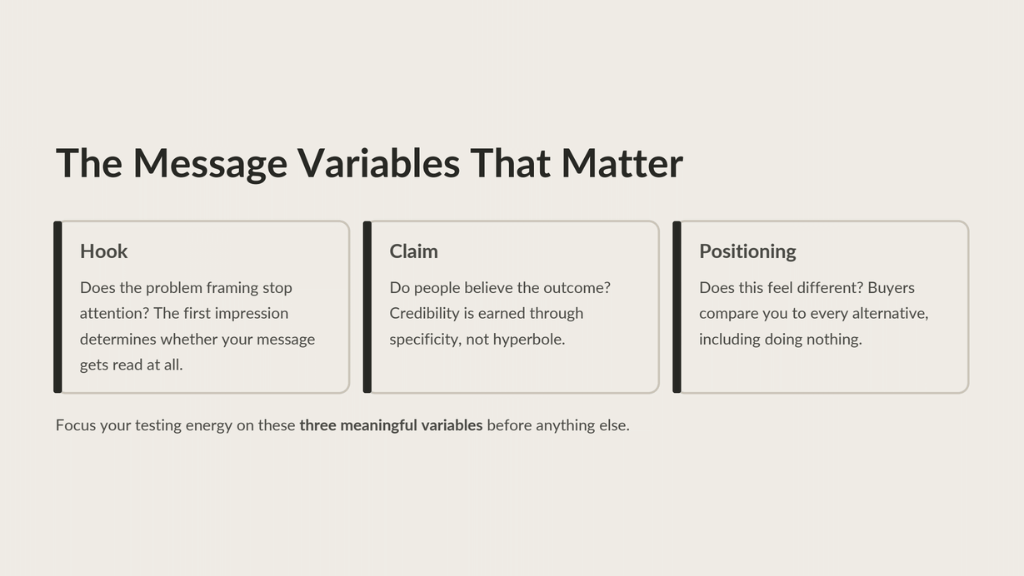
When you’re building a message testing framework, one of the easiest traps to fall into is trying to test everything at once. You can drown in variables. So the discipline here is focus. Pick one thing to test at a time, and make it meaningful.
There are three variables I come back to consistently:
The hook
The hook is your first impression. It’s the thing that either stops a buyer in a crowded, noisy world or lets them scroll straight past you. The question to ask is whether you’re framing the problem in a way that grabs attention and makes someone feel like you understand their situation. If your hook doesn’t land, nothing else gets read.
Claims
Claims are key to credibility. They need to be believable, and they need to be specific.