About a year ago, I was standing in front of my product marketing team at AppDirect, making what seemed like an absolutely ridiculous promise.
“By this time next year,” I said, “you’ll be thinking like engineers and product managers. You’re going to build tools – really cool tools.”
The stunned silence was… memorable.
But here’s the thing: we did it – and not just a little bit. We built 11 SaaS applications, created 20 AI agents, wrote over 200,000 lines of code, and completely transformed how we enable sales teams.
This wasn’t about turning product marketers into full-time engineers. It was about solving a problem you’re probably wrestling with right now: how to deliver sales enablement that’s useful, contextual, and scalable – without burning out our small PMM team.
Instead of buying more tools or creating more static content, we decided to build our own AI-powered enablement experiences. What follows is a behind-the-scenes look at how we did it, including:
- Why classic sales enablement models break down at scale (and what to do instead)
- A practical framework for thinking about AI beyond chatbots and point tools
- How we used agentic AI to turn raw data into contextual, just-in-time sales insights
- What happens when product marketers start building applications – and why we’re uniquely positioned to do so
Why traditional sales enablement isn’t cutting it anymore
Before I dive into how we pulled this off, let me paint you a picture of the challenge we were facing at AppDirect.
We’re a marketplace company selling everything from SaaS to infrastructure to telco services, even natural gas and electricity. We’ve got 14,000 partners ranging from energy brokers to managed service providers, plus 12 internal sales teams.
Five product marketers. Twelve sales teams. Fourteen thousand partners.
As you might imagine, we were drowning in requests. Too many customer profiles to investigate. Too many industry verticals to explore. And our sales teams? Bless them, but they don’t always remember what we want them to remember when we need them to remember it, so we get a lot of requests for help.
Sound familiar?

Our traditional approach was… well, traditional. Pick an ideal customer profile or two. Maybe dive deep into a couple of verticals if we’re feeling ambitious. Record some training on Google Meet, slap them into the LMS, and call it a day. We’d take the easiest path to content, creating what I call the “Build-A-Bear sales deck” – here are all the slides you could possibly need, now go build your own presentation.
It wasn’t working. Not at scale.
For expert advice like this straight to your inbox every Friday, sign up for Pro+ membership.
You’ll also get access to 30+ certifications, a complimentary Summit ticket, and 130+ tried-and-true product marketing templates.
So, what are you waiting for?
The AI pyramid: A framework for thinking about enablement tools
When most people talk about AI in sales enablement, they’re talking about using tools like Gong or Crayon. We took a completely different path – we decided to build our own tools.
But building with AI isn’t just about throwing ChatGPT at your problems. I think of AI capabilities as a pyramid, where each layer builds on the one below.
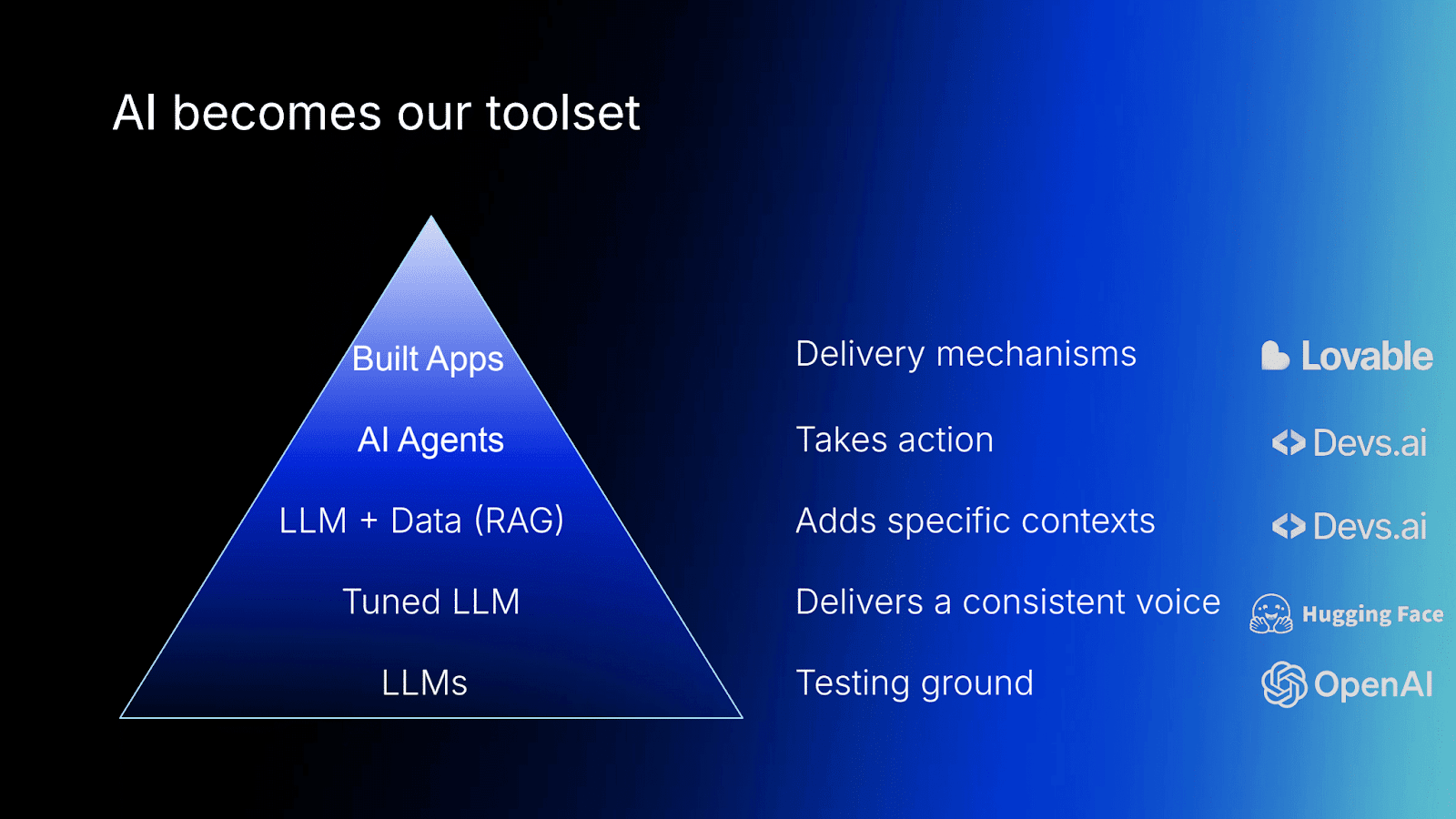
At the base: Raw LLMs like ChatGPT or Claude. Great for testing, terrible for scaling.
Level two: Fine-tuned LLMs that speak in your brand voice and understand your context. This is where most custom GPTs live.
Level three: LLMs combined with your data – your playbooks, competitive intelligence, and customer insights. You can continuously refresh that data, ensuring it’s up to date and contextually relevant.
Level four: Agents that can take action on your behalf.
The peak: Full applications that create entirely new experiences, building delivery mechanisms that give our sales teams new ways to engage with enablement content.
Most product marketers stop at level one or two. We went all the way to the top.
From market intelligence to contextual insights
Let me show you what this looks like in practice. We started with a seemingly simple problem: understanding our customers better. We had 120,000 customer records and half a million purchase records, but no clear picture of who was buying what and why.