
Templates, frameworks, and AI skills to pair with this playbook
- The product marketing skills pack – learn more here
- Product launch tiers framework
- Launch checklist
- Claude setup planner
Related certifications
I’ll start with a confession: AI didn’t come naturally to me.
I’ve been in product marketing long enough to know when something fits and when it doesn’t. PMM fit me immediately. It felt like a calling. I left for product management for four years, chasing better pay, and came back because I didn’t enjoy it. Product marketing is where I belong.
But agentic AI? That took a long time for me to adopt.
You’ve probably noticed that AI is reshaping who does what across the industry. Software developers are being squeezed by AI, so they’re moving toward product management, and PMs are eyeing marketing in response. PMMs are getting it from both sides; technical folks with AI workflows are moving in, while demand gen and field marketing do things many of us can’t.
So, you’ve got two choices: you fear AI, or you embrace it. I chose to embrace it, but not without a few painful lessons along the way. I’m going to share those lessons in this article. Here’s what we’ll cover:
- Why it’s time to stop treating AI as a writing tool and start treating it as an operating system
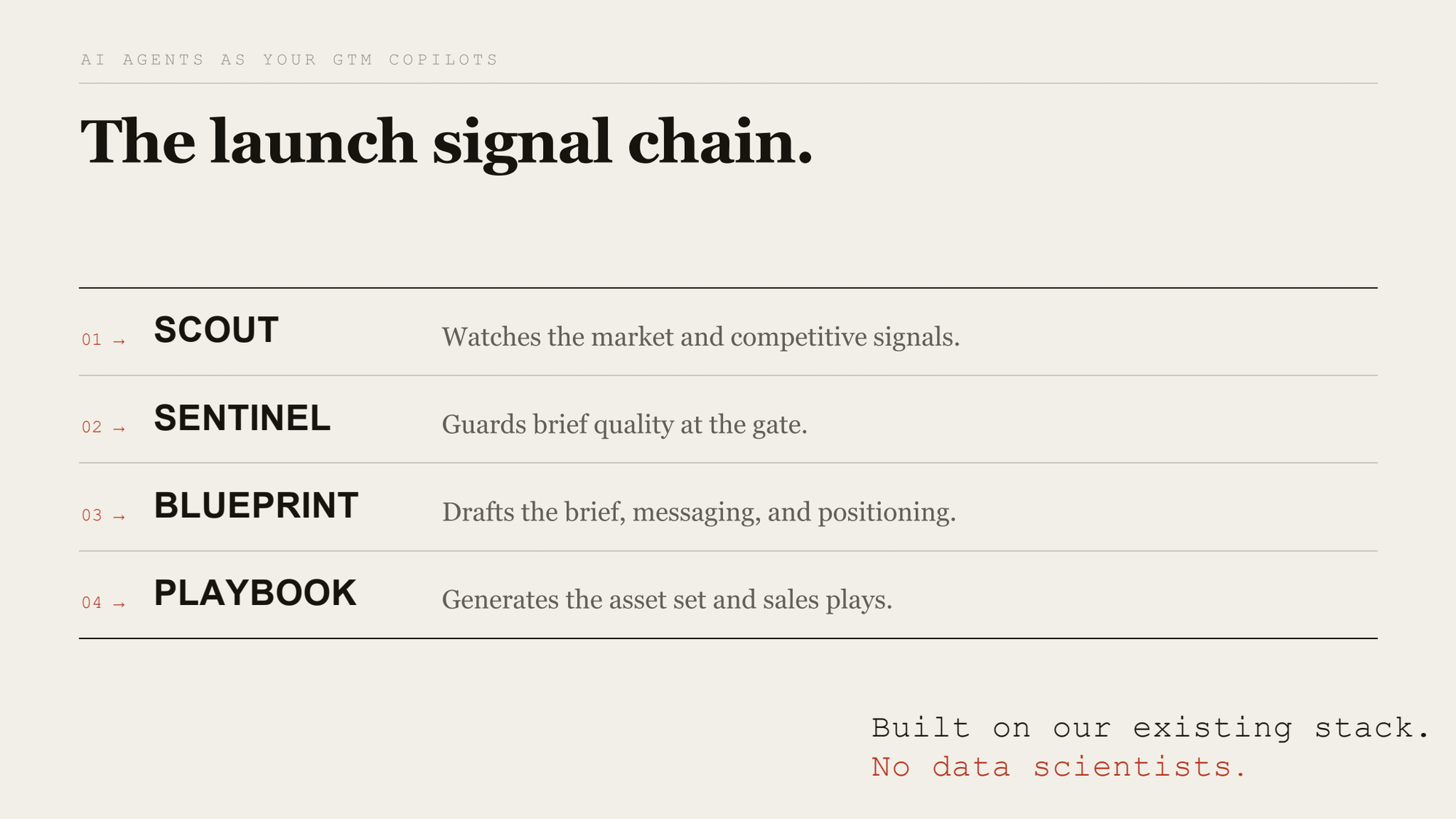
- The four agents my team built to run product launches
- What went wrong with our first brief, and the rule that fixed it
- Our results, including the hours we got back
- Three steps to start building AI workflows of your own
Rethinking AI
Most people start using AI as a content generator. I’m dyslexic and have never spelled anything correctly in my life. Finding a tool that helped me write was life-changing. But using AI to write content is just scratching the surface.
Think of it this way. I drive an 850-horsepower electric car. However, I live in North Seattle, where I almost never get above 25 miles per hour. We timed the trip from my house to downtown: 30 minutes by bike and 25 minutes in the car. That’s how I used to feel about AI. I had all that power, and I was getting around at about the same speed as before.
The shift happens when you stop thinking about AI as a tool and start treating it as an operating system.
For expert insights like this, in full, every Friday, sign up for Pro+ membership.
You’ll also get access to 30+ certifications, a complimentary Summit ticket every year, and 130+ product marketing templates.
So, what are you waiting for?
Five levels of AI maturity
As a PMM, I love frameworks, so I built one around AI adoption. It shows five levels of AI maturity, running from not started, through experimenting, operational, and integrated, up to agentic. I took it to my team, and we placed ourselves at Level 1 (experimenting) and made Level 3 (integrated) our north star.
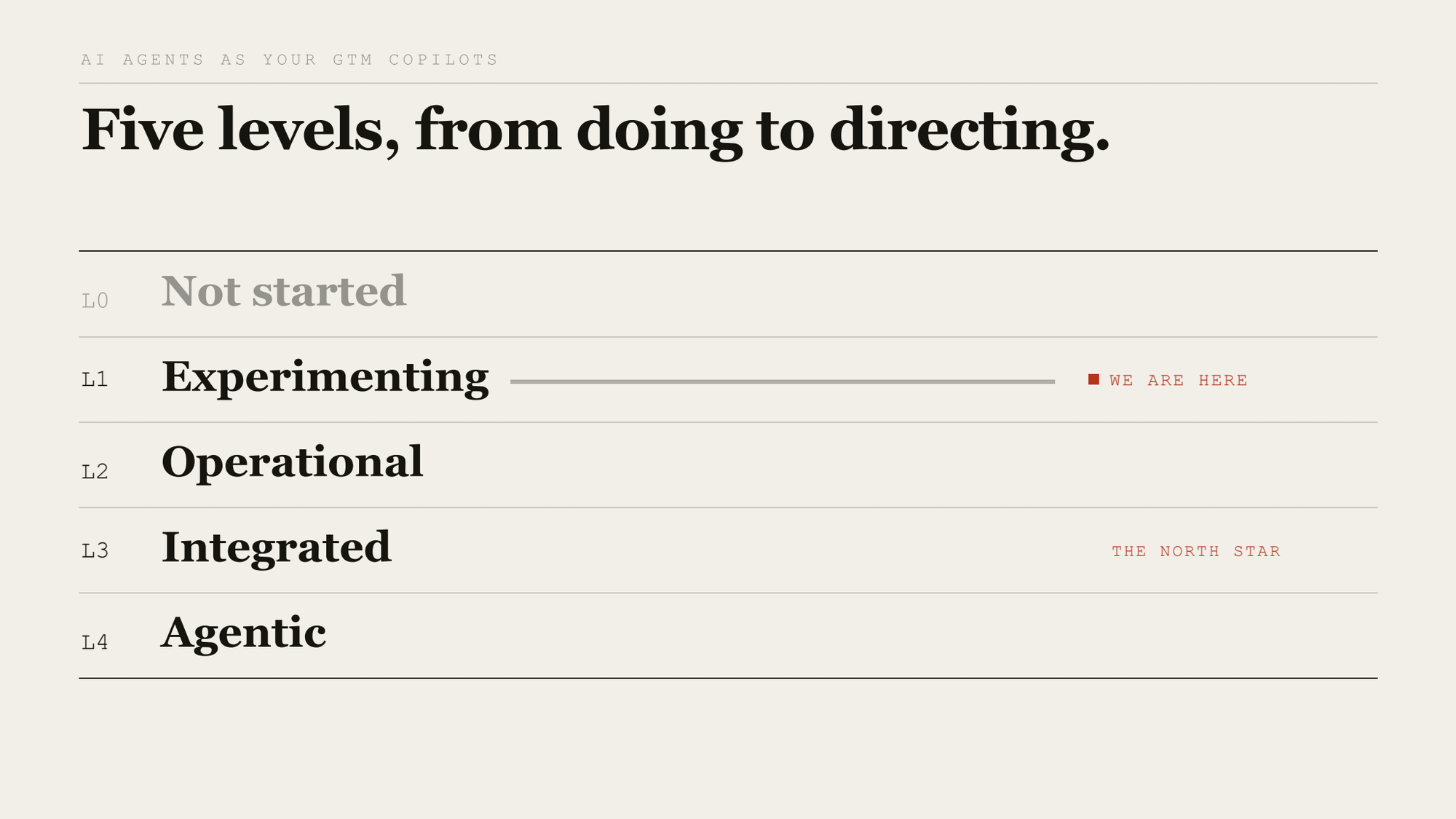
The framework gave us a map of where we stood. It also gave us a way to track each agent’s success, attach rate, and impact over time.
Why we started with launches
Ask most PMMs where to start with AI, and you’ll hear the same two answers: competitive intel and sales enablement. They’re sensible picks, but when my team and I sat down to choose the first workstream we wanted to automate, we went a different direction. We chose launches.
Why? Because almost every PMM has a complicated relationship with launches. Most of us have done at least one that didn’t go the way we planned. They’re painful, they’re time-pressured, and they never seem to have enough runway.
A launch starts with the product team and ends with the outbound team. When we looked at that path, we found three weak spots:
- Invisible brief quality
- Broken handoffs
- No single source of truth
So, we built a chain of agents to cover that whole path.
The four agents behind our launches
We call it the launch signal chain. Four hero agents sit at the center of it. I named them Scout, Sentinel, Blueprint, and Playbook. Let me show you how they work.