Templates and frameworks to pair with this playbook:
We’ve all been in that meeting.
Marketing pulls up their monthly metrics. Acquisition costs are ROI positive. The growth chart is trending up and to the right. Someone sings a bar from DJ Khaled’s “All I Do Is Win”, the room laughs, and everyone walks out feeling good about themselves.
Then, six months later, there’s a quieter meeting. A different chart. That cohort you celebrated has mostly gone silent. The users you paid to acquire showed up once and never came back. Nobody’s singing in that meeting.
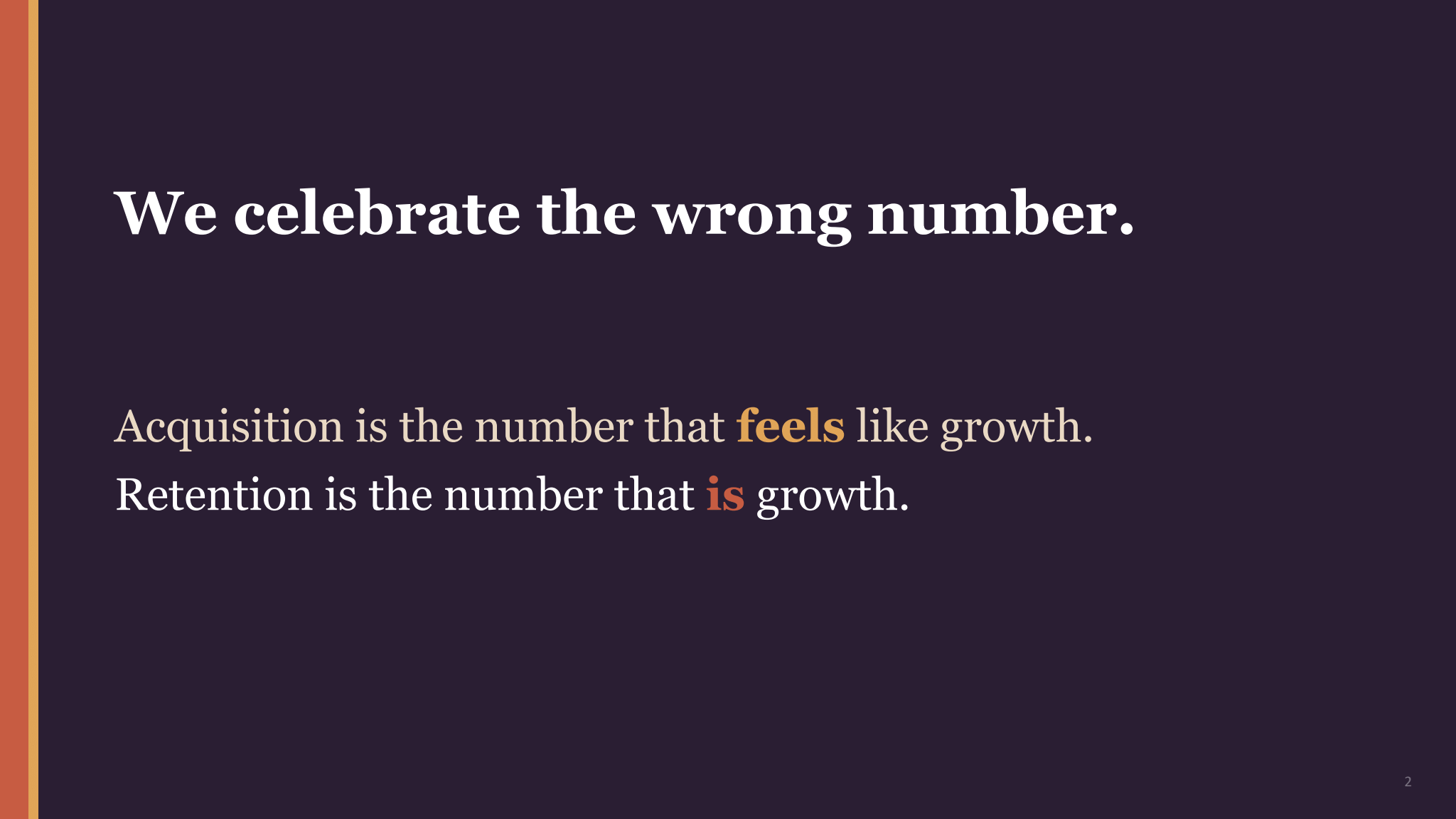
I’m a “call it as you see it” kind of person, so I’ll say it plainly: we’re celebrating the wrong number. Acquisition feels like growth, but retention is what actually compounds that growth.
The reason we chronically underinvest in retention is that everyone assumes it’s someone else’s problem. Product needs to build a better product. Lifecycle needs to send more engaging emails. Sales should have sent that churn-save email on a Tuesday. You know how it goes.
What I want to do here is make the case for two things. First, that retention is a product problem. Second, that product marketing is probably the best-positioned function to own the system that solves it.
I’ve lived this firsthand, so what follows isn’t just theory. It’s a playbook you can actually use.
The leaky bucket most go-to-market teams ignore
Most go-to-market strategies are a leaky bucket. We pour money into brand, paid acquisition, and orchestrated launches, then act surprised when the water level in that bucket never rises. The instinct, when a CMO starts asking questions, is to turn the dial on acquisition and just pour faster.
But you can’t out-acquire a retention problem. If customers leave faster than you can replace them, your acquisition spend isn’t growth. It’s a subsidy for churn. You’re essentially renting users you already paid to lose.
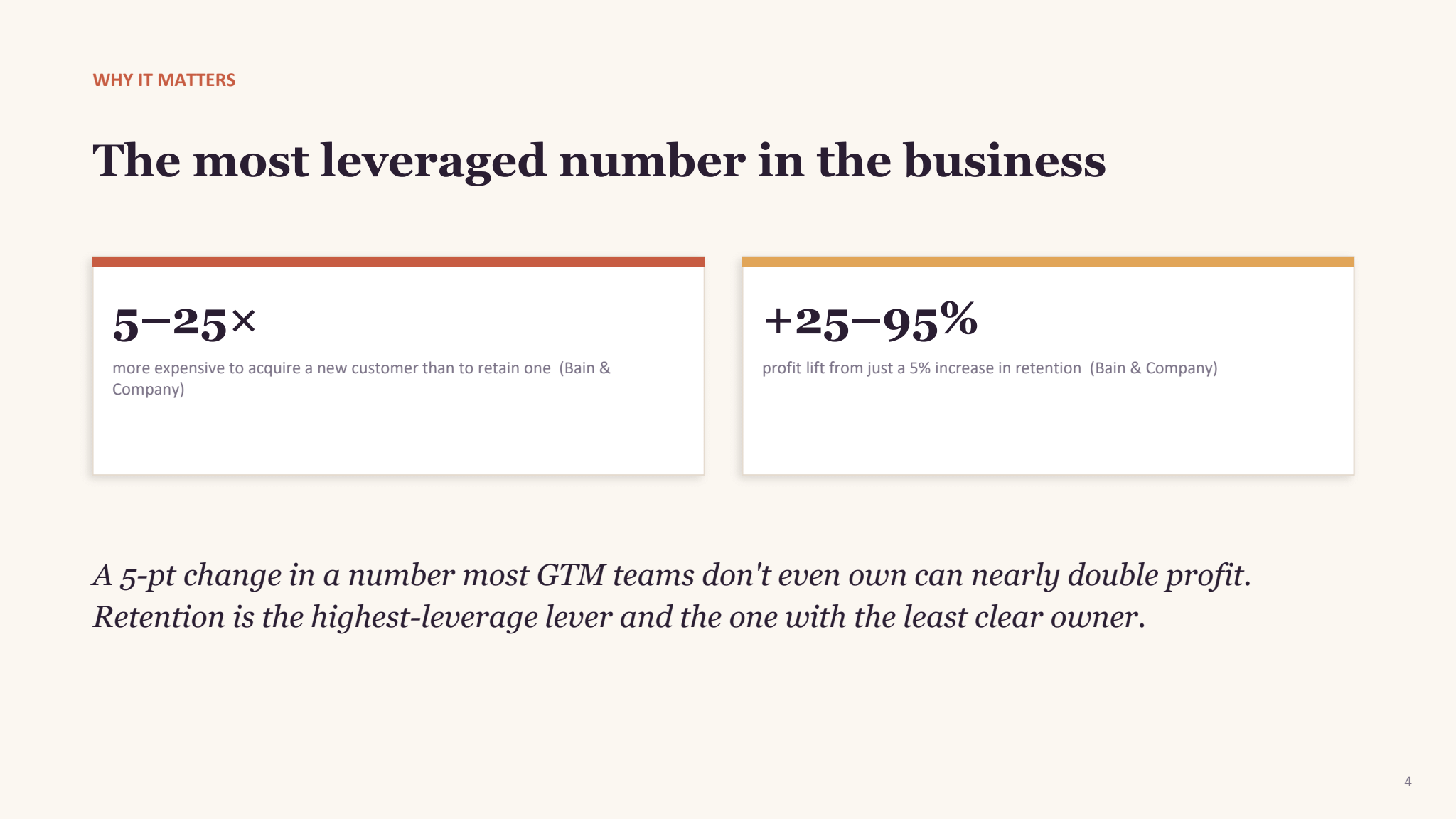
The economics here are not subtle. Research shows that acquiring a new customer costs anywhere from five to 25 times more than retaining one, and a 5% lift in retention can increase profit by 25% to 95%. There’s no acquisition lever on earth with that kind of leverage. Despite all this, retention rarely has a clear owner.
Why retention belongs in product marketing
People don’t stay because of a perfectly timed push notification. They stay because they felt value the moment they used the product. They felt it fast, and then the product gave them a reason to come back.
Value, speed, and a reason to return – those are product and positioning decisions long before they’re ever campaigns. That’s exactly why retention belongs in product marketing. We sit at the intersection of what the product actually does and what the customer believes it does. And that gap, when it exists, is where churn quietly begins.
This all comes down to finding what I call the value moment – the early customer action that makes staying more compelling than leaving.
Facebook found theirs: seven friends in ten days. Slack found theirs: once a team sends 2,000 messages, they’re 93 percent more likely to stay. Dropbox found theirs: one file, in one folder, on one device, and you have a Dropbox user.
To be fair, these metrics show correlation, not causation. However, the discipline behind them is what matters. These companies found that moment and then reverse-engineered everything to get customers there as fast as possible. That’s the model worth studying.
For expert insights like this, in full, every Friday, sign up for Pro+ membership.
You’ll also get access to 30+ certifications, a complimentary Summit ticket every year, and 130+ product marketing templates.
This month only: Save with code SUMMER26.
The hardest version of the retention problem
Retention looks completely different depending on how often a customer naturally uses your product.
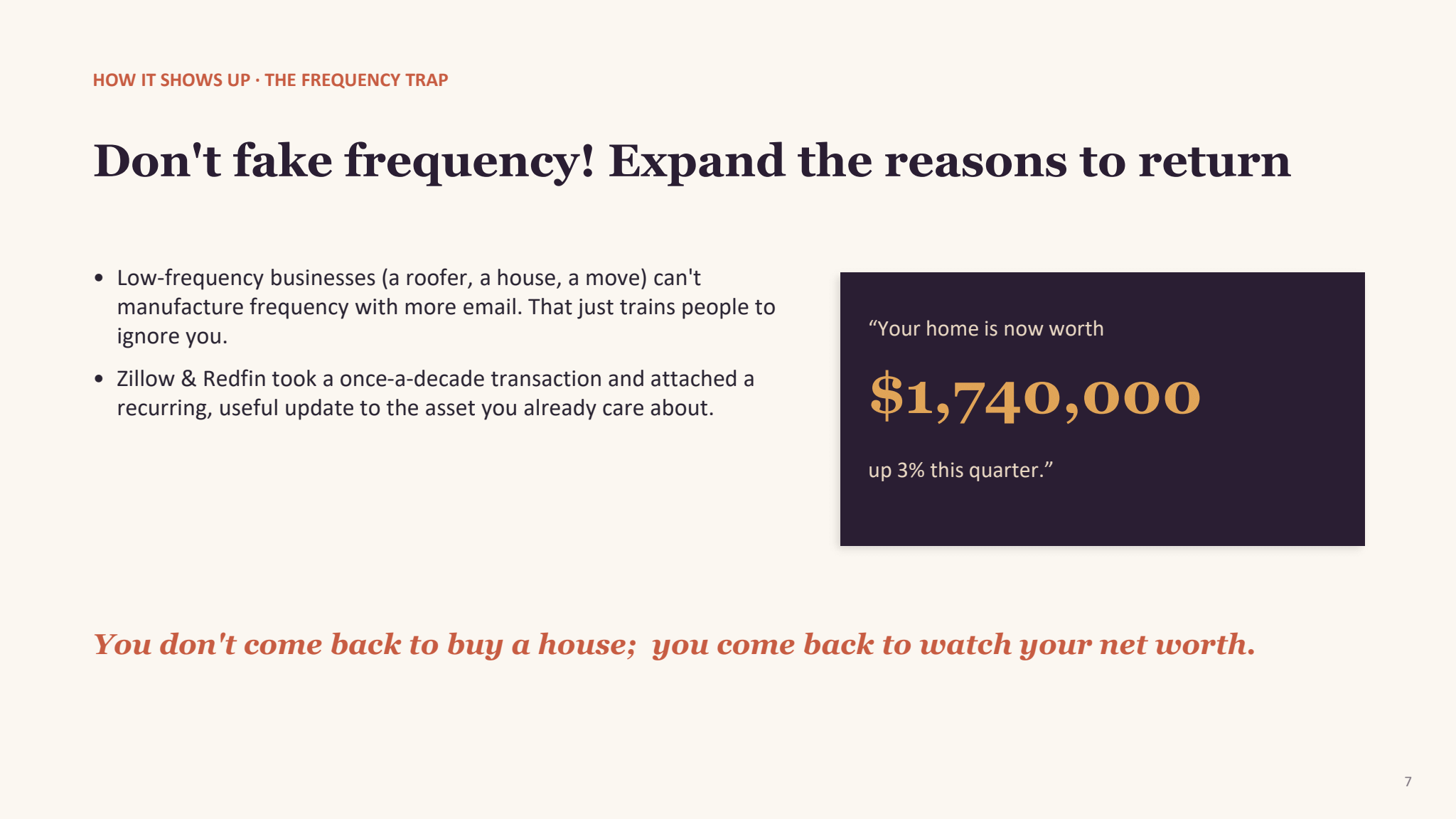
The hardest version is the low-frequency business. You don’t hire a roofer every week. You don’t buy a house every year. When natural frequency is low, the instinct is to manufacture it: send more emails, retarget people across the internet, and tell them you miss them. All that does is train people to ignore your brand.
The best operators do the opposite. They don’t fake the frequency. They expand the reasons to return.
Zillow, where I used to work, provides a useful example here. Most homeowners buy a home every seven to ten years, and in the current economy, that window is stretching even further.
So what did Zillow do? They turned your home into something worth checking. Their Zestimate feature tells customers, “Your home is now worth X, up 3% this quarter.” That’s brilliant retention design. They took a once-in-a-decade transaction and attached a recurring, genuinely interesting value moment to it. You’re not coming back to buy a home. You’re coming back to check on your net worth.
That’s the move worth remembering: find the high-frequency need that lives right next to your low-frequency transaction.
When you’re running a two-sided marketplace
Two-sided marketplaces add another layer of complexity. In businesses like Airbnb, Uber, or Thumbtack, keeping customers around isn’t just about making one side happy. It’s about keeping the right balance of buyers and sellers active at the same time.
The two sides retain each other. Retained, high-quality supply is what makes the demand side’s value moment reliable. Retained, active demand is what makes the supply side’s value moment real. Lose one side and the other side’s experience quietly degrades, and then they churn too. Churn becomes contagious across the whole marketplace.
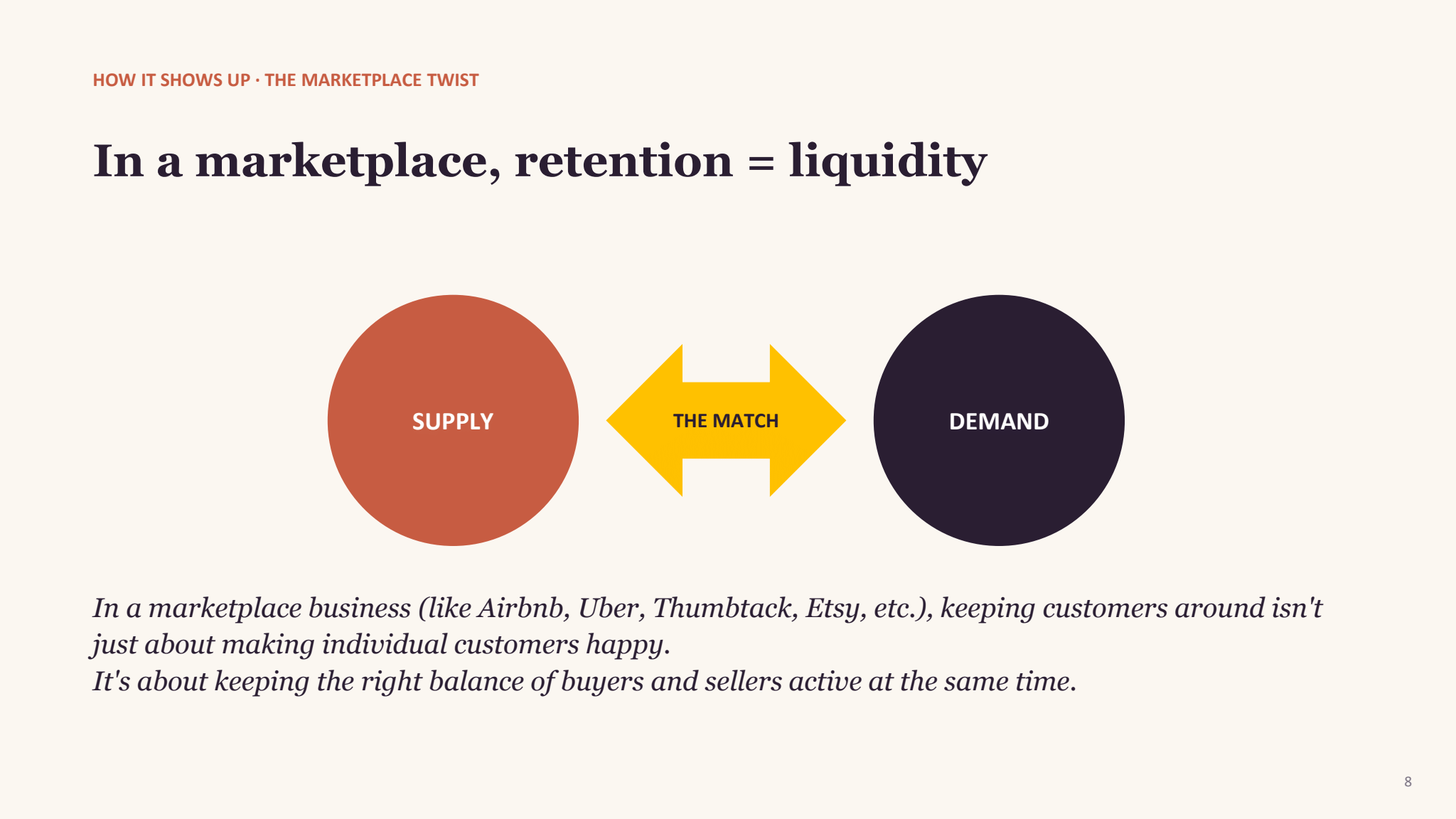
Airbnb retains both sides because hosts get reliable bookings and guests get reliable inventory. The whole thing holds together at the match.
How I tackled this problem at Thumbtack
Let me tell you a story about Thumbtack, where I’m the Senior Director of Product Marketing. It’s about as hard a case as I can imagine: low-frequency transactions in a two-sided marketplace.