
One inalienable truth for SaaS is that product active usage is the most revealing signal of having achieved product-market fit (PMF).
PMMs can build great positioning, define a sharp ICP, and design a killer GTM motion, but if users aren’t deeply engaging with your product, you haven’t earned PMF yet.
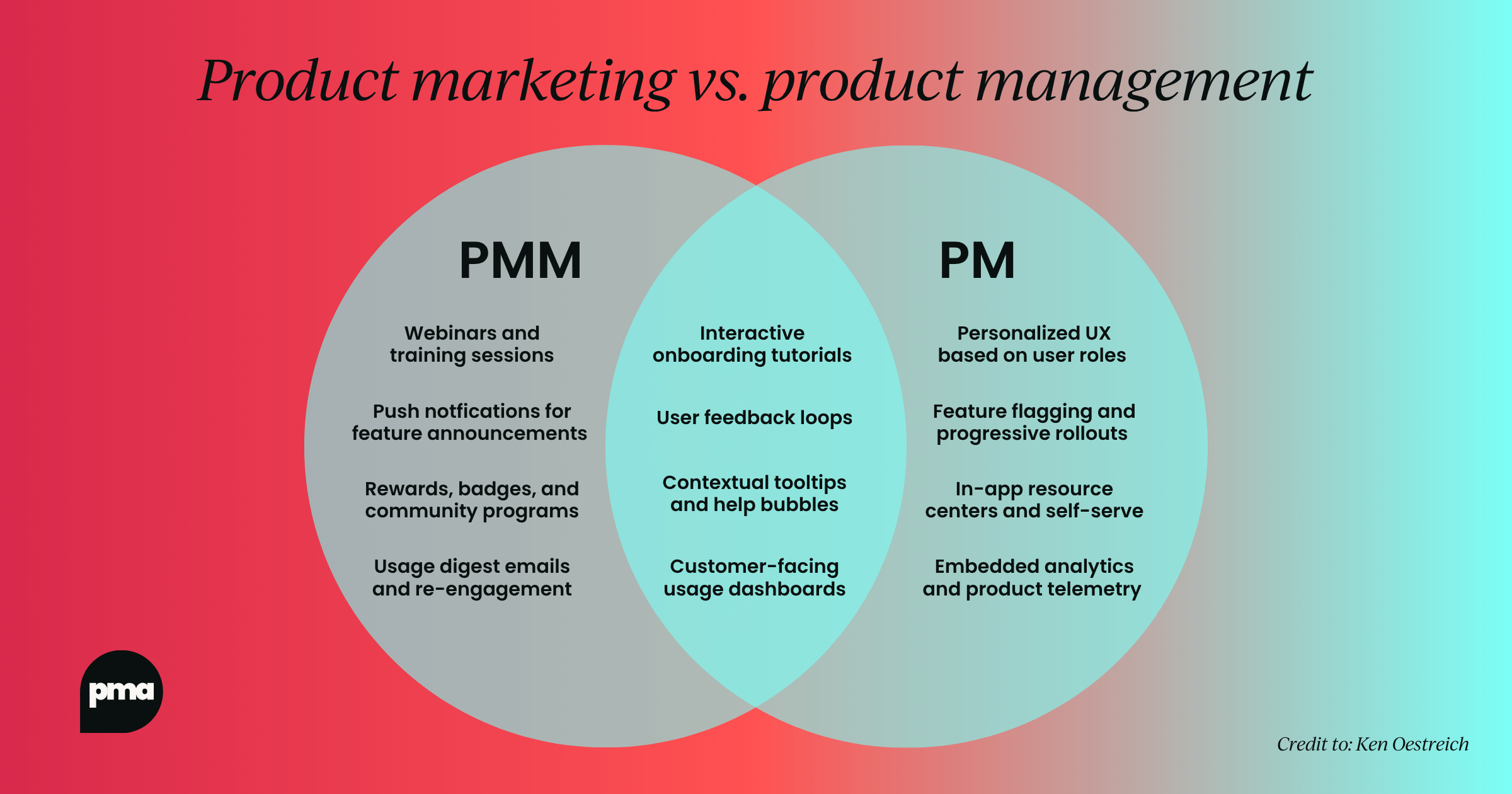
This is a PMM-and-product-management conversation, not a customer success conversation. While Customer success can rescue at-risk accounts, only PMM and Product teams can help build compounding retention. And that separates companies who’ve found PMF from companies that haven’t.
Below is my tried-and-true list of engagement options that PMMs should collaborate on with their Product Management counterparts… with very clear outcome metrics of driving higher levels of daily/monthly active use (DAU, MAU):
1. Focus on user onboarding and training
The most surefire approach to initiating healthy active use is to ensure that First-Time-Users (FTU) are onboarded quickly, are productive, and have a unique, contextual “aha” moment asap. Without this, you risk quick product defection, or at least low product usage depth. Try these approaches to ensuring successful onboarding:
Tutorials (separate or in-app): Start with Interactive tutorials that are designed around the user’s specific role and goals (not a generic product walkthrough). The most effective onboarding first identifies the user’s job-to-be-done during signup and then delivers a tailored “time-to-value” path that gets them to their first meaningful “Aha!” outcome as quickly as possible.
Webinars/training: If you’re running webinars and training, segment them by user maturity: i.e., new users need “getting started” sessions, while power users will want advanced workshops that deepen engagement.
Self-service knowledge bases include things like searchable video libraries to let users learn at their own pace and reduce support needs.
Certification programs: (think HubSpot Academy or Salesforce Trailhead) turn training into a credential, which can help improve stickiness and create evangelists, ambassadors, and champions.
Contextual onboarding checklists, e.g.. Persistent progress bars that track setup completion – give users a sense of momentum and a clear next step.
Popular tools:
- Appcues – a no-code platform for building in-app onboarding flows, tooltips, and checklists without engineering.
- Loom – helps teams to produce short walkthrough videos that can be embedded in-app or in a knowledge base.
- Skilljar – a customer education platform built for hosting courses and certification programs.
- Userpilot – helps product teams create personalized onboarding, segmented by user persona, plan tier, behavior, etc.
2. Feature enhancements
If you notice that certain product features are underused (or worse, undiscovered), or if customers begin asking for new functionality you don’t (yet) offer, you have important signals to evaluate, enhance, and/or roll out new functionality and adoption.
But to be clear: This isn’t about “more features are better”… this is about more features that customers regularly use, are better. Consider the following approaches:
Personalization: Going beyond cosmetic dashboard rearrangements will help users become more “sticky” because they’ll only see features that apply to their needs. Adaptive interfaces that show the right features based on usage patterns (not just stated preferences) will help reinforce engagement over time.
Feature flagging and progressive rollouts encourage product teams to slowly release enhancements to specific segments first. Then measure impact, and only then iterate before a broader release. This helps reduce risk, “takes off the rough edges,” and generates applicable feature-level usage data.
Beta programs: Launch Beta Releases with a curated group of engaged users to create co-development relationships that increase both product quality and user investment. Both product and marketing teams should monitor feedback, and collaborate on next steps.
Usage-based feature recommendations (e.g., “users like you also use xx”): Apply this discovery and recommendation approach that drives similar e-commerce engagement. This helps users discover features and functionality they might have otherwise missed.
Popular tools:
- LaunchDarkly – a PM feature management platform that helps with feature flagging, A/B testing, and progressive rollouts.
- Pendo – combines product analytics with in-app messaging, letting teams measure feature adoption and guide users toward underutilized features/capabilities.
- Productboard – for product managers, it centralizes user feedback and links directly to roadmap prioritization so product teams can see which requests map to which customer segments.
- Statsig – provides experimentation infrastructure for running controlled feature experiments and measuring their impact on key metrics.
3. In-app messaging
If you think about it, product education or training that sits *outside* the customer experience is far less likely to be used… and detracts time from actual product engagement.
But, placing guidance, tips, notifications, and other resources *inside* your product are more likely to be seen and acted upon – all with the intent of encouraging more and deeper product engagement. For example:
Tooltips and help bubbles are most effective when triggered by behavioral context, appearing when a user hesitates on a screen or encounters a feature for the first time, rather than firing on every login.
Push notifications need careful throttling and relevance scoring; the goal is to surface timely, actionable information (like a new integration that complements what the user already does) without training users to ignore notification noise. Announcements for major releases (used sparingly) can also drive immediate exploration of high-value features.
In-app resource centers, which are persistent, searchable help panels that users can open on demand, provide self-serve guidance without interrupting workflow.
Contextual microsurveys embedded at natural interaction points capture sentiment without pulling users out of the product.
Popular tools:
- Braze – a cross-channel messaging platform that helps orchestrate in-app, push, email, and SMS, taking into account customer segmentation.
- Chameleon – focused on in-app UX like tooltips, banners, and launchers with strong targeting and A/B testing capabilities.
- Intercom – combines in-app messaging, chatbots, and a help center, helping with both proactive and reactive communication.
- Userflow – a lightweight tool for building in-app tours, checklists, and resource centers without the need for developers.
4. Gamification
Some products and experiences will lend themselves to friendly social rewards and competition – even if only building “streaks” for yourself to admire. But gamifying certain experiences can make certain products more enjoyable, even friendly, to use. Consider implementing the following concepts when encouraging extended use of your product:
Rewards and badges can work well when they’re tied to behaviors that genuinely drive user value (e.g., completing a workflow, connecting an integration, inviting a teammate) rather than arbitrary activity like daily logins. The most effective gamification builds visible (social) proof: for example, leaderboards within a team workspace, or community recognition programs that make power users visible… which in turn motivates broader use/adoption.
Progress tracking (e.g., completion percentages, streaks, milestones) taps into the same psychology as above, without requiring a full gamification system. Also really great for onboarding per above.
Community challenges or “quests” tied to product usage can drive exploration of underused features in a time-bound, event-driven way.
Tiered user “status” (or ranking) programs (like a “Pro User” designation unlocked by usage depth) create targets and can tie into exclusive benefits like early access or direct product team engagement.
Popular tools:
- Gainsight PX – helps with engagement scoring and in-app experiences that can drive gamified adoption motions alongside other customer success workflows.
- Influitive – a customer advocacy platform that gamifies engagement via challenges, rewards, community participation, etc.
- Kahoot! – while known for quizzes, it’s actually increasingly used for gamified product training and internal enablement.
5. Performance metrics and dashboards
Akin to gamification, users also respond to positive metrics and feedback on their personal progress, on the value they’re deriving, or on how they’re performing relative to peers. Certain products lend themselves to giving users anything from progress bars to detailed value metrics.
Usage analytics should go beyond showing users what they did… the real value is in insight that tells them what they’re missing or underusing. Benchmarking a user’s engagement against (anonymized) peers in similar roles or companies creates a pull toward deeper usage. The dashboard then becomes a retention tool.
Automated health scores visible to end users (not just the internal CS team) create transparency and self-service course correction. Scheduled usage digest emails (weekly or monthly) summarizing activity, ROI metrics, and recommendations, all re-engage dormant users and reinforce value for active ones. Even better, embedded analytics that let users build custom reports turn your platform into their system-of-record
Popular tools:
- Amplitude – provides behavioral analytics with cohort analysis and predictive capabilities for identifying at-risk users.
- Mixpanel – product analytics focused on user behavior tracking, funnel analysis, and retention measurement.
- Sisense – an embedded analytics platform that lets SaaS companies build customer-facing dashboards directly into products.
- Vitally – a customer success platform that combines product usage analytics with health scoring and proactive workflow automation.
If there’s one metric that product marketers should obsess over, it’s active use. Not downloads, not signups, not even MRR in isolation – but whether the customers you fought so hard to acquire are actually using your product in ways that make it hard to leave.
That’s also where product-market fit lives. You don’t need to use all of these strategies. But pick the one that addresses your biggest gap today. Maybe your onboarding is leaking users before they ever reach the “aha” moment, or maybe your most valuable features are buried, and nobody knows they exist. Start there, instrument it, measure the outcome, and iterate.
Companies that win the active use game aren’t the ones with the longest feature list… They’re the ones who treat engagement as an experimentation opportunity to deliver value and to capture interest.


