
Back when I was a brand-new, bright-eyed, bushy-tailed product marketer, a product manager asked me to support a feature launch. I was all in.
I spent weeks building what I thought was the most beautiful deck ever – polished slides, a full messaging hierarchy, even outreach sequences for sales and customer success (CS).
Launch day went great. Product was ecstatic. Leadership was happy. Everyone loved it. I was so proud I even texted my mom about it!
Then I looked at the adoption numbers… they weren’t great. When I asked a salesperson what he thought about the launch, his response was simple: “Customers don’t care.”
That’s when it clicked. The feature came from an internal roadmap, not customer feedback. We hadn’t pressure-tested it with CS. There were no OKRs tied to it. I’d optimized for internal excitement instead of external impact.
That was my first real lesson in product marketing: just because something is new and shiny doesn’t mean it matters. That’s why prioritization is everything for PMMs.
PMMs are constantly flooded with requests – launches, decks, messaging, enablement, and more. You can’t do everything, and more output doesn’t equal more impact.
Strong prioritization is how you focus on what actually moves the business forward – and in this article, I’m going to show you how to get it right. Here’s a peek at what we’ll cover:
- How saying yes to everything quietly kills impact
- A simple framework for prioritizing what actually matters
- Real PMM examples – what to do first, what to bet on, and what to skip
- How to say no without burning bridges or losing trust
- How to turn prioritization into a shared, cross-functional responsibility
The high cost of always saying yes
Saying yes feels like the right thing to do. You want to be helpful. You want to be responsive. You want to be seen as a good partner to product, sales, and CS. But saying yes too often comes with a cost.
PMMs are constantly flooded with requests. Product wants launches. Sales wants decks. CS wants enablement. Leadership wants updates. Individually, none of these requests feels unreasonable. Collectively, they’re overwhelming.
In true MBA fashion, I’ve come to think of this as a funnel.
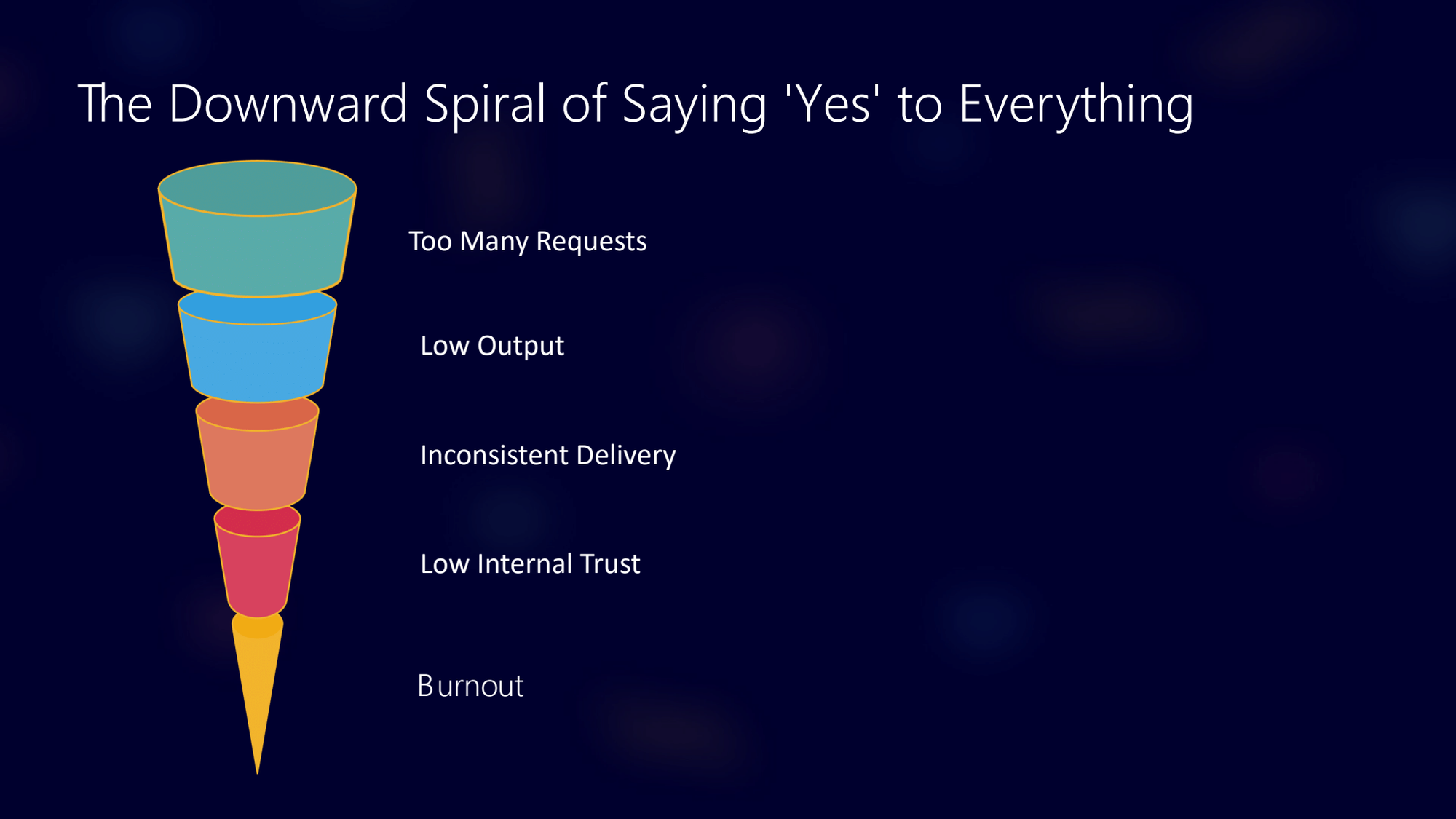
At the top, you have too many requests. When everything is a priority, output inevitably drops. Not because you’re bad at your job, but because you’re spread too thin.
Lower output leads to inconsistent delivery. You start missing deadlines or quietly deprioritizing work. You can’t hit all your yeses, so you start picking and choosing.
That’s when trust erodes. Stakeholders stop relying on you because they’re not sure what will actually get done. In the worst cases, product marketing gets ignored altogether.
And at the very bottom of the funnel? Burnout – for you and your team.
This spiral isn’t caused by a lack of effort. It’s caused by a lack of prioritization.
For expert advice like this straight to your inbox every Friday, sign up for Pro+ membership.
You’ll also get access to 30+ certifications, a complimentary Summit ticket, and 130+ tried-and-true product marketing templates.
So, what are you waiting for?
My prioritization framework
To break out of this cycle, I built a simple prioritization framework – one shaped by years of trial, error, and learning the hard way.
Step one: Build a request form
The first step is building a simple request form. It is hands-down the most effective way I’ve found to get rid of low-priority asks.
My intake form has around 15 questions: What do you need? Why? When? Who’s the customer? Who approved it? What OKRs does it tie to?
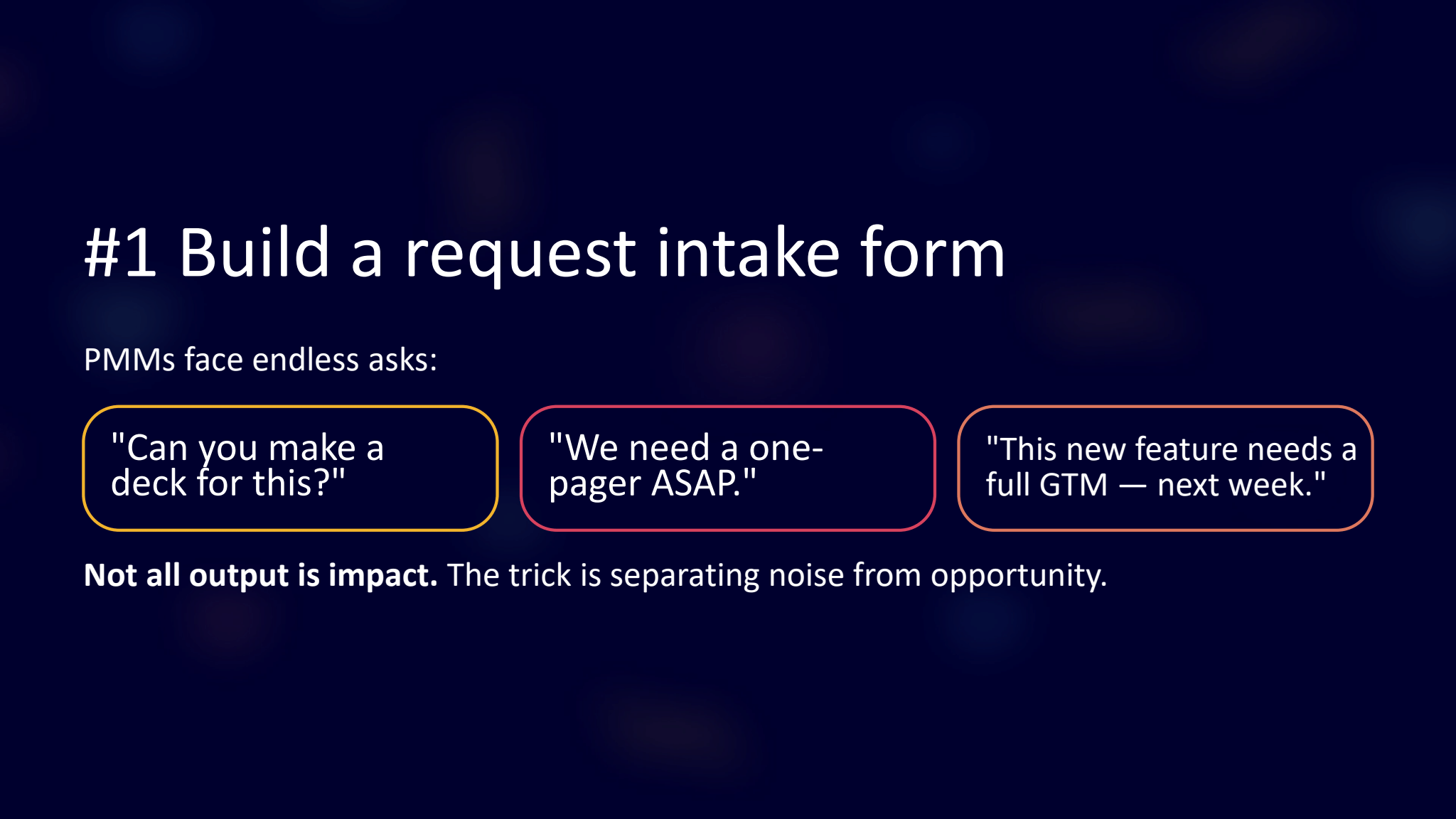
Any time someone Slacks me with, “Can you make this deck?” or “We need a one-pager,” I respond with, “Sure – fill out this form, and I’ll get back to you.”
Here’s the magic: most people don’t.
Just introducing the form filtered out about 50% of requests instantly. “Urgent” work stopped being so urgent when a little effort was required. My workload dropped by half, and my manager loved it.
I’ve also connected the form to our project management platform, so every request automatically becomes a task. At the end of each week, I can see exactly what has come in and make informed decisions about what to prioritize.
Step two: Filter out the noise
Once requests make it through step one, you’re still left with a pile of asks – and this is where things can still go sideways if you’re not careful. Step two of the funnel is about filtering out the noise.
Whenever a request comes in, I run it through four simple questions:
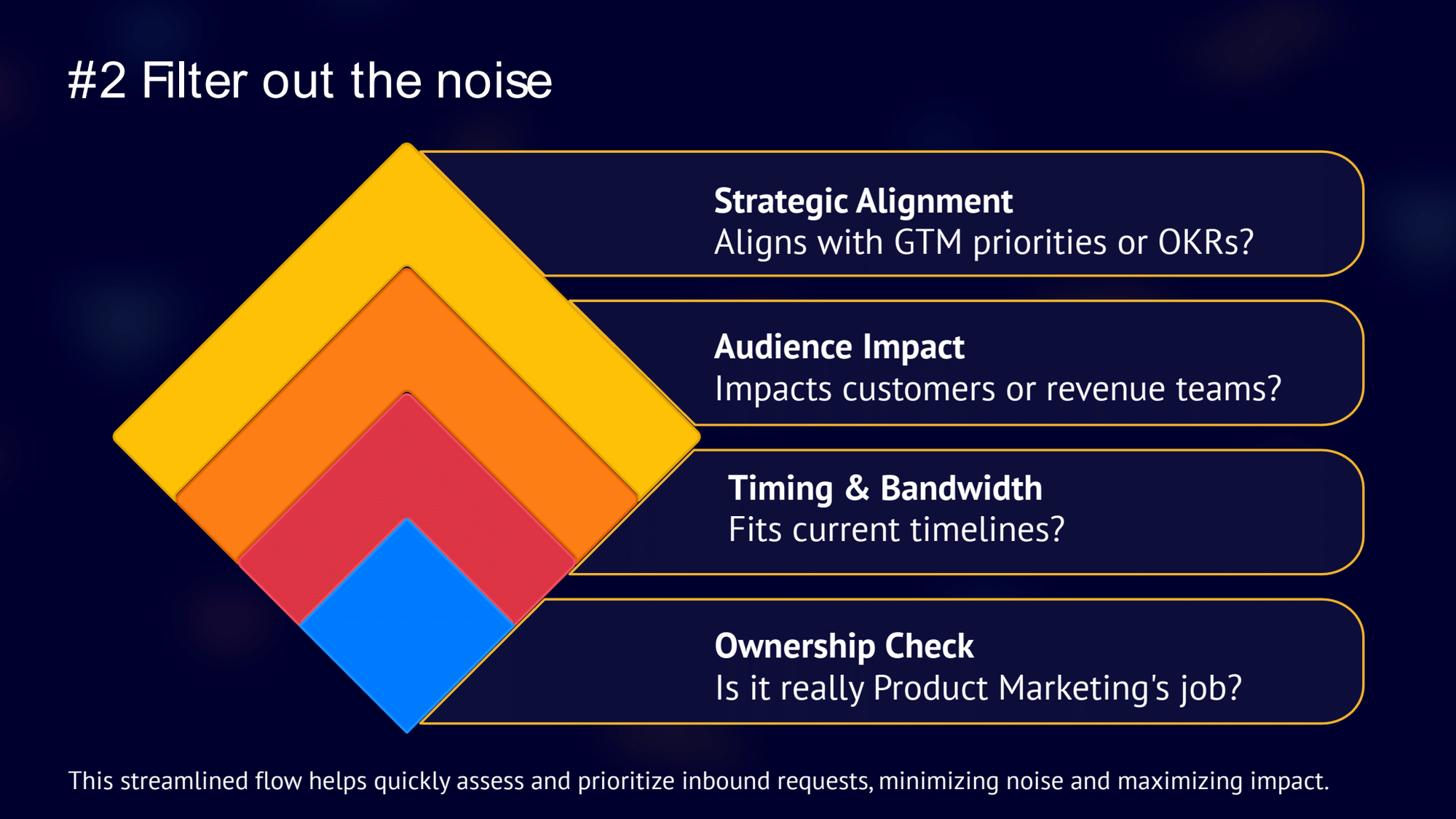
1. Does this align with our go-to-market priorities or OKRs?
First, I look for strategic alignment – and not just whether someone says there’s a metric attached, but whether it’s the right one.
For example, maybe a product manager asks you to plan a webinar, saying they want to drive adoption. In this case, you might ask why a webinar? Perhaps a video or some in-app guidance would actually be more effective.
This step is about pressure-testing the goal and the path to it, not just accepting the ask at face value.
2. Who does this actually impact?
Next, I think about audience impact. Does this affect customers or revenue? How many customers? How much revenue?
You won’t always have perfect numbers, and that’s okay. The goal is to force clarity on impact. Over time, you get better at estimating scale. Is this a one-off request for a single account, or work that could move ARR over the next few quarters?
3. Does this fit our timing and bandwidth?
Then there’s timing and bandwidth. Some requests are urgent but unrealistic. Others are doable – but only if something else gets deprioritized.
This is where opportunity cost really matters. Even if you can do the work, should you? Are you optimizing for the metric and impact that matter most right now?
4. Is this really product marketing’s job?
Finally – and this is my favorite – ownership.
I once had a salesperson reach out and ask me to recreate the sales deck for every industry vertical. My first reaction was, “Sure.” That’s what good partners do, right?
But then I stopped and thought about it. I’d already built a 40-slide sales deck and intentionally designed it like a Build-A-Bear. You pick the eight core slides, add the five or six that fit your industry, and you’re good to go. There was no reason for me to recreate the deck.
If I’d said yes, I would’ve been taking time, energy, and focus away from work that could actually move the needle – all to do something that didn’t really require product marketing in the first place.
This is where PMMs get into trouble. We default to yes because we want to be helpful, responsive partners. But not every request belongs with product marketing. Saying yes to the wrong work doesn’t just add to your plate – it quietly deprioritizes higher-impact initiatives.
That’s why this ownership check matters. It protects your time, your focus, and the work that actually drives impact.
Step three: Prioritize to maximize
By now, you’ve filtered requests down to a manageable list. The goal of step three is simple: prioritize in a way that maximizes impact. I do this with a simple quadrant.