


Templates, frameworks, and Claude Skills to pair with this playbook
- The product marketing skills pack – learn more here
- Positioning template
- Messaging framework
- Pressure-test your messaging template
- Positioning and messaging rollout checklist
Nail the skills
Last year, I repositioned four core products. I gave the marketing team campaign-ready messaging; they adopted it, and revenue grew year on year. Big ticks all around.
And yet, if you asked me to tell you exactly what the lift from that repositioning exercise was, I couldn’t. Six months of work, four products repositioned, and I couldn’t tell you the true impact beyond some top-line metrics I can’t fully claim credit for.
That’s the proof problem in product marketing, and I’d wager that you’re facing it too. In this article, I’ll show you how to tackle it.
Here’s a peek at what we’ll cover:
- Why adoption and revenue alone don’t prove that positioning worked
- The three judges every position has to survive
- What makes a position defensible and commercially true
- The proof chain, from claim through to signal
- Four pressure tests to run before you launch
Why adoption and revenue growth fall short as proof
Most PMMs go about halfway to proving the impact of positioning and messaging. We point to internal adoption and overall revenue growth, and we call that proof.
Think about the last quarterly business review you sat in. Someone probably said, “The launch drove adoption.” Maybe it was even you that said it. But nobody followed up with the questions that matter: adoption of what, compared to what, and because of what?
We’re very good at proving the work happened. The campaign shipped, the sales team was trained, the product page went live, and sales are up. What we rarely prove is what the positioning changed. Adoption isn’t attribution, and revenue isn’t proof.
In my case, there was no isolated signal. I couldn’t credit the repositioning for the lift, and I couldn’t have told you in advance what should move if it worked.
The three judges your positioning has to pass
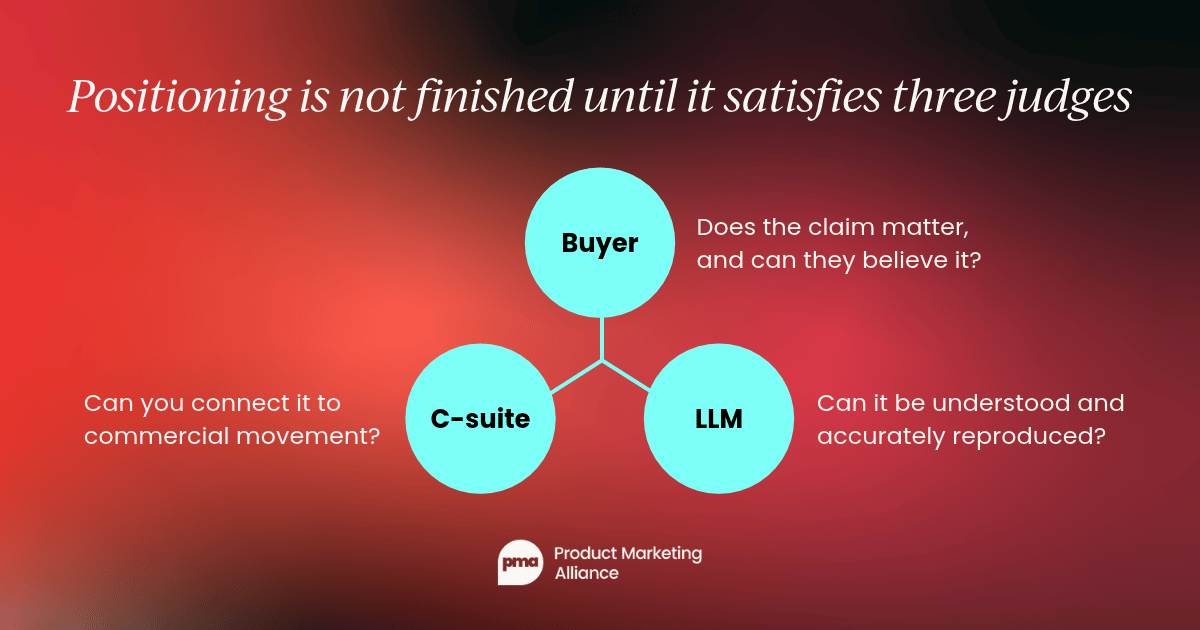
Positioning isn’t finished when legal signs off. It’s not finished when the deck goes out to sales. It’s finished when it survives three judging layers.
The first judge is the buyer, who asks two things at once. Does this claim matter to me, and do I believe it?
The second judge is senior leadership – the CEO, the CFO, or whoever holds the budget. They ask one question: did this move a metric I care about, and by when?
The third judge is the newest: LLMs. Buyers increasingly ask Claude, ChatGPT, or Gemini about your product before they ever read your website. LLMs don’t care about tone, clever copy, or a bold headline. They check whether your claim can be understood and repeated back accurately, and a model that can’t repeat your claim can’t recommend you correctly either.
Take a common claim like “we reduce time to value.” A buyer might find it relevant instantly and start to trust you. But when that buyer asks an LLM to compare vendors, will it credit you with reducing time to value, or lump you in with every vendor making the same claim because your evidence wasn’t distinct enough to read?
For your positioning to satisfy these three judges, you need to be able to answer the following four questions, which form the spine of this piece:
- What makes a position defensible?
- What makes it commercially true?
- What should move if it works?
- How do you prove the contribution?
These questions get progressively harder to answer. Most PMMs can handle the first. Far fewer can answer the last when a CFO puts them under real scrutiny.
For expert insights like this, in full, every Friday, sign up for Pro+ membership.
You’ll also get access to 30+ certifications, a complimentary Summit ticket every year, and 130+ product marketing templates.
So, what are you waiting for?
Question #1: What makes a position defensible?
When a buyer asks, “Should I trust this?”, they weigh relevance, confidence, trust, risk reduction, and whether they can defend the purchase internally.
When an LLM asks, “Can I summarize this confidently?”, it weighs specificity, consistency, repeated associations, evidence-rich claims, and clear category relationships.
A buyer trusts a claim for the same reason a model can summarize it: it’s specific, it’s said the same way everywhere, and there’s evidence behind it. Vague claims lose twice: with the buyer and with the LLM.
AI makes weak differentiation easier to see
Credit rating agencies provide a real example of poor differentiation. It’s a niche corner of financial services, and it’s been one of the least differentiated categories for twenty-five years or more. Now that everyone is using AI to write marketing copy, whatever thin differentiation was left is getting flattened even faster.
What stands out for buyers in that market is brand, reputation, and the human relationships behind the product. Those are also the only distinctive material left for an LLM to summarize when your product copy is weak. This holds even more in mature categories, where an established brand gives models more to lean on.


