Templates and frameworks to pair with this playbook
- Messaging framework
- Messaging cheat sheet
- Positioning and messaging rollout checklist
- Pressure-test your messaging template
- Storytelling framework
- Customer quote bank
Nail the skills
A few years ago, I wanted to quit product marketing. I remember one night having a conversation with my wife where I told her, “This job sucks. I kind of hate it.”
Here’s what had happened. After years in sales, I got into product marketing. I loved the idea of getting down to the brass tacks of what customers care about – doing the research, building the messaging, and moving the needle.
However, what I actually found myself doing was appeasing my boss. I’d have a good idea on how to market our product, then it would hit the approval process, and my boss would have certain ideas about what we should do instead. We had to use words like best in class, supercharge, and streamline.
My passion for the job started to wane. I told my wife I was thinking about quitting. She said, “Before you do that, talk to your mentor.” So I did. He told me flat out, “Of course you don’t like the job – you’re not actually doing product marketing. You’re writing for an internal audience.” It stung, but he was right.
That’s what got me obsessed with this topic: how to stop writing for your boss, push through your ideas, and create messaging that makes buyers care. In this piece, I’ll cover:
- Why B2B messaging so often sounds the same
- The two rooms every product marketer has to win with their messaging
- The tactics I use to get bold messaging past stakeholders
- How to write messaging that taps into feeling instead of features
- How to build creativity as a practice, not wait around for it as a gift
The unforgettable marketing campaign that almost never happened
Let’s take a trip back to the nineties for a second.
“Got Milk?”, created by an agency called Goodby, Silverstein & Partners, is one of the most successful ad campaigns of all time. At the time, milk sales were declining, in part because it was viewed as a kids’ drink. Goodby, Silverstein & Partners were tasked with reversing that trend.
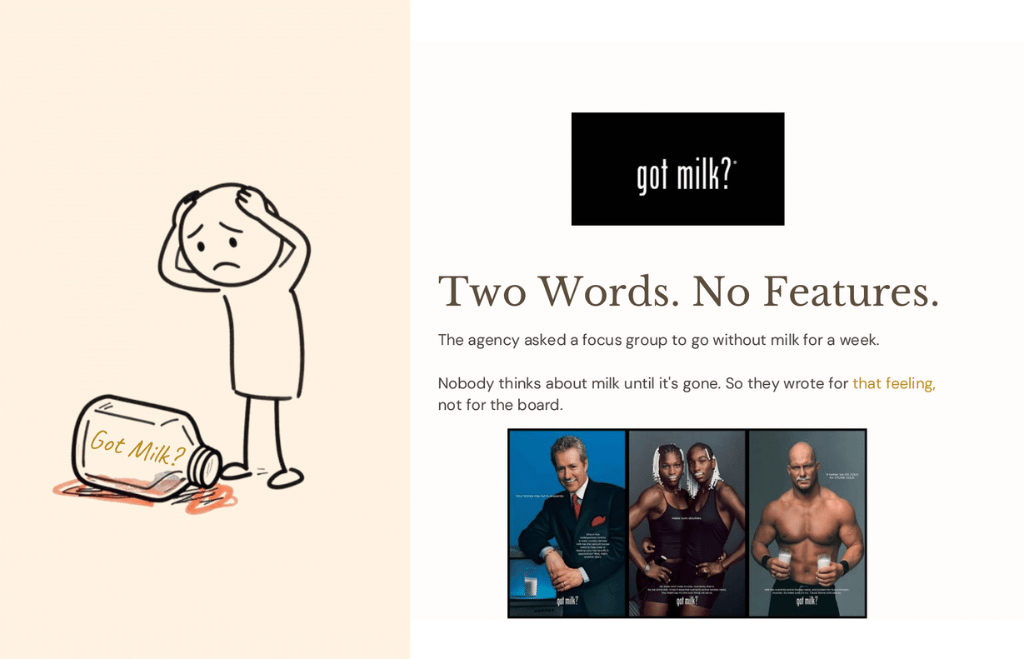
The agency ran a focus group and asked people to go without milk for a week. At the end of it, they asked how that felt. The answer was consistent: milk is essential, you never think about it until it’s gone, and then it’s frustrating.
The agency built a whole campaign around that insight. One ad has someone eating a peanut butter sandwich, trying to answer a radio trivia question for a big prize, and losing because their mouth is sticky with peanut butter and there’s no milk to wash it down.
It nearly didn’t happen. Inside the organization, there were real arguments. “Got Milk?” is grammatically incorrect, and the dairy industry was paying serious money for this campaign. But a few bold people pushed it through anyway, and it became one of the most successful campaigns ever. Why? Because it was written for humans.
For expert insights like this, in full, every Friday, sign up for Pro+ membership.
You’ll also get access to 30+ certifications, a complimentary Summit ticket every year, and 130+ product marketing templates.
This month only: Save with code SUMMER26.
Why B2B messaging falls flat
If you handed a typical B2B org the challenge of boosting declining milk sales, they would almost certainly lead with features, not feeling. Milk: it’s calcium, it makes you big and strong.
If they got as far as uncovering the insights that Goodby, Silverstein & Partners did, “Got Milk?” would go through a B2B approval process, come out the other side as “Got best-in-class, end-to-end dairy solutions at scale?” and quickly get forgotten.
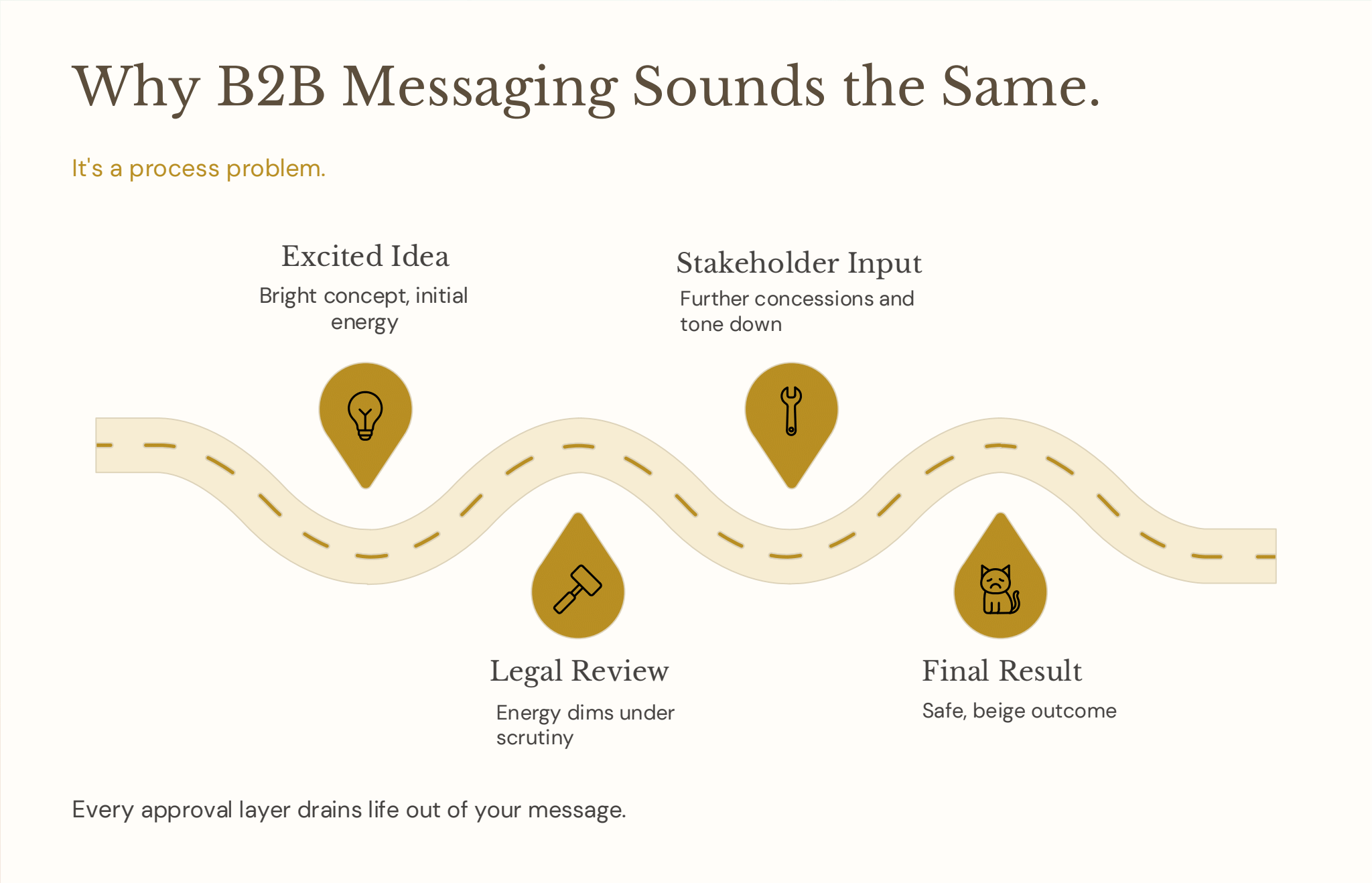
That’s the real reason B2B messaging tends to sound the same. It’s rarely a talent problem. It’s a process problem.
You come up with something bold, legal reviews it and tells you what you can’t say, stakeholders chip away at anything that makes them uncomfortable, and what comes out the other end is safe enough that it blends into the background.
The two rooms you need to win
When you write for the room instead of the buyer, three things happen:
- Sales ignores it – I was a seller, and if messaging from marketing felt bland, I’d do my own thing instead.
- Buyers forget it, because if every email in their inbox sounds the same, none of them stand out.
- You end up sounding exactly like your competition. That’s not only a brand problem. It’s a revenue problem.
So, if you want to be a good product marketer, you have to win two rooms:
- The internal room, where you push your ideas through approval.
- The buyer’s room, where your messaging actually has to land.
Most PMMs are good at one or the other. The ones who last are good at both. Let me show you how to get there.
Win the room: How to get bold messaging approved
We’ll start with the internal room, because if your messaging never survives approval, it never gets the chance to work on a buyer at all.
The good news is that stakeholders aren’t the obstacle you think they are. Once you understand what’s actually driving their pushback, you can work with it instead of against it.