Why your cost per acquisition (CPA) problem is a PMM problem
A lot of startup teams these days completely ignore product marketing. They think they can ‘paid media’ their way to success through brute force (and a lot of creative iteration).
The reason teams get drawn in this direction is that performance marketing works measurably (for a while). Early success makes leaders think they need to put more budget into performance, and that they will grow linearly as they scale spend.
I’ve seen this break down time and time again. Before long, performance marketing becomes inefficient. CPAs shoot up as you run out of early adopters, and the team is stuck wondering, “How do we fix our CPA?”
In this article, I’m going to tell you how this played out for us at Stakemate on the way to £5m MRR, and how product marketing was the key that allowed us to keep scaling spend efficiently.
Most importantly, I’m going to walk you through how you can convince your performance-obsessed organisation of the importance of doing good PMM work.
How do we fix our CPA?
When performance breaks down, people start pointing fingers and asking what the plan is to fix it. To answer this, it’s useful to start by asking: ‘What was working in the first place?’
Often, your marketing may have been really good at capturing early adopters, but the same product marketing that captured those early adopters won’t work on the next cohorts of users.
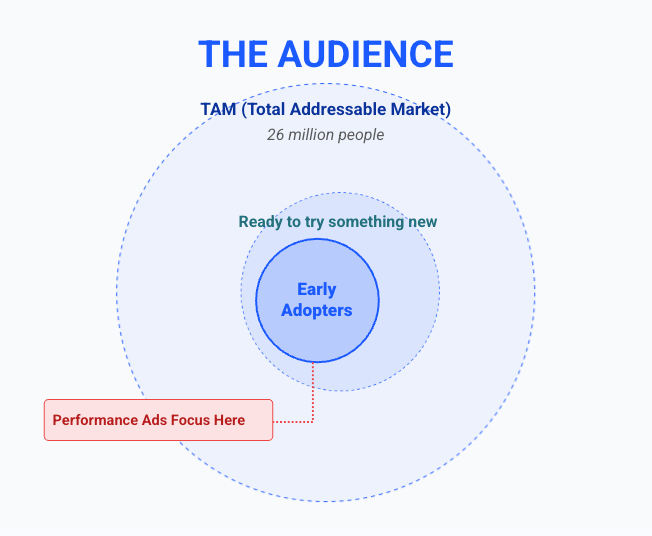
Only a small proportion of your TAM (total addressable market) is open to buying a new product. At Stakemate – a UK Gaming App – we estimated the total TAM to be about 26 million people. Of this number, something around 3-4 million might fall in the ‘early adopters’ category.
Once we captured a significant portion of this number, our CPAs shot up. We realised every incremental user would cost more, and importantly, the same message that worked for the early adopters simply would not work for the next groups of users. This meant we needed to properly understand our audience and adjust the product marketing strategy accordingly.
Understanding your audience’s skepticism
The reality is that users have different behaviours and beliefs, and the difficulty of capturing each progressive group of customers increases over time. But most importantly, the product marketing that worked for one cohort simply won’t work for the next.
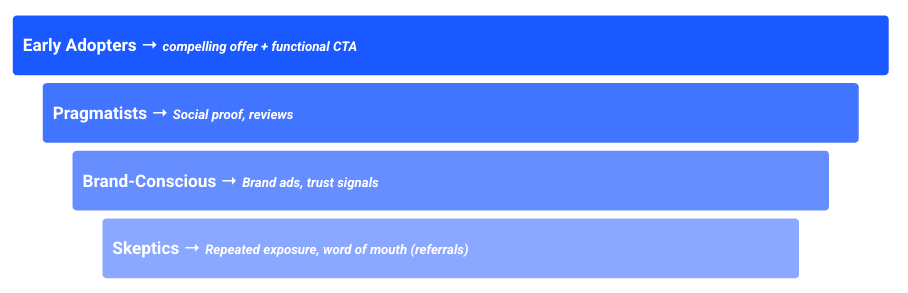
If you’re working in a performance-obsessed organisation where the performance marketing team is running around in circles trying to bring down acquisition costs, you need to ask the hard questions and help them see that the actual problem is the product marketing.
In this case, you should talk to your users. Reach out to customers who recently started using the product and send them a survey asking the following questions:
|
Questions |
Response type |
|
What did you think about [PRODUCT] before you decided to use it? |
Free text |
|
How many times did you hear about [PRODUCT] before you used it? |
1 (once) – 5 (many times) |
|
On a scale of 1-5, how much do you agree with this statement: “I need to make sure a company is legitimate and has a lot of users before I try out a new product”. |
1-5 |
|
How many similar products to [PRODUCT] did you use or have you tried? |
1 (none) – 5 (more than 3) |
|
Would you still be open to trying a new product similar to [PRODUCT] now? |
Yes/No |
Sum up the numerical responses to Q2 and Q3, then subtract the answer to Q4, and add another 5 if the user answered NO to Q5. This sum is your ‘Skeptic score’ – which ranges from -3 (early adopters) to 14 (skeptics).
Track your skeptic score over time; a rising score is evidence you’re moving out of early adopters (partly shows your strategy is working, and partly shows you’re running out of early adopters!).
The three pillars
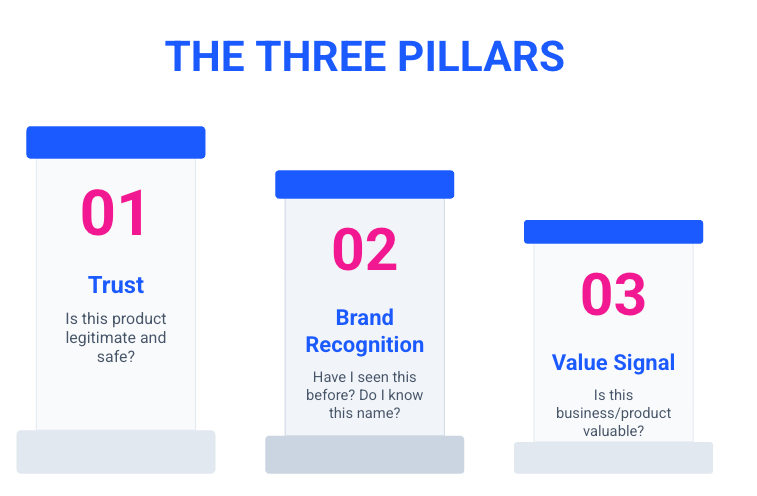
Looking at the audiences and the things they want to see, ultimately, your product marketing has to do three things really well to break past the early adopters and convince the skeptics:
Build trust
Users want to know your product will deliver on its promise, not leak their personal data, and most critically, keep their money safe (important in our category, or say, Fintech, where we deal with people’s money).
Drive brand recognition
As humans, we’re highly drawn towards things we’ve been exposed to and things that seem familiar. This is known as the mere exposure effect: I’m more likely to reach for a KitKat than a Tony’s Chocolonely because I’ve seen the KitKat logo everywhere since I was three.
Signal value
People want to use and buy valuable things. Not only valuable to them personally, but also perceived as being valued in society as a whole. This is why startups put out press releases announcing their raise rounds, or buy out Superbowl ads: to tell users, ‘hey, we’re valuable, use us’.
Convincing your team
To set about fixing this problem, you need to convince your performance-obsessed org (or finance department) that product marketing is important, and that you need to invest in building awareness for your product. To get the conversation started, ask your performance team three questions:
- Who are we reaching today, and are they still early adopters?
- What does our target audience have to believe about our product BEFORE they see our performance ads?
- Are we building those beliefs, or just spending more to say the same thing to the same people over and over?
Use the results of the surveys you sent above. The key lies in making them see that they’re not going to be able to optimise their way out of the CPA trap they’re caught in. Audiences beyond the early adopters are more risk-averse, and less likely to try new things off the back of a random ad they see online.
Redefining product marketing strategy
Once you’ve had the ‘we can’t scale performance infinitely’ conversation, it’s time to start answering the question ‘how do we fix our CPA?’ from a PMM perspective.
The answer usually lies in re-thinking the strategy using the three pillars. The simple fact is that the type of audience you’re targeting thinks differently compared to those early adopters.
This is why your PMM strategy needs include rebuilding your advertising as well as website landing pages and other assets to target the three pillars across the funnel, including by hammering in a unique, differentiated and distinct message, signalling trust and value as well as building your brand recognition.

At Stakemate, for example, we consistently had high Trustpilot ratings, and we realised this could help us hit a few of the pillars at the same time. So we asked influencers we worked with to do a comparison video comparing our rating to some competitors, and it became one of our most effective ads.

We also realised we couldn’t possibly get the exposure and visibility we needed just repeating a message that said “Download Now”. So we worked with influencers to create genuinely entertaining content that our target market would enjoy, co-branded with our brand assets.
PR also helped us reach our target audience through legacy media. This helped us create trust, visibility, and signal value (as well as drive some direct conversions).
How this played out for us
We saw CPAs grow by 197% over 3 months as we started to exhaust our early adopters. It took a lot of hard questions, but adapting our strategy, understanding our audience and rebuilding our product and brand marketing helped us to 7x revenue, 6x our active user base and decrease CPA by 29% over 6 months. This CPA decrease occurred despite a more than 600% increase in paid media spend.
A framework for scalable growth
Performance-obsessed teams tend to think they can ignore good PMM work and scale using performance ads only. They focus on looking for ‘the next winner concept’, or a media buying / channel strategy hack that will bring down their CPAs.
Hopefully after reading this you can see why that logic is flawed, how you can help your team see that, and what you can to do keep the business growing profitably.
Please let me know in the comments if these strategies helped you, and how you see your role as a PMM in performance-obsessed orgs.