
Recent progress in AI and the tooling around it is changing the economics of competitive intelligence. With a small upfront investment of time – and at very low operational cost – it is now possible to automate parts of competitive monitoring at scale, run workflows on a continuous schedule, and track a breadth of competitors that would be impossible to sustain manually.
The idea behind the Product Marketing Engineer approach is simple: processes that once depended entirely on manual effort can now be turned into systems.
Systems that run on a schedule, scale without proportional overhead, and keep delivering consistent output regardless of how busy the quarter becomes. And critically, most can be built with no-code tools rather than complex engineering projects.
Our orchestration layer is Make.com – intuitive and accessible without dedicated engineering support. If your team already uses Zapier or n8n, the underlying logic transfers easily. Each workflow sends structured data to Claude for analysis, with output delivered into Notion on a schedule.
These workflows are not intended to replace dedicated CI platforms like Crayon or Klue; they work best alongside them, extending depth and covering adjacent signals. For teams starting from scratch, they offer a practical entry point.
One design principle runs through all five workflows: the difference between a system that produces summaries and one that produces actual intelligence lies largely in how the questions are framed. Prompting is not a cosmetic layer on top of the workflow – it is where much of the analytical value is created.
Here’s the map.
1. “Tell me where you bid, and I’ll know who you really are”
A competitor’s website tells the story they want to tell. Their paid keyword strategy often reveals something more candid: where they are actually allocating budget, and therefore where they believe meaningful demand exists.
This workflow uses SpyFu’s API to pull paid keyword data into Make.com via an HTTP module, before passing it to Claude for analysis. Tools such as SEMrush support a similar workflow, though API access is typically more expensive.
The important part is not the keyword list itself, but the framing of the analysis. Rather than asking for a summary, the prompt asks what the overall pattern reveals: which intent categories the competitor prioritizes, where their paid acquisition strategy diverges from their public positioning, and – often most revealing – which strategically important terms they appear not to be investing in at all.
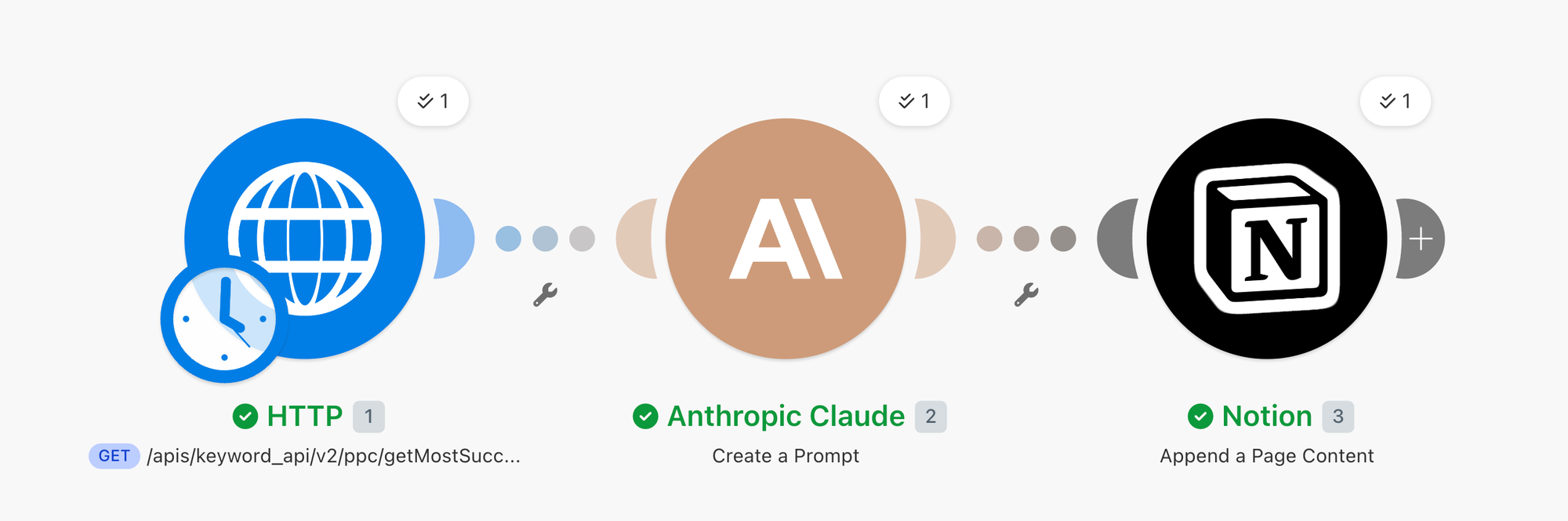
In one example, the system concluded that despite a competitor’s messaging around AI-powered product discovery, they were “not visibly investing in search relevance, site search, or AI-powered discovery” in their paid strategy. The resulting analysis writes automatically into Notion on a schedule.
2. “Tell me who I’m missing, and I’ll see the whole category”
Most PMMs work with a tiered competitor list. Tier 1 gets continuous attention. Tier 2 gets monitored occasionally. Everything else disappears until an unexpected name surfaces in a deal cycle, a funding announcement, or an acquisition that reshapes the landscape.
This workflow uses Apify actors – such as the Google News Scraper for competitors with active press coverage, or the Google Search Results Scraper for lower-profile companies – to pull results automatically into Make.com for analysis by Claude.
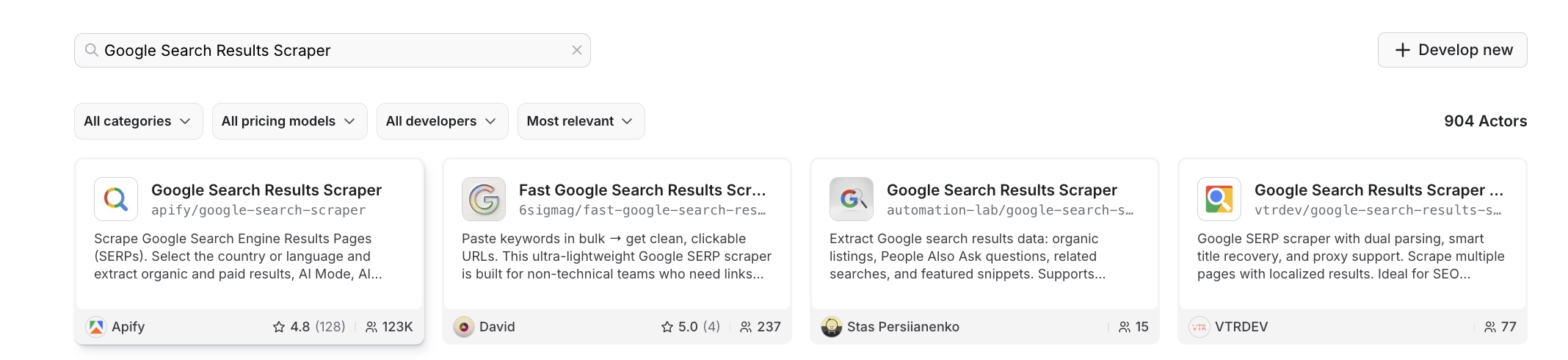
A second variation queries by category rather than by company name – for example, “enterprise search software” – and asks Claude to identify companies appearing in results that are missing from your existing competitor list.
In practice, this functions as an early-warning system for emerging players. The important shift is economic: once the workflow exists, the marginal cost of monitoring additional competitors becomes close to zero.
3. “Tell me where you fracture, and I’ll find our opening”
The most honest version of a competitor’s product usually isn’t found in their demo or on their website. It lives in the three-star reviews on G2: written by customers who broadly like the product but describe, often in detail, exactly where it breaks down.
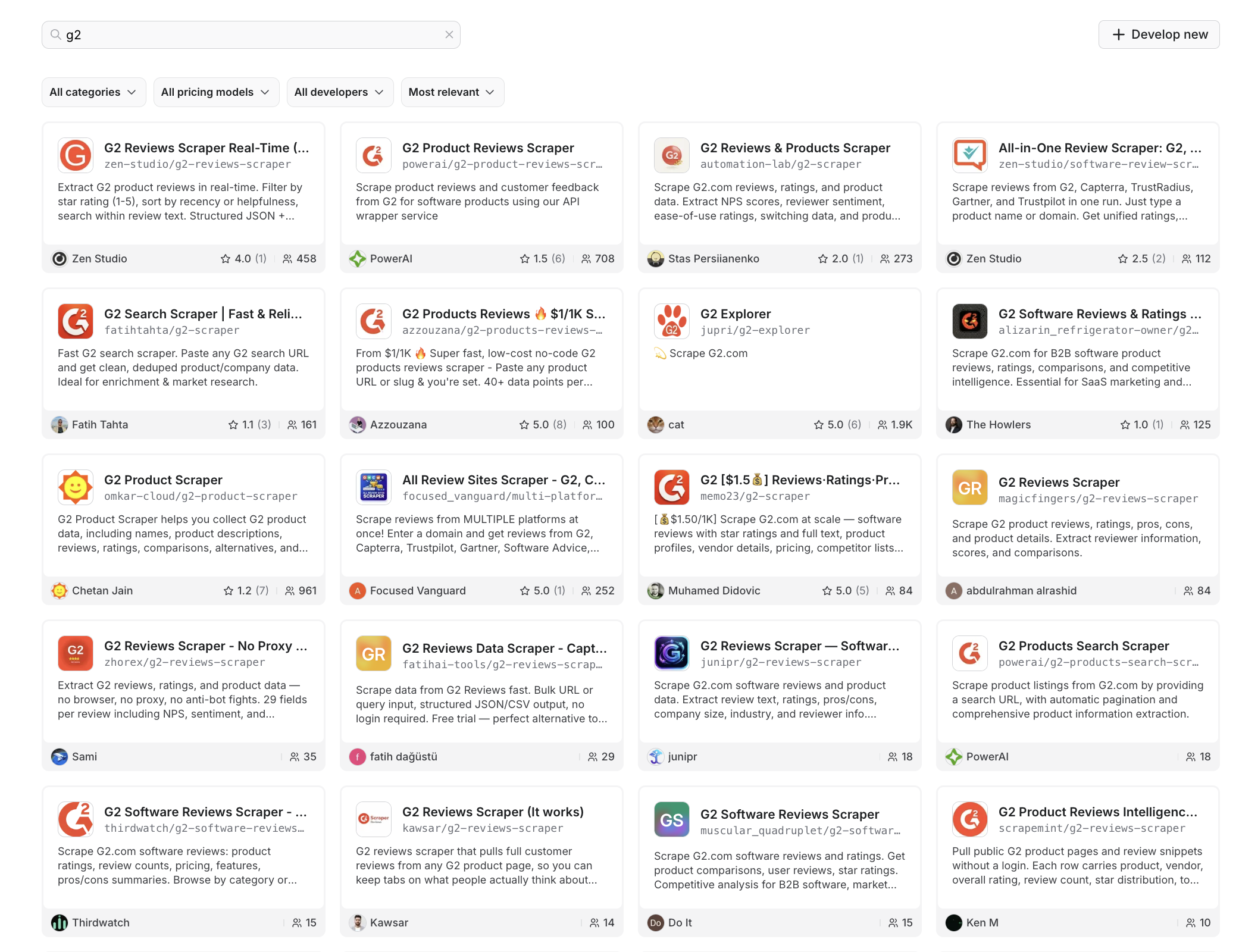
This workflow uses Apify’s G2 review scrapers to collect structured review data before passing it to Claude for analysis. A few practical choices improve signal quality considerably.
Restricting the timeframe to the past 12-18 months surfaces current sentiment rather than historical averages. Sorting by “Most Popular” prioritizes the reviews buyers are most likely to read.
Ironically, you may end up reading reviews to choose your review scraper – quality varies considerably across actors.
The key, however, is the prompt design. The workflow does not ask Claude for a summary. It asks for contradiction detection. Where does a company position itself as “easy to use” while reviews repeatedly mention usability friction? Where does “predictable pricing” appear alongside complaints that “costs spiral as you scale”?
In one run, the workflow identified pricing complaints in 12 of the last 20 reviews for a competitor whose positioning heavily emphasized developer simplicity. At that point, the output stops being a collection of observations and starts becoming the foundation for a battlecard. Cost per run: under $1.
4. “Tell me what you’re hiring for, and I’ll see what actually matters to you”
Job postings are a leading indicator. Before companies announce a strategic shift, they usually start hiring for it. Before they expand into a market, roles appear there. Before they quietly retreat, postings begin to disappear.
This workflow uses Apify scrapers for applicant tracking systems such as Greenhouse to collect structured job listing data – titles, departments, locations, posting dates – before passing it to Claude for analysis. The prompt treats hiring patterns as strategic signals.
- Which departments are growing?
- Which appear absent?
- What does a surge in GTM hiring relative to engineering imply about the company’s current phase?
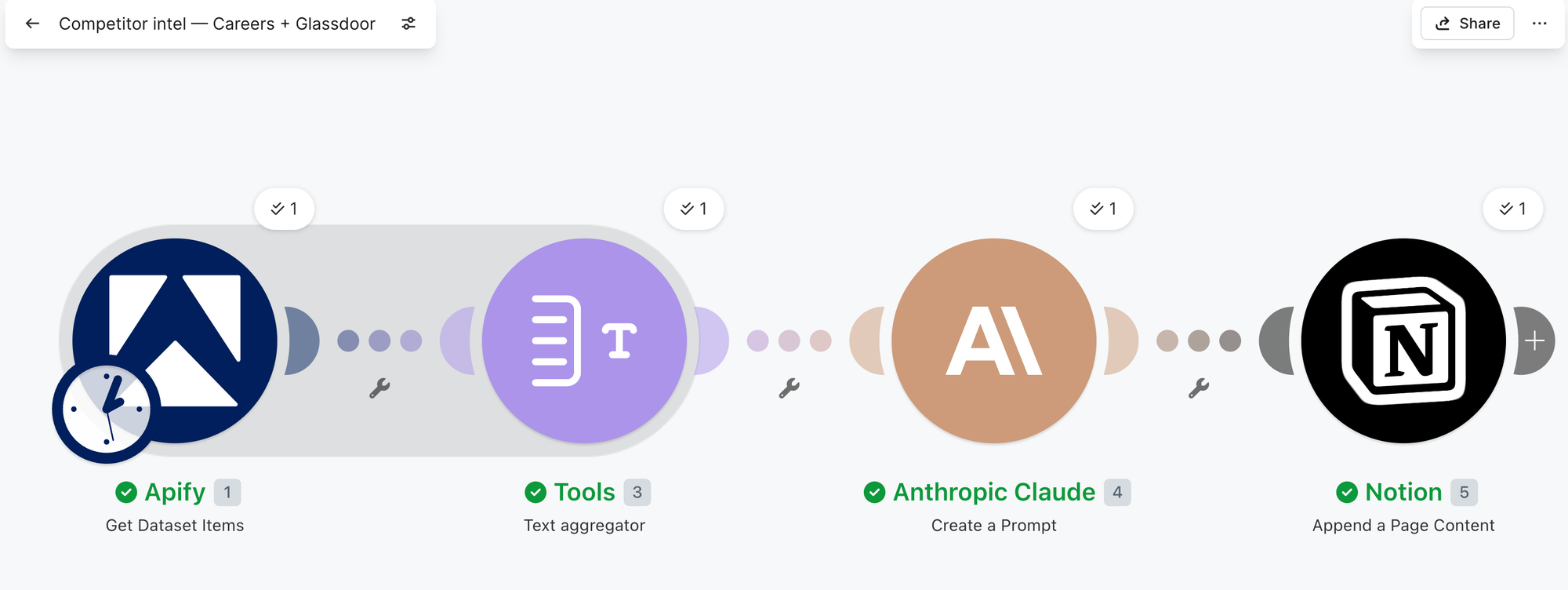
In one run, the workflow pointed toward a competitor entering a strongly revenue-oriented phase: London and Paris accounted for roughly 75% of open roles, while US engineering hiring remained limited. The inverse can be equally revealing. A competitor that quietly stops hiring in a region or function is often signalling something as well.
5. “Tell me how your employees feel, and I’ll see what your messaging conceals”
When a company is under internal pressure, traces of it often appear in employee reviews before they surface in official messaging. Leadership changes, strategic confusion, morale shifts, and frustration with product direction – these themes frequently emerge on Glassdoor in operational detail that external communications rarely provide.
This workflow uses an Apify Glassdoor scraper to collect review data filtered to the past 12–18 months, then passes it to Claude for analysis. The prompt identifies recurring themes across leadership, culture, product direction, and morale – and surfaces contradictions between external positioning and internal employee sentiment.
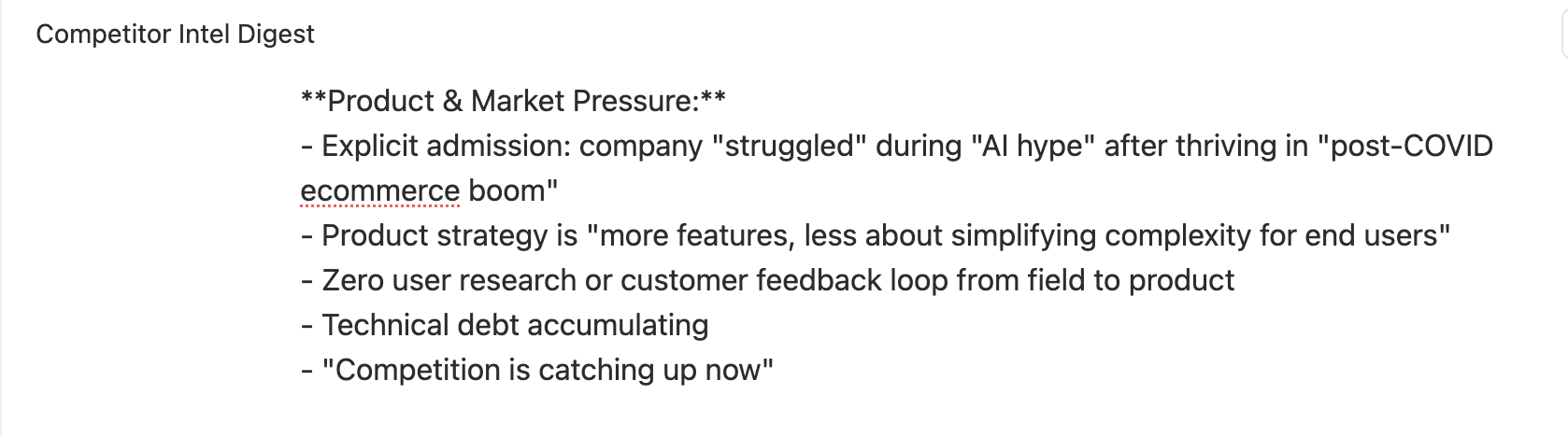
Employee reviews are noisy and emotionally charged. But repeated patterns across independent reviews can still become strategically useful signals – especially when they align with observations from customer reviews, hiring data, or market behavior elsewhere.
Note that the Glassdoor scraper runs at around $32 per month after a free trial – modest compared to a dedicated CI platform, but worth weighing against review volume for smaller competitors, where signal quality can be thin.
What comes next for competitive intelligence
Each workflow targets a different category of signal: commercial intent, competitive visibility, customer reality, strategic direction, and internal health. Individually, each source is partial. Together, they begin to form a picture that no single source – and no purely manual process – could maintain consistently over time.
The underlying architecture is simple. A data source feeds into Make.com, which structures and passes information to Claude for analysis. Output lands in Notion as a searchable, continuously updated intelligence layer.
These five workflows are only a starting point – the same pattern extends to monitoring competitor website changes, tracking messaging shifts, analyzing executive interviews, or comparing pricing language across landing pages.
What has changed is not the importance of competitive intelligence, but the economics of maintaining it. The cost of building and operating these systems has fallen low enough that continuous, broad coverage is now realistic for relatively small teams.
And the value compounds: not from any single workflow in isolation, but from convergence – patterns appearing across customer reviews, hiring behavior, paid strategy, and employee sentiment simultaneously.
Your competitors are already generating these signals. The advantage is no longer access to information. It’s the ability to build systems that continuously interpret it – before everyone else does.
Want to start? Workflow 3 – the G2 review analyzer – is the lowest-friction entry point: under $1 per run, immediate strategic output, and no engineering required. Build that one first, then layer in the rest.