Have you ever tried to go-to-market with something that no one seems to want? Of course, that is not the original intention, but it does happen.
Both well-known brands and not-so-well-known brands have bad launches. In fact, depending on the sector, analyst, and definition of failure…
anywhere from 80 to 95% of new products fail.
As product marketing managers (PMMs), it is hard to believe that happens. If we understand our buyers’ needs, then we should be able to use that knowledge to build our product pipelines and effectively communicate our marketing messages to ensure that our sales pipeline is filled.
The biggest shock is when you know you have a new, unique, and desperately needed solution, but the market does not seem to want it.
So, what is the problem? It could be anything – market saturation, biased research, buyer inertia, or lack of need, to name a few.
What is next?
Firstly, make sure your assumptions are not wrong by understanding, confirming, and/or leveraging that market need.
You can do that by revalidating your data, copying and improving someone else’s sales and marketing tactics, using early adopters and influencers, and/ or educating the market.
Re-validate your data
This process is not always easy, because it involves reflection and humility – and the PMM might not be the one struggling with this.
However, it is important to acknowledge how you determined market interest:
- Did someone internal tell you?
- Did you profile your existing customers?
- Did a third-party researcher come up with the recommendation?
The answers to these questions will help you figure out how to best move forward for your launch re-boot.
In general, it is always good to ensure you do not have biased and/or inaccurate data.
That means it is useful to perform more research with a fresh set of eyes: new interviewees, larger sample sizes, buyers who were not interested in your solution, more open-ended questions, new researchers, etc.
You want these fresh insights to better understand:
- What will make buyers want your solution and,
- If they decide not to buy, what are they doing/ using instead?
- How long will it take for them to be ready to buy?
Remember that this can still be a go/no-go decision. In other words, you do not have to relaunch the product until it makes sense.
Also, do not forget that you own the decision – no one else does. If your research tells you to change something, make sure the cost of making the change is worth the expected revenue stream(s).
One-offs are generally not a good idea because you want to be proactive, not reactive, and any product changes should lead to longer-term, macro wins. Ideally, the new research insights should help you adjust your campaigns and change your offerings to generate sustainable sales.
Copy and improve
If you know there is a market need, because your competitor is getting a lot of business with a similar offering, then it is time to learn from them.
Perform a thorough analysis of your offering with your competitors. List what everyone is doing and how well they are doing it; then compare those items on your list.
It is a simple table with competitors as columns, strengths/ weaknesses as rows, and low/ medium/ high as ratings:
|
Strengths/Weaknesses |
Competitor 1 |
Competitor 2 |
Your offering |
|---|---|---|---|
|
Brand awareness |
High |
Medium |
Low |
|
Product innovation |
Medium |
Low |
High |
|
Market agility |
Low |
Medium |
High |
When the table is completed, assess where you can uniquely stand out, decide what you can do better than everyone else, and then implement the items where you have a defensible advantage.
Leverage early adopters and influencers
If you have re-validated a need based on your own research or competitive analysis, but buyers seem to be hesitant because you are a new company or you are not well known, then you need to create a stronger, more immediate demand.
An effective way to do that is to have a third-party proselytize for you. If you have the budget, pay for the services of a PR agent or industry analyst.
If your budget is too tight to pay a third party, then promote a wide variety of testimonials, use cases, or case studies.
Use quantitative data whenever possible and directly quote from big brands or users with executive titles. Work aggressively on co-marketing with these companies and individuals – if you promote them, then they will promote you.
Also, make sure you know your audience, because some of these co-promotions might require incentives and others might not.
And remember, we are all incentivized differently, so you will see some companies offering nothing and other companies offering everything from coffee gift cards to CEO thought-leadership roundtables.
Educate the market
Sometimes your solution really is ahead of its time, which means you will need to bifurcate your resources into sales and marketing.
It is natural for everyone to focus on sales first and, from that perspective, make sure you have a formal pipeline to assess your attrition. Where are your prospects dropping off? If you are familiar with the marketing funnel, are they dropping off at the Awareness, Consideration, or Conversion stage?
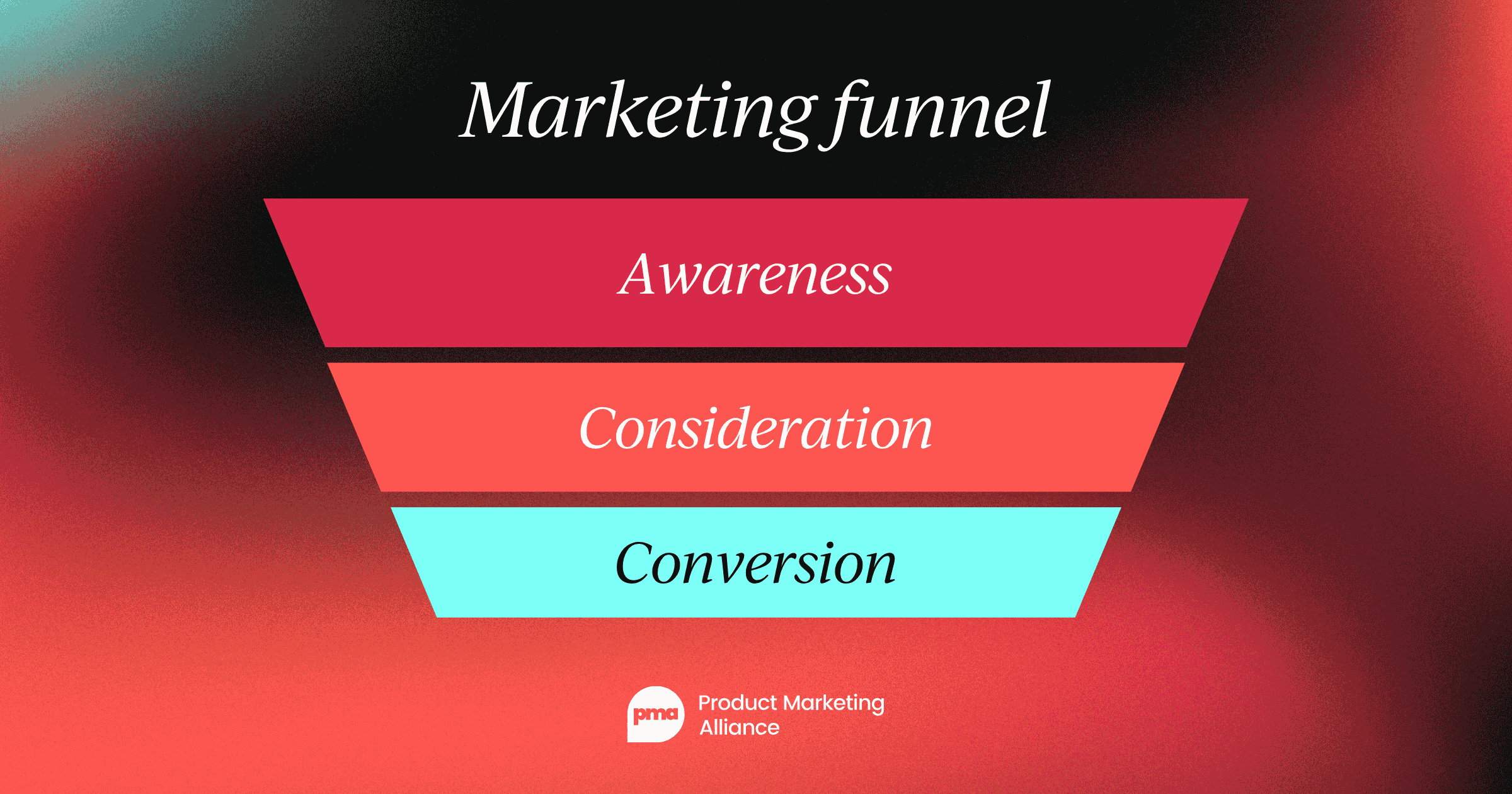
If buyers do not know who you are, then that lack of Awareness might not matter if you are solving a problem for them. Focus on a singular problem in a specific, lucrative market. Use consistent and prevalent messaging and try to only target prospects who have that problem.
If your drop-off happens at the Consideration stage, then you need proof that your company’s solution is solving those problems. Use those resonating soundbites from your heavy hitters – “These Big names used our solution, and they got these Big results.”
If your drop-off happens at the Conversion stage, then you need to look at product functionality and features. Invest in engagement programs and actively ask for user feedback.
For software users, utilize heat maps and A/B testing to improve the User Experience (U/X). Make sure your solution is as easy to use as possible. These days, if you think you need tutorials or manuals, then maybe your solution is not as intuitive as you thought it was, which could be to your detriment.
These sales initiatives will provide the revenue to fund marketing’s long-game of education to facilitate inbound interest. This requires patience and consistency, which is not always popular in our immediate-gratification world – but they do work!
The Cloud
A fitting example of market education is the Cloud. In the year 2000, most people thought about Clouds being related to weather. People who worked at Salesforce or Amazon, though, knew differently: These insiders knew that virtual web Cloud services were the wave of the future.
Around 2008, the general population still was not familiar with the Cloud, and, based on the growth of other Cloud solutions, IBM saw this as a strategic opportunity.
It wanted to add technology infrastructure to its product portfolio and realized its first step would be to educate the market. It launched its Smarter Planet commercials, targeted at consumers but focused on executives, so that the Decision Makers would be familiar with the value of the Cloud when IBM started selling it, thus reducing time in the buying cycle.
While these advertising campaigns were running, IBM researched Cloud technologies and eventually acquired Red Hat’s hybrid Cloud solutions in 2019.
That was a lot of time invested in market education, but IBM knew this was a long game, and they had a large and profitable portfolio to subsidize this education. At the time of the acquisition, IBM claimed that its investment would pay off within the first year.
Online interviewing
Sometimes, you can be ahead of technology, but you do not have the deep pockets to educate the market.
In 2012, WebEx was the commonly used video conferencing tool, Zoom was an up-and-comer, and there was no Google Meet. Around that time, this concept inspired a startup to integrate video conferencing with recruiting through an online interview platform.
The tool enabled employers to ask a handful of online interview questions, and the candidates would video-record answers as part of the first-round qualification process.
This made the screening easier for the employer, automated the feedback process to the candidates, and improved the quality of the hiring process for both employers and candidates.
In today’s environment, that company would have been highly competitive, but at that time, the idea was novel.
Plus, this was a few years after the dot-com bust, and there were more interested candidates than employers. Since the revenue model was based on employers as customers, the startup did not get enough traction and ended up pivoting its solution.
The company is doing well today; if this company had started a few years later, it might now be a household name because of the COVID-19 pandemic. This was all about timing, which you can’t always control.
Palm Pilot
Sometimes, being ahead of your time means launch, hold, and relaunch – and not necessarily with the same company or technology, like with the Palm Pilot.
Have you seen iPhone owners use NameDrop? Did you know it is a similar feature to one that the Palm Pilot used to have? You ask yourself, what is a Palm Pilot?
Well, in 1998, it was an innovative technology and had a NameDrop-like feature called Beaming. However, the Palm Pilot did not evolve quickly enough, and it was eventually sunsetted in 2011 – only for the feature to come back in 2023 on the Apple iPhone.
The Palm Pilot might have been behind the times in 2011, but its NameDrop-like functionality was not. It took ten years for that much-loved feature to come back around.
The future
Today, the advancement of product development is greater than ever with the advent of AI, because we are now able to aggregate and build on our successes more quickly than before.
More people will have access to information, and, inevitably, this means that technological solutions will be ahead of buyer readiness. It also means that there will be a lot of white noise, which is not great for PMMs.
To keep up with new-school needs, we are going to have to constantly reinvent our go-to-market plans by being faster and better with our old-school methodologies.
And, as fellow PMMs respond to AI with increasing go-to-market agility, we will need to remain focused on accurate market analysis, specific segmentation, and consistent prioritization.
This lends itself to Account-Based Go-To-Market strategies (a combination of Account-Based Sales and Marketing), which do not need to be overly sophisticated:
In the future, if we want to stay ahead of our buyers’ needs, PMMs will have to quickly intake all accessible information, use laser-beam focus to appeal to a narrower target audience, and be aggressive about keeping up with the increasing advancements in technology.
It is the smartest way to keep up with innovation and avoid product launch failures.