
I love data because it’s much easier to interpret data than people. However, data is generally meaningless without context. And in business, the data is especially meaningful when you have both the context and the trends.
Translate that into feedback surveys. If you want to sell something to people other than yourself, then it’s important to understand what those “real” buyers need.
Whether you’re selling a product, a service, or a new internal policy, if you want to see success, then you must ask the right questions, listen to the answers, and deliberately decide how to react.
Asking the right questions is the feedback you want. And if you listen well and respond appropriately, then you’ll be using your feedback to properly understand your responses and to hopefully improve your brand value.
That’s the relationship between collecting feedback and understanding markets. The feedback is the data, and the understanding is the context and trends.
A bad example
If you say that 100% of those surveyed think you have the best product ever, it’ll appear that you have a data-driven statement. However, what if:
- Only one person was surveyed.
- The person surveyed was the founder of the company.
You’d then have a different understanding of the claim, wouldn’t you? The data would not be statistically significant; the respondent would be biased; and your initial impression would have been wrong. So the data might be accurate, but your understanding wouldn’t be.
A good survey
A good survey starts with being clear about your objective. If you know what you want to learn from your data, then you can use questions that naturally flow and relate to your desired outcome.
You also need to know how much time you think you’ll have for your interview; it’s important to build to the critical questions without wasting time.
You don’t want to start with your most important question, especially if it’s sensitive, because you don’t want a negative initial answer to set the tone for all the other responses.
Lastly, make sure the targets want to take your survey. Your odds are better if you have a hot topic, offer to share the data/ insights, or provide some type of incentive.
With these guidelines, you’ll know that you’re going to get meaningful data, even if the survey taker isn’t chatty.
 Charley Gale
A good example
Here’s a survey example from a software company that primarily wanted to learn why their software was being bought, so they could improve their messaging.
Once the software was operational, the marketers verbally interviewed the client stakeholders. They figured they would get 5-15 minutes for their interviews.
Per below, they designed a survey with bold, italicized questions for a 5-minute interview, numbered questions for a 10-minute interview, and all questions for an interview for at least 15 minutes.
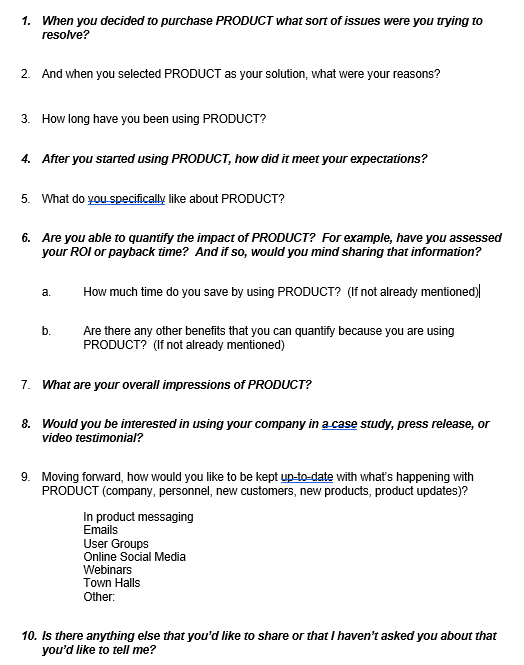
The first question was easy and open-ended (What issues were you trying to resolve?). If this were the only question answered, then the marketers had enough information to achieve their objective, which was understanding client pain points.
As the questions continued, based on the interviewee’s availability and interest, the marketers would get additional information for product development (How did it meet your expectations?), case studies (What is the ROI?), and engagement (How can we keep you up to date?).
Each question was important and built on the previous question, culminating in the most difficult request, which was for a case study interview. As you probably know, corporate approvals for public-facing documents are nearly impossible to obtain. So, a good warm-up has a much better chance of getting a positive response than a cold and direct ask.
 Amelia Wilson
Since the questions were all related, the data collected from the surveys was meaningful and immediately actionable in the follow-up and ongoing client communications.
The clients loved these immediate adjustments based on their inputs, which also provided positive reinforcement of the time they spent on the surveys.
Plus, they were more willing to participate in future surveys and more likely to provide candid feedback. Note that, in this case, the feedback loop was enough of an incentive for the client to make time for the surveys.
The entirety of this process is known as “collecting feedback”. It provides anecdotal value to the organization and, when used properly, can also be incorporated into premium customer service.
However, collecting feedback is only the first part of a robust survey process. That feedback can also be aggregated to get a more comprehensive understanding of the marketplace and market priorities, which can then be used for messaging and product development.
Trends
The new client survey discussed previously was a one-off feedback mechanism, but a client’s perspective can and does change. So, if resources allow, it’s ideal to have ongoing outreach to clients. When you do this, make sure:
- You’re not spending too much time on the administration of the surveys.
- Your client does not feel over-surveyed.
- Your team has enough time to incorporate the client’s insights into meaningful follow-up.
- The trends are reported and analyzed with responsive actions.
The key is to make sure that the survey work does not stop after collecting the feedback.
It’s invaluable to use that momentum to further assess the data and to understand the impact of the relevant market variables. These trends from surveys can be invaluable because they provide indicators to keep you ahead of market needs and expectations.
An ongoing survey
A popular survey to get a better understanding of client satisfaction is the NPS (Net Promoter Score). The NPS reflects whether someone would recommend your product to others on a scale from 1 to 10, where one is “hate” and ten is “love.”
The warm-up questions to this “ask” provide deep insights into understanding your market.
In and of itself, the score is telling, but equally important are the trends. Whether the score is flat, going up, or going down, your goal is to determine what to do to improve client satisfaction, so that your scores will get better.
These surveys are typically conducted annually, but, depending on the sector and budget, that frequency is adjustable.
An NPS example
A FinTech (Financial Technology) company used to take quarterly NPS surveys for its Help Desk services. These surveys were instrumental in understanding the impact of their work, and the company used the trends to adjust how it served its clients.
With a concerted effort over time, the company learned that, although the feedback was volatile, in general, their adjustments were working and the NPS score was going up.
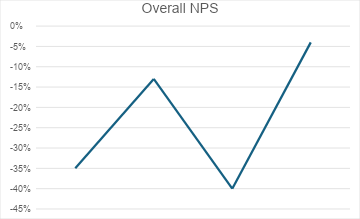
This program was successful because the company listened to the data. They learned that there were great NPS swings based on regions and client types/roles. So they improved their services by responding to their priority targets, which would have an impact on everyone:
- Help desk, e.g., establishing meaningful metrics and targets
- Regions, e.g., giving automated status updates based on the feedback from the US clients, which had the largest volume of users
- Influencable clients, e.g., improving response times to address the needs of the time-sensitive Hedge Funds and Traders
- Rankings, e.g., “we love you” campaigns to convert the passives (7-8) to promoters (9-10)
Note that the adjustments didn’t address the needs of smaller volume sectors, like the clients in Asia or in Bank Trading Systems, or the needs of the always unhappy cynics in the Help Desk or Tech Support roles.
These people would have needed a lot of investment for minimal satisfaction improvement. So the ROI was not there, and this was an acceptable tradeoff for the company.
In a highly competitive market, the NPS surveys provided data and understanding that enhanced the ongoing value and revenue of the organization.
Ten years later, it merged with another cloud-based company to further improve its end-to-end service offering, and the company is still regarded as one of the top services in the financial space.
Market feedback
Feedback comes in many different ways. A backhanded comment is always welcome as one point of data, to handle as you’ll based on the source and the cause.
Getting lots of comments from a survey is even more useful because you know the context of the problems; if there are common problems, then you can decide if there is value in addressing them.
The pièce de résistance is when you roll up your data, look at the trends, and use that information to proactively address the market.
That is the evolution of transforming survey feedback into market understanding, whether you’re comprehensively using feedback from clients, prospects, or employees.
Running a successful business depends on these types of inputs, and the resulting analysis and responses help ensure that you’re as proactive as possible. It’s an impactful way to make the most use of the information you’re receiving.