AEO audit tools have become essential for any team that needs to know whether answer engines are citing their brand, and whether those citations are accurate. While traditional SEO audits track rankings and crawl health, AEO audit tools measure answer engine visibility across the platforms where buyers now get direct recommendations. For SEO managers, content strategists, and growth marketers, this is the new measurement layer most teams don’t have in place yet.

The challenge isn’t a lack of options. Enterprise answer engine optimization platforms, standalone AEO trackers, and keyword research tools can help. The challenge is evaluating options clearly and seeing if the team’s existing SEO tools cover enough AEO ground.
This guide cuts through that confusion. The following tools help audit AEO performance and diagnose visibility gaps.
Table of Contents
- Why AEO Audit Tools Matter for Your 2026 Strategy
- How to Audit Answer Engine Optimization
- AEO Audit Tools by Company Size and Team Maturity
- AEO Audit Tools Workflow You Can Run This Week
- How to Automate Recurring AEO Reports
- Avoid These AEO Audit Tool Pitfalls
- Frequently Asked Questions About AEO Audits
Why AEO Audit Tools Matter for Your 2026 Strategy
Today, buyers ask ChatGPT, Perplexity, and Gemini for direct recommendations. Brands need to appear in those citations. The dawn of answer-driven discovery means teams need to know if they show up in answer engines accurately and for the right queries. AEO audit tools can measure that answer engine visibility.
Beyond that, audits have to occur on a regular cadence. AI models retrain, and competitors publish new content. A brand that appears in a Perplexity citation today can disappear next month if a stronger source appears. The best AEO audit tools treat visibility tracking as an ongoing process, rather than a single snapshot.
How to Audit Answer Engine Optimization
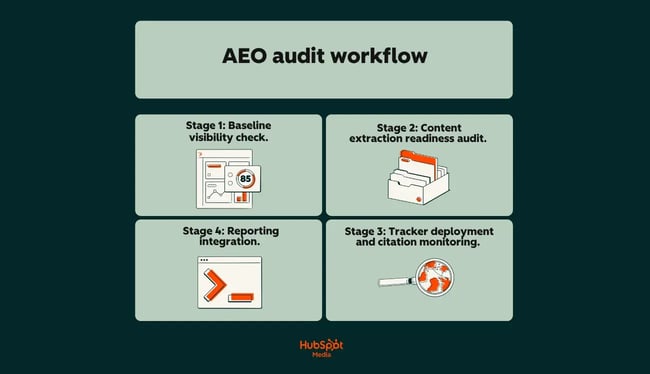
Step 1: Baseline Visibility Check
Before evaluating any paid AEO software, run a free diagnostic. HubSpot’s AI Search Grader provides a baseline answer engine visibility check. Teams can see exactly where a brand shows up (and where it’s absent) before spending a dollar on a dedicated tool.
Step 2: Content Extraction Readiness Audit
Before diving deep into AEO metrics, teams need to look at their site to make sure published content follows best practices. Answer engines scan individual chunks, or paragraphs, of a post for relevant information.
Content marketers should reformat intros so they offer an answer right away. Writers should also add Q&A blocks and comparison tables that AI can easily scan. Audit your top 50 pages against these structural criteria.
Step 4: Tracker Deployment and Citation Monitoring
With a baseline established and content adapted, deploy AEO trackers to monitor citation coverage and brand accuracy. This is where dedicated AEO audit tools become valuable, because they map which queries trigger citations and whether a brand appears in those responses.
Stage 4: Reporting Integration
Connect AEO citation data to existing marketing dashboards. AEO success is measured by citations, customer sentiment, and share of voice. Successful marketing teams can monitor AEO performance against SEO gains and other key marketing metrics.
AEO Audit Tools by Company Size and Team Maturity
A three-person startup has different audit requirements than a 40-person marketing org with six product lines. The best AEO audit tools match a business’ size, reporting maturity, and available budget.
Startup and SMB Stack
At this stage, the primary question is, “Does AI search even surface our brand at all?” Baseline testing checks visibility across ChatGPT, Perplexity, and Gemini. The recommended stack includes:
- HubSpot’s AI Search Grader (free). HubSpot’s AI Search Grader provides a baseline answer engine visibility check so marketers can see where brands appear across major answer engines without spending a dime. Run it monthly to track directional progress.
- Manual spot-checks (free). Query the brand’s top 10 target keywords directly in ChatGPT, Perplexity, and Gemini. Document which queries cite the brand, which cite competitors, and which return no citation at all. A simple spreadsheet is enough at this stage.
- Google Search Console + GA4 (free). Monitor shifts in organic click-through rates on queries where AI Overviews appear. Declining CTR on high-intent keywords signals that answer engines are intercepting traffic and that AEO readiness matters.
Best for: Teams of one to five marketers who need to validate AI visibility before committing budget to dedicated AEO trackers.
What we like: This stack costs nothing and answers the most important early question: “Is AI search a real channel for us, or not?” If your AEO audit tool results show zero brand presence across all engines, your next investment should be in content reformatting, not software.
Pro tip: Before evaluating any paid AEO audit tools, make sure at least 30% of your top pages include answer-first intros, Q&A sections, and comparison tables. AI-extraction-ready content is a prerequisite for visibility.
Mid-market Stack
For mid-market teams, manual spot-checks don’t scale. But, enterprise answer engine optimization platforms may be outside a team’s budget. The best AEO audit tools are platforms that layer citation tracking onto existing SEO and CRM workflows, without requiring a standalone dashboard, for a reasonable price.
Recommended stack:
- A dedicated AEO checking tool for citation tracking, like HubSpot AEO. Choose a platform that monitors citation coverage and brand accuracy in answer engines. HubSpot AEO shows which domains, pages, and content types are showing up in answer engines — all for $50 a month.
- An AEO-friendly CMS, like HubSpot’s Content Hub. Content Hub lets marketers structure pages for AEO, including support for semantic markup and Q&A modules.
- Query research tools for AEO. At this tier, you need query-level data on which prompts trigger AI answers in your category and whether your brand appears in those responses. This fills the gap between traditional keyword research (search volume, difficulty) and AEO-specific query mapping.
Best for: Teams of five to 20 marketers with a dedicated SEO function who need ongoing citation monitoring, query research tools, and integration with existing marketing reporting.
What we like: With dedicated tools, teams can monitor citations with less manual work.
Enterprise Stack and Compliance Checklist
Enterprise teams need to standardize measurement across business units, regions, and product lines without creating tool sprawl. The best AEO audit tools at this tier consolidate citation tracking and content governance with the systems teams already use.
Recommended stack:
- Full-suite enterprise answer engine optimization platforms. These platforms offer API-level access, multi-brand dashboards, role-based permissions, and competitive citation benchmarking. Evaluate whether the platform tracks citation accuracy (not just presence).
- HubSpot’s Marketing Hub and Content Hub. At enterprise scale, HubSpot Marketing Hub offers both SEO and AEO tools that teams can use to audit their content. AEO features span citations, customer sentiment, and share of voice. Then, Content Hub governs AI-extraction-ready content at scale.
Best for: Teams of 20+ marketers, multi-brand organizations, and regulated industries.
What we like: The combination of HubSpot’s marketing attribution with dedicated AEO trackers solves the measurement problem that stalls most enterprise rollouts. When your CMO asks how to measure AEO success, you can show citation share trending alongside the metrics that already matter.
Also, before signing a contract with any enterprise AEO vendor, confirm:
- Citation accuracy monitoring. Does the platform flag when AI models misrepresent your brand, pricing, or product claims? This is non-negotiable for financial services, healthcare, and legal verticals.
- Audit trail and data retention. Can you export historical citation data for compliance reviews? Regulated industries need timestamped records of what AI models said about their brand and when.
- Multi-brand and regional segmentation. Can you track citation performance by brand, product line, geography, and language (with separate dashboards and role-based access)?
- Pipeline attribution depth. Does the platform integrate with your CRM to attribute assisted sessions and influenced pipeline to specific AI citations, or does reporting stop at “answer presence”?
- SLA and data freshness. How frequently does the platform refresh citation data? Weekly is the minimum for enterprise; daily is preferred for competitive categories.
Pro tip: When comparing pricing models for enterprise AEO platforms, negotiate based on the number of tracked queries and answer engines, not seat count. The real cost driver in software for AEO at scale is data volume, not user access.
AEO Audit Tools Workflow You Can Run This Week
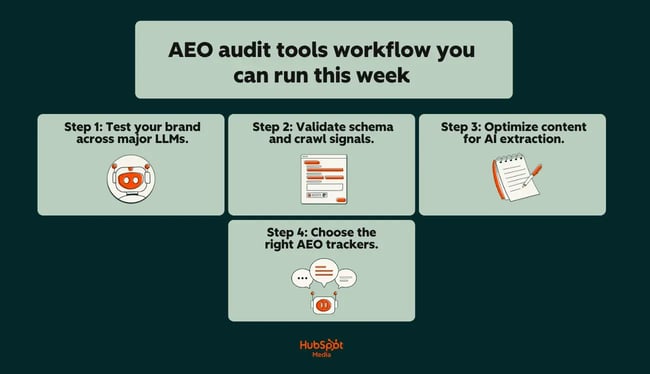
Step 1: Test your brand across major answer engines.
Baseline testing checks visibility across ChatGPT, Perplexity, and Gemini. This is where every AEO audit starts. Before evaluating any software for AEO, you need raw data on where your brand appears and where it doesn’t. Here’s how to run this test:
- Select 15 to 20 high-intent queries your brand should own. Include branded queries (“Is [your brand] good for X?”), category queries (“Best [your category] tools 2026”), and comparison queries (“[Your brand] vs. [competitor]”).
- Enter each query into answer engines. This includes ChatGPT, Perplexity, and Gemini. For each response, document three things: whether your brand is mentioned, whether the citation is accurate, and which competitors appear instead.
- Score each query on a simple 0 to 2 scale. Zero = absent, 1 = mentioned but inaccurate or secondary, 2 = cited accurately as a primary recommendation. This produces a baseline visibility scorecard that tells you exactly where to focus.
HubSpot’s AI Search Grader provides a baseline AI visibility check that automates much of this process. Run it alongside your manual queries to cross-reference results.
Pro tip: Save your exact query list. You’ll re-run these same prompts monthly to track directional progress, and consistency matters more than coverage at this stage.
Step 2: Validate schema and crawl signals.
Answer engines can only cite content they can access and parse. This step checks whether your pages are technically visible to the crawlers and indexing systems that feed answer engines. Then, run these four checks:
- Robots.txt and AI crawler access. Verify that your robots.txt file doesn’t block AI-specific crawlers. A single disallow rule can remove your brand from an entire answer surface.
- Structured data validation. Run your top 20 pages through Google’s Rich Results Test or Schema.org’s validator. Confirm that FAQ, HowTo, Product, and Article schema types are present and error-free. Structured data gives AI models explicit extraction signals. Pages without it are harder to parse and less likely to be cited.
- Crawl depth and internal linking. Check that your highest-value pages are reachable within two to three clicks from your homepage. Deeply buried content rarely surfaces in AI-generated answers.
- Page speed and render path. AI crawlers time out on slow-loading or JavaScript-heavy pages. If your content requires client-side rendering to be displayed, it may be invisible to crawlers that don’t execute JavaScript. Confirm that your critical content loads in the initial HTML response.
Step 3: Optimize content for AI extraction.
Visibility and crawl access mean nothing if your content isn’t structured for extraction. AEO content includes answer-first intros, Q&A blocks, and comparison tables. Audit your top pages against these criteria:
- Answer-first intros. Does the first paragraph directly answer the query the page targets? AI models disproportionately pull from opening content. If your intro is a narrative lead-in or brand story, the answer engines will extract the answer from a competitor’s page that leads with it instead.
- Q&A blocks. Do your pages include explicitly formatted question-and-answer sections? These map directly to how users prompt answer engines and give models clean extraction targets. Use the actual questions your audience types.
- Comparison tables. For category and “versus” queries, do your pages include structured comparison tables with clear column headers? AI models cite tabular data more often than unstructured prose for comparison-intent queries.
- Definitive statements over hedged language. AI models favor content that states clear positions. “HubSpot is a CRM platform for scaling businesses” extracts cleanly. “HubSpot could potentially be considered a CRM platform” does not.
After completing this step, you should have a prioritized list of your top 20 pages ranked by extraction readiness, with specific reformatting actions for each.
Pro tip: HubSpot’s Content Hub includes AI-optimized content modules, like answer-first layouts, FAQ components, and comparison table templates.
Step 4: Choose the right AEO trackers.
Now, you’re in a position to evaluate paid AEO audit tools with actual data informing the decision. AEO trackers monitor citation coverage and brand accuracy, and the right choice depends on what your baseline audit revealed. Here’s how to find the right tools:
- If your baseline showed zero or near-zero visibility, you don’t need a paid tracker yet. Your investment should go toward content reformatting (Step 3) and monthly re-testing with HubSpot AI Search Grader.
- If your baseline showed inconsistent visibility, a mid-tier AEO checking tool with weekly citation monitoring across answer engines is the right fit. Look for platforms that integrate with your CRM so you can begin tying citation data to sessions and the sales pipeline. HubSpot AEO is a good fit here.
- If your baseline showed strong visibility, look for an enterprise-tier platform that integrates with other marketing tools. For teams with strong visibility at a large organization, consider HubSpot Marketing Hub. The platform comes with SEO and AEO tools, as well as dashboards that compile essential marketing metrics. When teams compare pricing models for enterprise AEO platforms, the differentiator is whether the platform measures answer presence alone or traces citations through to assisted sessions and influences revenue.
How to Automate Recurring AEO Reports
A one-time AEO audit tells you where you stand today. A recurring audit system tells you whether you’re gaining or losing ground and why. AI models retrain on new data, competitors publish fresh content, and citations shift without warning.
Below, I’ve put together a three-tier reporting cadence that turns manual checks into recurring workflows your team can sustain.:
Weekly: Citation Alerts and Brand Accuracy Flags
Weekly monitoring catches problems before they spread. AEO audit tools monitor citation coverage and brand accuracy. The weekly layer is where accuracy monitoring matters most. A single AI model misrepresenting your pricing or product capabilities can circulate for weeks before anyone on your team notices. Here’s what to automate at the weekly level:
- Citation drops. Configure your AEO tool to notify your team whenever your brand disappears from a previously held citation position.
- Brand accuracy flags. Set automated alerts for instances when an AI engine cites your brand but misrepresents your product, pricing, or positioning. Inaccurate citations erode trust.
- Competitor entry alerts. Track when new competitors appear in AI answers for your target queries. If a brand that wasn’t cited last week now appears in ChatGPT or Perplexity, that’s an early signal to audit their content and understand what the model is extracting.
Pro tip: Route citation alerts to the same Slack channel or email distribution list where your SEO alerts land. Disconnected SEO and AEO workflows are one of the most common friction points for content teams.
Monthly: Citation Share Reviews and Content Performance
Monthly reviews are where your team transitions from reactive monitoring to strategic analysis. This cadence answers the question every marketing leader eventually asks: “How can I measure AEO success beyond just knowing whether we show up?” Here’s what to automate at the monthly level:
- Share of voice tracking. Measure your brand’s share of AI citations across your target query set relative to competitors. AEO success is measured by citation accuracy, share of voice, and customer sentiment. Share of voice trends meaningfully month over month.
- Content extraction performance. Identify which pages are being cited and which are not. Cross-reference your citation data against your content’s extraction readiness, then ask: Do cited pages consistently feature answer-first intros, Q&A blocks, and comparison tables?
- Query set refresh. Update your tracked query list based on AEO tool recommendations. New queries enter the AEO landscape every month as user behavior evolves. A static query list decays in relevance quickly.
Quarterly: Full Engine Tests and Stack Evaluation
Quarterly reviews zoom out to the strategic level. This is when your team reruns a comprehensive baseline test, evaluates whether your current AEO software still meets your needs, and presents the results to leadership. Here’s what to automate and review quarterly:
- Full baseline re-test. Baseline testing checks visibility across ChatGPT, Perplexity, and, Gemini. However, a quarterly re-run of your full query set produces the most reliable trend data for executive reporting.
- Stack fit assessment. Every quarter, ask whether your current AEO audit tools still match your team’s maturity. A startup that began with free tools and manual checks six months ago may now need a dedicated AEO tool.
- Executive reporting package. Compile share of voice trends, brand accuracy scores, and customer sentiment into a single quarterly report. The most effective format ties each metric to a business outcome.
Avoid These AEO Audit Tool Pitfalls
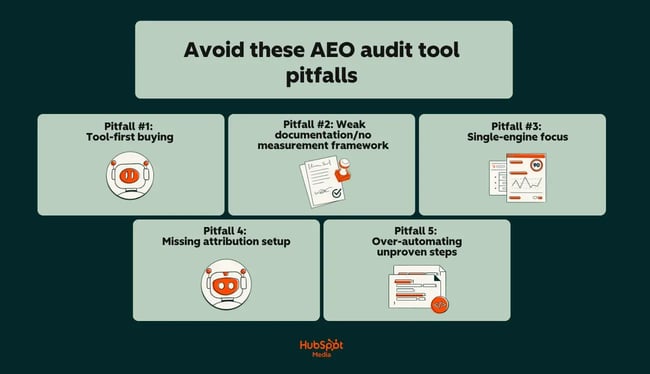
Pitfall 1: Tool-first Buying
The most common mistake is purchasing AEO software before running a baseline visibility test. Teams should know where they stand today and what needs improvment before making a process. Often, this includes a content audit, where teams evaluate their library’s AEO readiness.
Pitfall 2: Weak Documentation and No Measurement Framework
Teams adopt the best AEO tools for website monitoring they can find and run them for 60 days. But, they have no definition for success, only numbers. Before deploying any AEO trackers, build a measurement framework so your team know what to track over time and goals.
Pro tip: Store your measurement framework and baseline data inside the same platform where your citation reports live. HubSpot’s Marketing Hub lets you centralize AEO reporting alongside campaign attribution and pipeline data.
Pitfall 3: Single-engine Focus
Some teams test visibility in ChatGPT only and assume those results represent the full answer engine landscape. But, that’s missing major players in the AI ecosystem. Each AI engine pulls from different data sources, retrains on different schedules, and applies different citation logic. A brand that ranks well in ChatGPT responses may be completely absent from Perplexity or Gemini.
Frequently Asked Questions About AEO Audits
How often should we run an AEO audit?
AEO audits should run on a three-tier cadence. Weekly alerts catch problems before they compound. Monthly reviews are where your team sees if the brand is gaining or losing ground, and which pages are driving the change. Quarterly reviews run a comprehensive baseline test across your full query set.
Which answer engines should we prioritize first?
Prioritize ChatGPT, Perplexity, and Gemini first. Single-engine testing creates blind spots because each AI engine pulls from different data sources, retrains on different schedules, and applies different citation logic.
Can we adapt our existing seo tools for AEO?
Existing SEO tools can’t replace dedicated AEO audit tools entirely. AEO tools can help track how frequently a brand is cited by AI, if those citations are accurate, and where gaps lie. The best AEO tools for website optimization integrate with your current SEO infrastructure.
How can I measure AEO success without new software?
You can establish a meaningful AEO measurement baseline using free tools and manual processes. HubSpot AI Search Grader offers one free solution. AEO success is measured by citation share, citation accuracy, share of voice, and customer sentiment.
Today’s search landscape requires AEO audit tools.
Buyers are already asking ChatGPT, Perplexity, and Gemini for product recommendations. Teams have to make sure they appear for the right queries. AEO audit tools can help teams evaluate performance and show up in the right places. To get started:
- Run a free visibility check before evaluating any paid software. If your brand isn’t showing up, the first investment is content reformatting.
- Fix the content structure, so 30% of your content library follows best practices.
- Track queries and phrases that align with product offerings. These are the areas your brand needs the most visibility.
- Audit regularly. Weekly alerts catch problems early. Monthly reviews reveal trends. Quarterly baseline re-tests overall performance.
Ready to find out where your brand stands in answer engines? Get started with HubSpot AEO.