Understanding your ideal customer is the key to crafting high-converting marketing strategies. But how do you identify who they are?
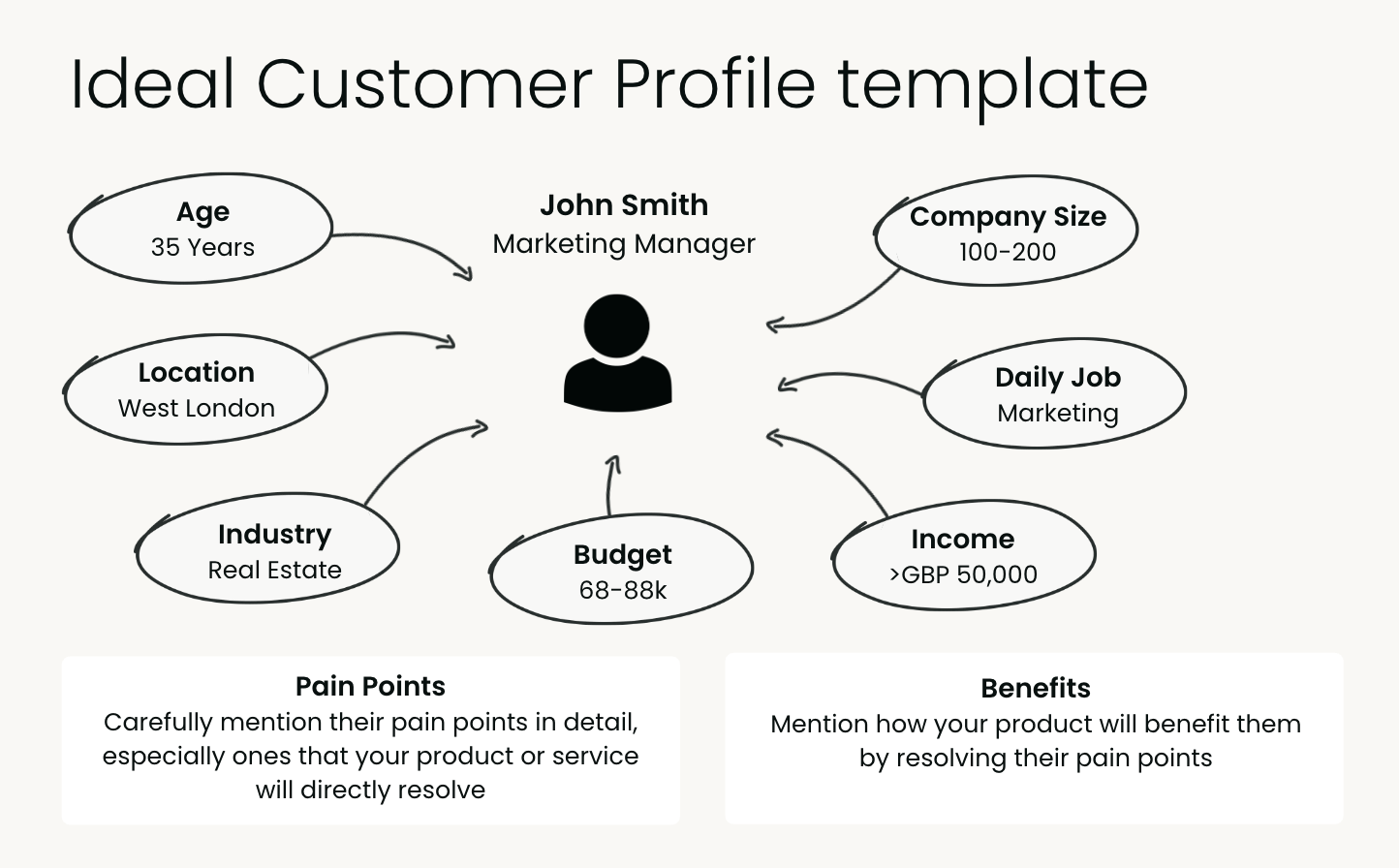
Our ideal customer profile (ICP) template provides a structured framework to help you define and document your most valuable customers – so you can tailor your messaging, refine your targeting, and align sales and marketing efforts.
What is an ideal customer profile template?
An ideal customer profile template helps you define your best-fit customers – the ones who gain the most value from your product or service and, in turn, drive the most revenue for your business.
It includes details like:
- Demographics (job title, company size, industry)
- Pain points (challenges your product directly solves)
- Budget & buying behaviors (how they make purchasing decisions)
- Tech stack & decision-makers (tools they use and who influences buying)
By clearly mapping this out, you can improve lead qualification, optimize marketing campaigns, and drive higher conversions.
Who is it for?
This template is designed for:
- Product marketers refining their go-to-market (GTM) strategy
- Sales teams focusing on high-value leads
- Growth teams optimizing customer acquisition
- Founders & startups defining their target market to scale efficiently
How to use the template
A strong ICP is based on data, not just gut feeling. Here’s how to research, define, and apply your ideal customer profile using this template:
1. Analyze your best customers
Start by identifying the customers who bring the most value to your business—those who renew, refer others, or have high engagement. Look for trends in:
- Industry
- Company size
- Job roles
- Buying behavior
2. Conduct customer research
Talk to your existing customers through interviews or surveys and ask:
- What problem were they trying to solve when they found your product?
- What alternatives did they consider?
- What made them choose you?
3. Use data & analytics
Leverage CRM data, website analytics, and sales insights to spot common characteristics among high-value accounts. Consider:
- The industries that convert the fastest
- The average deal size of your most successful customers
- Pain points they commonly mention
4. Identify pain points and decision-making factors
Your ICP should reflect the challenges your ideal customers face. Think about:
- What’s driving their need for your product?
- Are they switching from a competitor?
- How do they justify the purchase internally?
5. Complete the template
Use your research insights to fill in the template with:
- Demographics – Job title, industry, company size
- Challenges & pain points – What they struggle with and how your product helps
- Buying behaviors – Who makes the decision and what influences them
- Tech stack – The tools they already use
6. Align with your sales & marketing teams
Your ICP should be a shared resource. Make sure sales, marketing, and customer success teams are on the same page to improve lead qualification, refine targeting, and drive revenue growth.
ICP FAQs
What’s the difference between an ICP and a buyer persona?
An ICP describes the type of company or account that gets the most value from your product, built from firmographic and behavioral data. A buyer persona describes an individual person within that company, built from their role, goals, and pain points. You typically need both: the ICP tells you which companies to target, and the persona tells you who to talk to once you’re there.
Can you have multiple ICPs?
Yes, and most companies with more than 1 product line or market segment do. It’s common to have a primary ICP for your core product and secondary ICPs for adjacent segments or newer offerings. The risk is spreading yourself too thin, so most teams cap it at 2 or 3 well-defined ICPs rather than trying to serve 5 or more at once.
How often should you update your ICP?
Review it at least once a year, and revisit it sooner after any major shift: a pricing change, a new product launch, or a noticeable change in who’s actually renewing and expanding. An ICP based on 2-year-old data can quietly steer your targeting in the wrong direction long before anyone notices.
What data do you need to build an ICP?
At minimum, firmographic data (industry, company size, revenue) on your best-performing accounts, pulled from your CRM. The strongest ICPs also include behavioral data (how these accounts research and buy) and direct customer interviews to capture the pain points and goals that firmographic data alone won’t show you.
Who should own the ICP within a company?
It varies, but it’s most effective when sales and marketing leadership build it jointly, since sales has the account-level reality and marketing has the research and positioning context. Product marketing often facilitates the process even when they don’t formally own the final document.
Download your ideal customer profile template