Every product marketer is sitting on more evidence than they will ever have time to read.
The win/loss calls from the last two quarters. Every G2 review. The competitor pages you keep meaning to audit. Three years of your own decks and one-pagers.
The raw material is all there, but the time it would take to read across it isn’t, so a lot of PMM calls are made on gut instinct instead of proof.
Claude Fable 5 changes this. It holds your entire evidence base in a single run and reasons across all of it, which turns a week of reading into an afternoon.
So this edition is practical: what Fable 5 is, the six pieces of reading-heavy PMM work it makes worth doing, and a free pack to run them.
What is Fable 5?
Fable 5 landed on June 9. It’s Anthropic’s most capable model right now, built for heavy, complicated thinking rather than quick everyday tasks. Two things make it different from the models you use day to day.
It can read an enormous amount at once
Its context window (how much it can hold in its head in a single session) is 1 million tokens. That’s roughly 750,000 words, or a few thousand pages.
So you can hand it every sales call transcript, all your reviews, your entire website, and a stack of competitor pages, and it holds all of it at the same time and connects across the whole pile. The everyday models make you feed material piece by piece, and they start forgetting the early pages by the time they reach the end. Fable doesn’t.
It thinks harder by default
It’s tuned for demanding reasoning, so it works the material and draws connections rather than skating over the surface and handing back a tidy summary. For “read all of this and tell me what I’m missing” work, that depth is the whole point.
The catch is that Fable is expensive and slower than the everyday models. It runs about $10 per million words of input and $50 per million out, so a near-full evidence base can cost real money in a single run.
That’s a feature, not a bug, for how you should think about it.
Fable isn’t your daily drafting model. It’s the one you reach for a few times a quarter, for the big evidence-heavy jobs that were never worth a human’s week of reading.
Which is exactly the work that keeps getting put off.
Where the bottleneck sits
Writing the battle card, the positioning doc, the launch plan – that can be a day’s work once you know what goes in it.
The hard part is the reading and research that comes first: the synthesis nobody has time for, so it gets skipped, and the asset gets built on the three data points someone happened to remember.
Fable is built for that reading. So I packaged the six jobs it handles best into a free, open-source set – the PMM Signal Pack.
Each one points at a pile you never have time to read across, where holding the whole thing at once is the difference between a real finding and a lucky guess.
And every skill holds one rule: each finding points back to the exact place in your material it came from – the line between real synthesis and a machine handing you a plausible doc.
What’s in the PMM Signal Pack
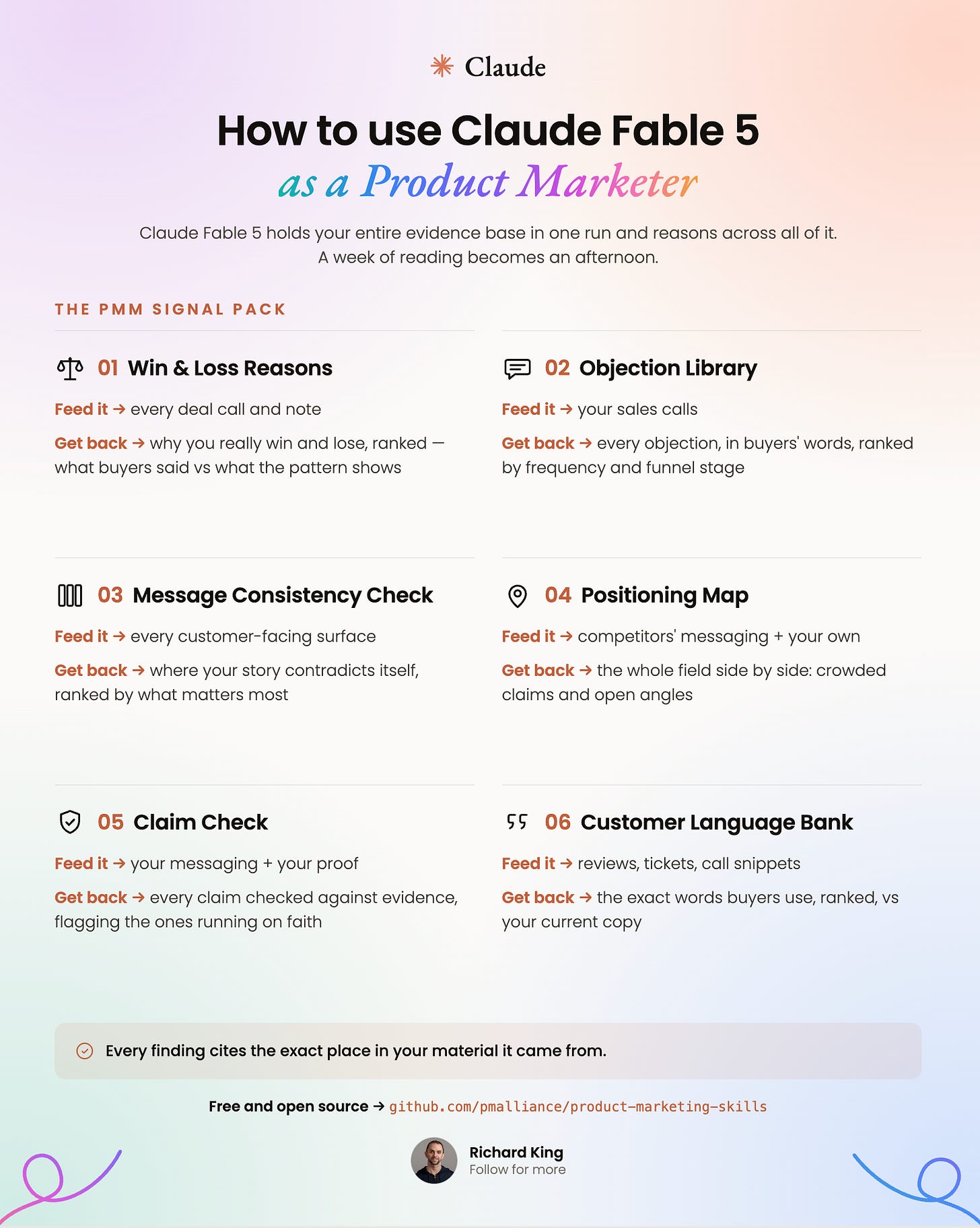
1. Win and loss reasons
Feed it every deal call and note from the last couple of quarters. It comes back with the real reasons you win and lose, ranked by how often each shows up, and it separates what buyers said out loud from what the pattern across many deals reveals was really going on.
Price gets named in the loss; the transcripts show the deal turned on a missing integration raised in the second call. One deal is an anecdote. The same reason across nine deals is a finding.
2. Objection library
Feed it your sales calls. It returns every objection buyers raise, in their own words, ranked by how often it comes up, and tagged to where in the funnel it lands – not the three objections your team happens to remember from last week.
3. Message consistency check
Feed it every customer-facing surface you ship: homepage, sales deck, pricing page, one-pagers, nurture emails, ads.
It finds where your core story says different things in different places, and sorts the mismatches by which surfaces matter most. No one person ever reads all of that side by side, which is why messaging fractures after a launch or a reposition.
4. Positioning map
Feed it your competitors’ public messaging alongside your own. It lays the whole field out together – how each player frames itself, where everyone is crowding onto the same claims, and which credible angles nobody is taking. Looking at one competitor at a time hides the pattern. Seeing them together is what shows you where the room is.
5. Claim check
Feed it your current messaging plus your proof: reviews, case studies, call transcripts, data. It pulls every claim you make and checks whether anything in the evidence backs it, flagging the ones running on faith. These are the claims a skeptical buyer probes, sales can’t prove, and legal won’t sign off on.
6. Customer language bank
Feed it hundreds of reviews, tickets, and call snippets. It returns the exact words buyers use for their problem and the outcome they want, ranked by how often each shows up, mapped against your current copy so you can see where you’re writing in the boardroom’s language instead of theirs.
None of these are new PMM ideas. What’s new is that you can now do all of them properly, against everything you have, in an afternoon.
I’ve compiled all of this into a clean asset for you to save and share:
How to get it
The pack lives in the same GitHub repo as our original Product Marketing Skills Pack, in its own pmm-signal-pack folder – so one repo now holds both. You don’t need the first pack to use this one.
To install:
- Go to the repo, click Code, then Download ZIP, and unzip it
- In Claude, open Customize → Skills and add the six
.skillfiles from thepmm-signal-pack/.claude/skillsfolder - Type / in any chat and all six show up
Already running the original Skills Pack? Same steps – just add these six alongside the ones you’ve already got.
On Claude.ai Projects instead? Upload the same .skill files into your project. Same skills, different surface.
One practical note: these jobs are built for Fable’s large context, but they aren’t locked to it. Each skill carries a fallback – run it on an everyday model in smaller batches and merge the results. You lose a little cross-set nuance and keep the method. So the pack stays useful whether or not you’re running Fable that day.
Fable can read your whole evidence base in an afternoon.
What it can’t do is notice that the integration gap buried in call twelve is what stalled three deals, or that the objection your reps keep shrugging off is the one costing you the quarter.
It hands you the material. Seeing what matters in it is still your job – and it’s the part you’re good at.
So point it at the pile you’ve been meaning to get to. There’s a good chance the answer you’ve been guessing at has been sitting in there all along.