

Most product roadmaps look convincing from a distance. They show major capabilities, planned releases, and a logical progression from an initial product to a more mature offering. The boxes are arranged neatly across quarters, and each release appears to build on the one before it.
Then the team begins the detailed work. A feature that looked independent turns out to require a data capability that has not been built. A future release depends on an architectural decision the team planned to defer. A seemingly simple workflow requires supporting components across the user interface, application logic, integrations, data, and testing layers.
Suddenly, the roadmap is not as sequential as it first appeared. This is a common challenge in complex, software-intensive product development. The roadmap may correctly describe the outcomes the organization wants to deliver, but it does not always reveal what must be true beneath those outcomes for the proposed sequence to work.
A two-level vertical slicing model can help address that gap:
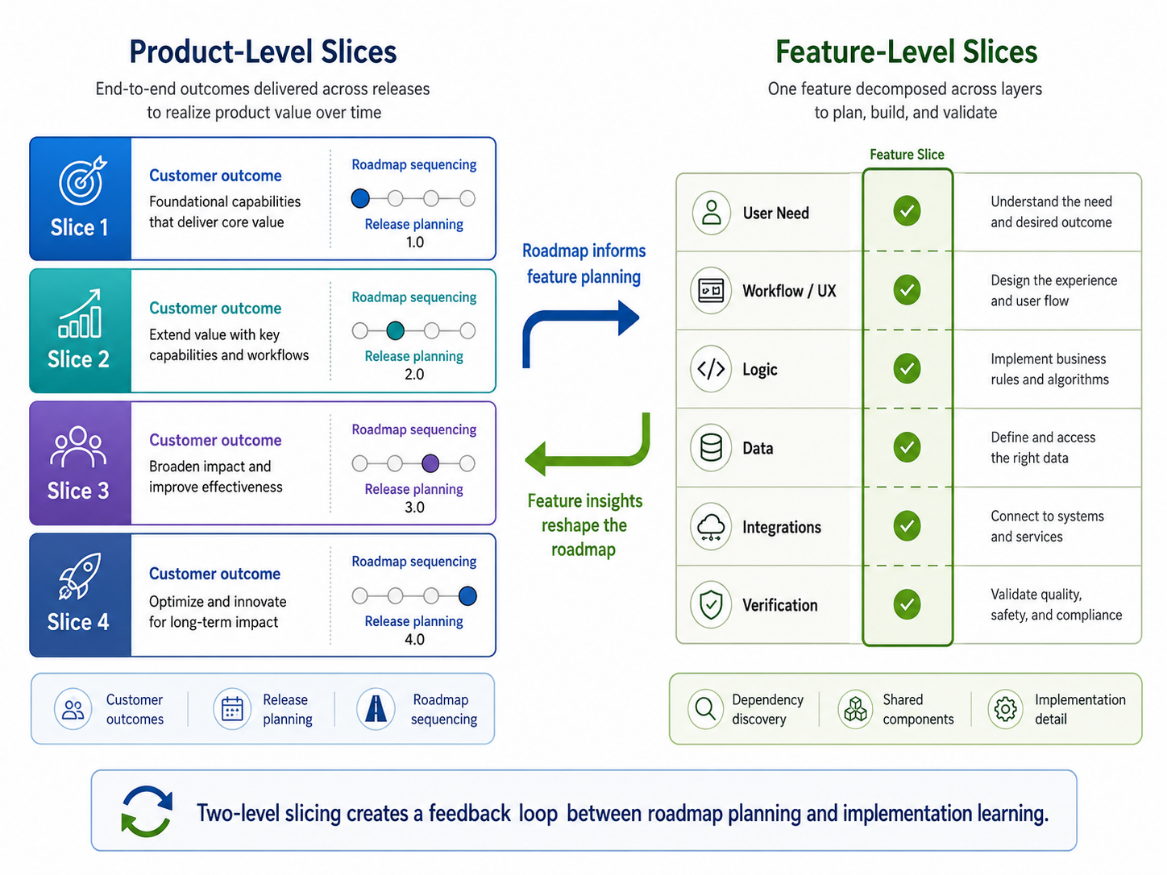
- Product-level slicing organizes the roadmap into meaningful, end-to-end increments of value.
- Feature-level slicing decomposes those increments far enough to expose dependencies, shared components, uncertainties, and evidence needed for delivery.
The value comes from creating a two-way relationship between the roadmap and the underlying product design. The roadmap should guide execution. At the same time, what the team learns during detailed decomposition should be allowed to influence the roadmap.
What is a vertical slice?
A vertical slice cuts through the software stack layers needed to deliver a narrow but usable outcome. It may include a small amount of user interface work, data handling, logic, integration, and testing, all connected to one stakeholder need.
Instead of asking, “How much of each technical layer has been completed?” the team can ask, “What can a user now accomplish from beginning to end?” That approach is valuable at the feature level.
In software-intensive medical products, vertical slicing can also provide a structured foundation for managing architecture, development evidence, and emerging AI-enabled workflows.
For a complex product, however, it does not fully solve the roadmap problem. A team can build individual features using vertical slices while still organizing the overall roadmap as a loosely connected list of capabilities.
Conversely, a roadmap can describe valuable customer outcomes while hiding the technical and operational relationships between them. That is where a two-level slicing model becomes useful.
Product-level slicing: Organizing the roadmap around outcomes
A product-level slice is a release milestone or an end-to-end product outcome that delivers value to a user or enables an important product capability. It is usually larger than a user story and smaller than an entire product vision.
Depending on the product, a product-level slice might represent a new customer workflow, a decision-support capability, a reporting experience, a system integration, or a capability designed for a particular customer segment.
The purpose of product-level slicing is to give the roadmap a more useful unit of planning: a coherent outcome that can be considered in relation to customer value, dependencies, risk, and future product growth.
A simple example
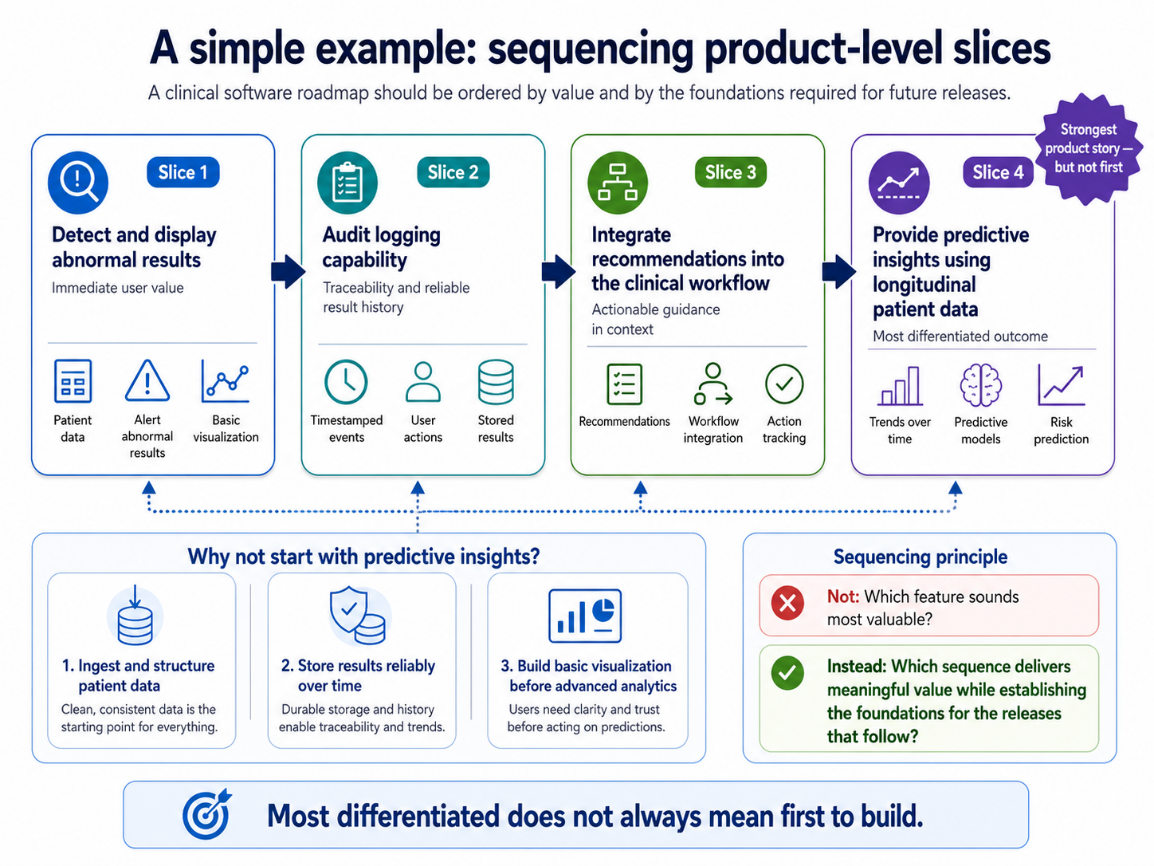
Consider a software product that helps clinical users review patient data and identify abnormal results. Its product-level roadmap might contain the following slices:
- Detect and display abnormal results.
- Audit logging capability
- Integrate recommendations into the clinical workflow.
- Provide predictive insights using longitudinal patient data.
From a market perspective, the fourth slice may sound the most differentiated. Predictive insights are likely to create a stronger product story than audit logging. That does not mean predictive insights should be developed first.
The product may need to ingest and structure patient data before it can analyze trends. It may need a reliable way to store results before it can compare them over time. It may need basic visualization capabilities before it can display advanced analytics.
The real sequencing question is therefore not: Which feature sounds most valuable? It is: Which sequence delivers meaningful value while also establishing the foundations required for the releases that follow?
Four factors are especially useful when ordering product-level slices.
1. Customer impact and user value
Every product-level slice should be connected to a recognizable outcome. What problem does it solve? Who benefits? What can the user do after the slice is delivered that could not be done before? This is where product marketing brings essential market context.
Customer interviews, competitive research, win-loss analysis, positioning work, and feedback from sales and customer success can help distinguish between genuinely valuable capabilities and those that are merely interesting.
However, value should not be defined too narrowly. Some slices create visible, immediate value. Others enable future value. A data model, audit capability, or integration layer may not support a compelling campaign on its own.
Delaying it, however, could make future capabilities slower, more expensive, or less reliable.
The answer is not to fill early releases with internal infrastructure and ask customers to wait for the benefits. Foundational capabilities should be paired with outcomes users can experience. The first release should solve a real problem while also making subsequent releases easier to build.
2. Technical and operational dependencies
Some roadmap items are genuinely independent. Many are not. An analytics capability may require historical data. Personalization may depend on identity and permissions. Workflow automation may depend on external integrations. A new pricing model may require metering and entitlement management.
Not every dependency is technical. A product-level slice may also rely on updated customer onboarding, new implementation processes, partner agreements, customer-support readiness, data rights, new pricing or packaging, regional or legal approvals. These relationships matter because the roadmap may prioritize the right outcomes in the wrong order.
Dependency analysis is sometimes viewed as a constraint imposed by engineering. A more useful interpretation is that it gives the product strategy an executable structure. Understanding dependencies does not mean that architecture should dictate the roadmap. It means the organization can make better-informed choices about where to invest first.
3. Regulatory, verification, and evidence constraints
In medical software, teams must consider the evidence needed to demonstrate that a product performs safely and as intended. The same principle applies in other industries, even when the specific obligations differ.
An enterprise product may require security assessments, accessibility testing, data-processing reviews, or customer validation. An AI capability may require performance evaluation, monitoring, explainability, or human-oversight mechanisms. A financial product may require additional controls or auditability. These activities cannot always be added after the product has been built.
The way a capability is designed affects how it can be tested. The way data is stored affects what can later be demonstrated. The release sequence may determine whether evidence can be collected progressively or must be recreated. This can change the roadmap.
For example, introducing auditability early may make later verification, troubleshooting, and customer adoption easier. A slice that initially appears secondary may therefore need to become part of the product foundation.
Product marketers do not need to own verification or compliance, but they should understand these constraints because they influence launch timing, external claims, and customer commitments.
4. Implementation confidence
Most roadmaps make future items appear equally understood. They rarely are. One slice may be based on a validated customer problem, familiar technology, and existing infrastructure. Another may depend on uncertain user behavior, a new algorithm, an unfamiliar data source, or a partner integration that has not been tested.
That difference should affect sequencing. Low confidence does not always mean that a capability should move later. Sometimes it means the organization should begin learning earlier.
For each slice, it is useful to distinguish among several types of confidence:
- Confidence that the customer problem is real
- Confidence that the proposed solution will address it
- Confidence that the technology will perform as expected
- Confidence that the required data will be available
- Confidence that the capability can be tested or validated
- Confidence in the delivery estimate
A strategically important but uncertain slice may need an early experiment, even if the full capability is planned for a later release. The roadmap should therefore sequence both value delivery and learning.
What should go into the first meaningful release?
This is where the distinction between product-level and feature-level slicing becomes especially useful.
Teams are often encouraged to make the first release as small as possible. Small and meaningful, however, are not the same thing. A thin collection of partially connected functions may technically qualify as an early release, but it may not solve enough of a problem to change customer behavior.
A meaningful first release should:
- Provide a complete outcome for a defined user
- Perform well enough to earn trust
- Include the supporting capabilities necessary for that outcome
- Establish reusable foundations for later slices
- Avoid unnecessarily limiting future product options
In the clinical software example, the first release could include abnormal-result detection because it provides an immediate user benefit. A closer examination may show that the capability also needs patient-data ingestion, basic visualization, alerts, result storage, and some level of traceability.
That does not mean every future capability needs to be built in version 1.0. It means the first release boundary must reflect what is required for the promised outcome to be meaningful and reliable.
Feature-level slicing: Looking underneath the roadmap
Product-level slicing gives the roadmap its strategic structure. Feature-level slicing tests whether that structure still makes sense when the team examines what each capability actually requires. A feature-level slice begins with the user need and follows it through the different parts of the product needed to deliver the outcome.
The categories will vary by organization, but they might include:
- User need
- User tasks
- User experience
- Application logic
- Data
- Algorithms
- External integrations
- Risks and controls
- Testing and evidence
The goal is not to fully specify every future roadmap item. That would consume significant effort and create false certainty around work that may still change.
Instead, the team decomposes near-term, foundational, or highly uncertain slices far enough to identify decisions that could affect the roadmap.
For an abnormal-result detection feature, the user may need to:
- Upload or receive patient data.
- View the data.
- Run the detection process.
- See abnormal findings.
- Store the result.
- Review how and when the result was generated.
- Take an appropriate next action.
Walking through that workflow can reveal several important dependencies. The data must be stored in a way that will later support longitudinal analysis. The visualization may become a shared component across multiple product slices. Auditability may need to be built into the workflow from the beginning. The format of stored results may affect future integrations.
Those are not simply engineering details.
They can change:
- What belongs in the first release
- Which slice should be developed next
- Which technical experiments should begin early
- How much uncertainty exists in a target date
- Whether two slices should be combined
- Whether a large slice should be divided
- What claims can credibly be made at launch
Feature-level slicing is therefore not only an execution technique. It is also a roadmap discovery technique.
The roadmap should inform the architecture – and the architecture should inform the roadmap
Roadmap development is often presented as a one-way flow.
Product leaders decide what the organization wants to build. Product managers define the features. Engineering determines how to implement them. Product marketing prepares the launch. That process works only when implementation discoveries do not materially affect the proposed sequence.
In complex products, they often do. The roadmap should guide feature-level planning by establishing the outcomes the organization wants to prioritize. Early feature decomposition should then provide feedback to the roadmap by revealing shared elements, hidden dependencies, uncertainty, and constraints.
That feedback may lead the team to move a shared component into an earlier release, start an uncertain experiment sooner, split one large outcome into two independently valuable slices, combine two slices that only create value when used together, delay an advanced capability until the required data exists, change the scope of the first release, reframe a launch claim or adjust the roadmap sequence without abandoning the overall strategy. This creates a continuous loop between strategy and execution.
A roadmap is a connected system, not a feature list
A strong roadmap is not simply a collection of good ideas arranged across time. It is a connected set of decisions about customer value, technical foundations, commercial readiness, uncertainty, evidence, and learning.
Product-level slicing helps the team define meaningful outcomes and decide how those outcomes should be sequenced. Feature-level slicing reveals what those outcomes depend on and whether the roadmap still makes sense when examined more closely.
Together, the two levels create a two-way relationship. The roadmap shapes the work. The details discovered through the work reshape the roadmap. That is what turns a polished roadmap presentation into a more credible product plan.


