Because your Flutter app deserves a brain, and you deserve to never look at a Python traceback again.
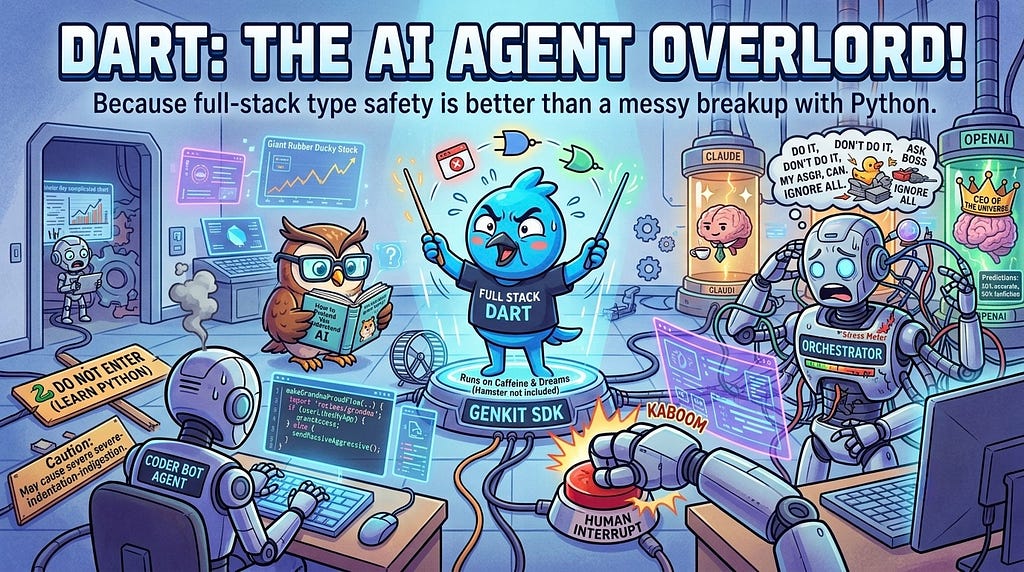
Let’s be honest. We all love Dart. It’s clean, it’s safe, and it powers our beloved Flutter. But until recently, if you wanted to build serious, multi-step AI agents, the industry basically told you to pack your bags, leave your cozy typed ecosystem, and go write Python.
Gross 🤮
Thankfully, Google finally heard our collective sighs and dropped the Genkit Dart SDK. Now, you can build full-stack, hyper-intelligent AI agents natively in Dart and deploy them straight to Cloud Functions for Firebase. No context-switching. No spinning up a random Node.js microservice just to talk to an LLM.
Grab your coffee (or your energy drink of choice). Let’s look at how Genkit turns your Dart code into an absolute powerhouse.
https://medium.com/media/91c2efa4198c043f3f400f216214650e/href
The Shift: From “Dumb Chatbots” to “Autonomous Overlords”
Building traditional chatbots or strict multi-step UI flows often feels like playing one of those terrible, rigid video games that block you at a level until you do exactly what the developers scripted.
Agentic AI, by contrast, is the ultimate open-ended sandbox. An agent doesn’t just blindly answer a prompt. It analyzes what the user wants, figures out which tools it needs to achieve the goal, and dynamically orchestrates the steps to get there.
With Genkit’s new Agents API, all the messy plumbing: maintaining conversational state, keeping track of history, and parsing streams, is handled behind a single API. You just focus on giving it a brain.
The Holy Trinity: Models, Tools, and Flows
To stop your AI from just hallucinating fan-fiction, Genkit uses a few core primitives. Think of this as the toddler-proofing stage of AI development.
- Models (ai.generate()): The actual brain. Whether you are using Gemini, Claude, or OpenAI, the API stays exactly the same.
- Tools (defineTool): This is how you give your AI hands. By defining strict input schemas, you allow the model to interact with the real world, like querying your database, checking the weather, or ordering a pizza.
- Flows (defineFlow): This is the leash. Wrapping your logic in a flow gives you massive observability. You can test and debug exactly what the AI is doing before it goes rogue in production.
https://medium.com/media/36bab17e7cb6b5565e779b07f2d18b53/href
Multi-Agent Delegation: The Art of Doing Nothing
Sometimes, a single massive AI prompt gets confused and starts acting like a stressed-out intern. Genkit fixes this with multi-agent delegation.
Instead of one mega-agent, you can create a team. You build a “Researcher” agent, a “Coder” agent, and an “Orchestrator” agent. Using Genkit’s agents() middleware, the Orchestrator analyzes the user’s request and silently delegates the work to the sub-agents.
It’s exactly like a college group project, except this time, your team members actually do the work while you sit back and take all the credit.
Human-in-the-Loop: Please Don’t Delete the Database
If your AI has the power to do things like process refunds or drop production tables, you probably shouldn’t let it run on autopilot.
Enter the interrupt() capability.
Genkit natively supports “human-in-the-loop” workflows. Your agent can intentionally pause its execution, beam a signal down to your Flutter frontend, and basically ask, “Hey boss, I’m about to do something crazy. You cool with this?” It waits for your explicit human authorization before proceeding.
https://medium.com/media/fa2d74efa2c9feee86e3068ee55dddf0/href
The Bottom Line
Genkit is the bridge we’ve been waiting for. By keeping everything in Dart, we keep our beautiful full-stack type safety, share our schemas between Flutter and Firebase, and avoid the headache of maintaining multiple languages.
It’s time to stop writing basic API wrappers and start building actual agents. Go give Genkit a spin, your future AI overlords will thank you.
The Final Verdict
So, the next time a client slides into a meeting demanding a fully autonomous, self-healing AI ecosystem, but sternly notes that the entire solution cost shouldn’t cross $1000, you don’t have to panic. You don’t need to hire a pricey Python team, spin up weird microservices, or cry into your keyboard.
Just fire up Genkit, stay in your cozy Dart ecosystem, and ship the MVP before they even finish writing the requirements document.
What kind of chaotic agents are you going to build first? Let me know in the comments, and please, for the love of all that is type-safe, don’t forget to wire up the subscribe button.

Full-Stack AI in Dart: Because Learning Python is for Snakes 🐍 was originally published in Google Developer Experts on Medium, where people are continuing the conversation by highlighting and responding to this story.