By Geeta Kakrani (GDE in AI & TPU)
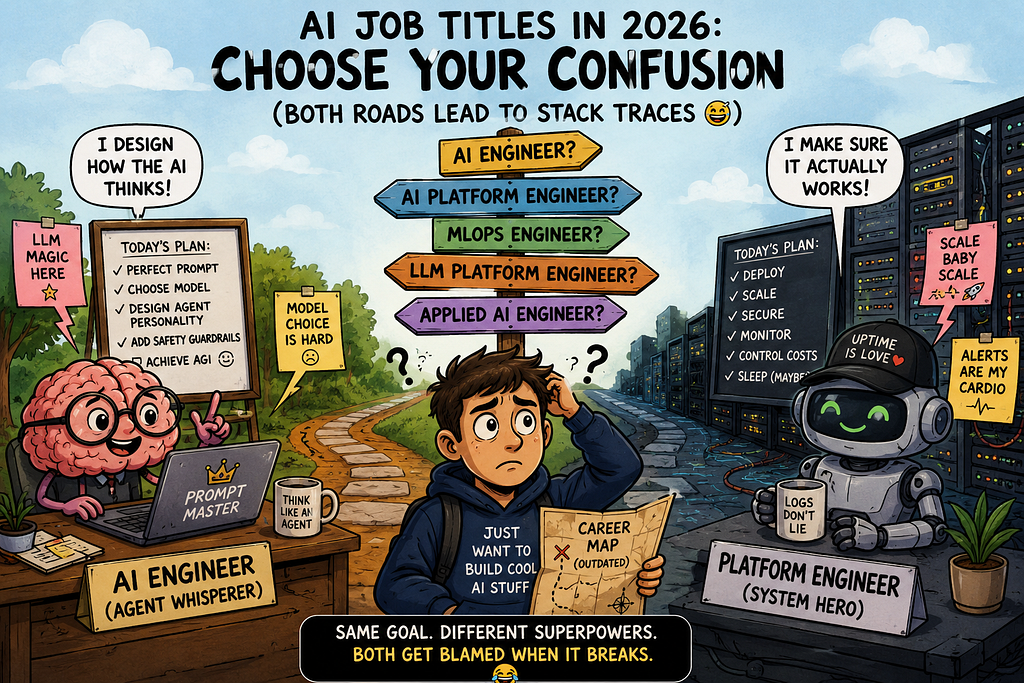
Open any job board right now and search “AI.” Within a few listings, you’ll notice something odd: the roles don’t line up. Two postings with almost identical requirements have completely different titles. One company’s “AI Engineer” is another company’s “AI Platform Engineer” is a third company’s “MLOps Engineer.”
This isn’t a small naming quirk. For anyone trying to plan a career — or even just understand where they fit — it’s a real, growing source of confusion. Not because AI itself is hard to understand, but because nobody clearly explains who is responsible for what anymore.
The job title problem nobody talks about
You’ll find titles like:
- AI Engineer
- AI Platform Engineer
- AI Infrastructure Engineer
- MLOps Engineer
- LLM Platform Engineer
- Applied AI Engineer
These titles overlap heavily. They pay in similar ranges. They list nearly identical skills. And most of them didn’t exist as separate roles even three years ago.
This isn’t because companies are confused. It’s because the industry is still figuring out what to call a very real, very new job — one that sits between two older disciplines that used to be completely separate.
If you’re a student or early-career professional trying to plan your path, this title chaos makes it genuinely hard to know what to learn, what to apply for, and what a company actually expects from you on day one.
So what’s the actual difference?
Strip away the job titles, and there are really two different jobs hiding underneath the AI buzzword.
The AI Engineer works on the intelligence itself. Choosing which model to use. Designing prompts and instructions. Deciding how an agent should behave, what it should refuse to do, when it should use a tool versus answer directly. This is the “thinking” layer.
The Platform Engineer works on everything that lets that intelligence actually run in the real world. Servers, deployment, scaling, security, monitoring, cost control. This is the layer most people never see — until it breaks.
Here’s the part that trips people up: in AI specifically, these two jobs have started merging into something new, often called an AI Platform Engineer. This person builds the infrastructure and tooling that other engineers use to build AI products — think of it as building the kitchen, not cooking the dish. Meanwhile, an AI Application Engineer builds the actual product the end user touches — the chatbot, the assistant, the recommendation engine.
That distinction — platform versus application, not “AI versus non-AI” — is the one that actually shows up in real job descriptions. And almost nobody explains it clearly.
Why this confusion is getting worse, not better
A few real reasons, based on where the industry is heading in 2026:
AI tools now sit inside every developer’s workflow, not just AI teams. Someone has to decide how that’s deployed safely, monitored, and governed across an entire company — that’s platform work, but it now requires AI literacy too.
The “should I learn cloud first or AI first” debate is still unresolved. Some experienced engineers argue you should build infrastructure fundamentals first, because that knowledge stays valuable regardless of which AI model or framework is trending. Others say get hands-on with AI tools immediately, because that’s where the fastest-growing demand is. Both are reasonable. Neither is universally right. That contradiction alone confuses a lot of newcomers.
People worry AI will replace one of these roles — usually platform engineering, since it sounds “less AI.” In practice, the opposite is happening. Platform engineering is becoming more valuable because someone still has to build the reliable, secure, repeatable systems that AI tools run on top of. AI didn’t remove that need. It multiplied it.
What this actually means for you
If you’re trying to figure out where you fit, ask yourself which of these frustrates you more:
“The agent gave a wrong or unclear answer.” That’s an AI Engineer problem — prompt design, instructions, model choice.
“The agent worked yesterday, but nobody can access it today.” That’s a Platform Engineer problem — deployment, infrastructure, reliability.
Most people have a natural pull toward one of these. Neither is more “advanced” than the other. They’re just different kinds of hard.
And if you enjoy both — if you like designing how an AI behaves and you don’t mind digging through a stack trace to find why a server route is failing — you’re describing the AI Platform Engineer role, which is currently one of the fastest-growing and least-titled jobs in tech right now.
The takeaway
The confusion around these job titles is real, and it isn’t your fault for feeling lost in it. The industry itself hasn’t settled on consistent names yet. But the underlying skills are clear enough to plan around:
- If you’re drawn to what the AI says and decides — lean into AI engineering fundamentals: models, prompting, agent design.
- If you’re drawn to making systems run reliably at scale — lean into platform fundamentals: infrastructure, deployment, observability.
- If you’re drawn to both — don’t force yourself to pick. That combination is exactly what companies are quietly hiring for right now, even if the job title hasn’t caught up yet.
What’s your experience been — have you run into this title confusion while job hunting or building your own projects? I’d love to hear how you’re navigating it.

AI Engineer or Platform Engineer? Nobody Explains This Confusing New Job Title Problem (2026 Guide) was originally published in Google Developer Experts on Medium, where people are continuing the conversation by highlighting and responding to this story.