

There is a moment I have watched play out in almost every PMM meeting I have been in, whether it’s a quarterly planning sync, a feature walkthrough with sales, a positioning discussion, or a launch review.
The product is explained. Features are clear. Timelines are set. Then the conversation turns to customers, and something shifts.
“What is the actual story here?”
“Who is this really for?”
“How do we explain this without a ten-minute preamble?”
In nine years of experience, I have heard these questions at Seed-stage startups, Series C scaleups, and companies with mature GTM operations. The organization changes… the questions don’t.
Most people in the room reach for a messaging solution – a sharper value proposition, a better brief, or another one-pager.
In my experience, the problem underneath those moments is documentation rather than messaging.
When there is no shared source of truth defining what the product is, who it is for, why it exists, and where its boundaries are, every team creates its own version of the story.
That misalignment shows up everywhere:
- Sales calls, where reps oversell scope
- Support tickets, where expectations were set incorrectly
- Onboarding experiences that emphasize the wrong features
- Roadmap discussions, where product and marketing quietly develop different assumptions about the customer
By the time it becomes visible externally, the problem has usually existed internally for weeks.
For PMMs, internal documentation is a strategic asset rather than a supporting task, and it’s often one of the first things to get skipped when teams move fast.
Why documentation sits at the centre of PMM work
There is a version of the PMM role that looks like this: Product builds something, PMM makes it sound good, and everyone goes to market.
I spent the first few years of my career operating roughly inside that frame.
What I eventually understood is that great messaging is an output. The work that produces it (the real PMM work) is creating internal clarity before that output exists.
I remember working on a workflow automation feature where I kept getting slightly different answers every time I asked clarifying questions. The issue wasn’t the PM’s knowledge of the product, but rather that nobody had written the answers down in one place.
I was simply the fifth person asking the same questions. That was the moment I started treating internal documentation as part of my job, not someone else’s.
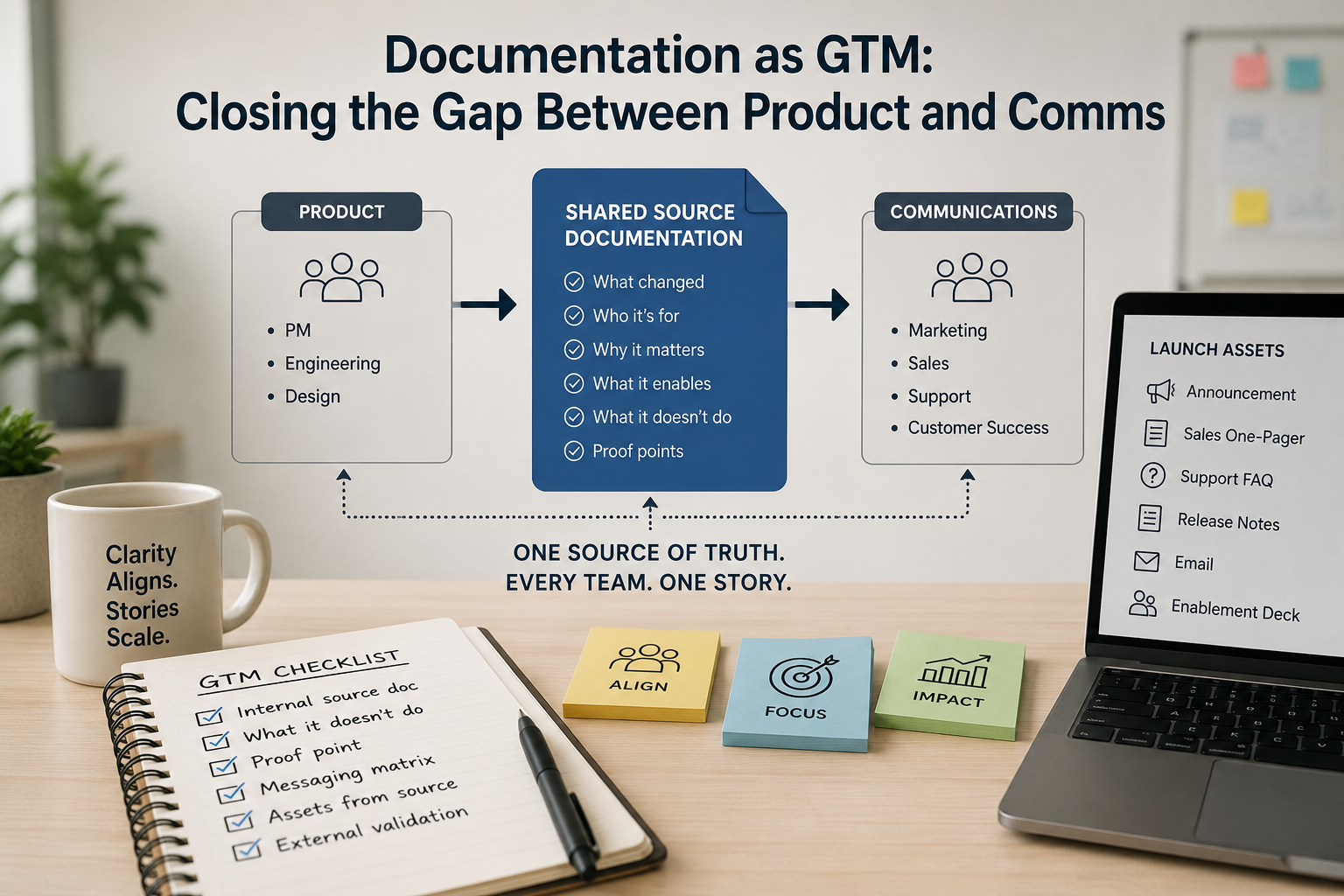
The document itself doesn’t have to be long or formal. But it has to answer six things clearly enough that any team (sales, support, marketing, customer success, or leadership) can use it without needing another meeting.
- What changed or exists today?
- Why was this built?
- Who is it actually for, and who is it not for?
- What can users do now that they could not before?
- What are the limitations or exclusions?
- Why does this matter in a real-world context?
This is a shared understanding of the product written in the language every team actually uses. Without it, PMM work becomes permanently reactive. You spend your time translating, re-explaining, and correcting after the fact. With it, you create the foundation everyone else builds on.
What happens when this is missing
When documentation is not treated as a core asset, teams still move forward. That’s the deceptive part. The wheels do not visibly fall off.
What happens instead is subtler and harder to fix later. Sales learns the feature but not the customer outcome. Reps lead with capabilities instead of value.
Support knows how the feature works but struggles to frame expectations. Customers are surprised by limitations that were never clearly communicated.
Marketing builds narratives from specifications and screenshots alone, and the external story drifts from what the product actually delivers.
Product assumes alignment because documentation exists somewhere, while every function quietly interprets it differently.
The result is an inconsistency that compounds. Different teams tell slightly different stories until customers are left stitching them together and gradually lose confidence in the product experience.
A practical example: launching an analytics dashboard
Product launches make this gap visible faster than anything else.
A while back, I was leading GTM for an in-app analytics dashboard built for operations managers. The team had done thorough work. There was a detailed product specification, comprehensive engineering documentation, and beautifully annotated Figma files.
Everything looked complete. Yet, none of it answered the questions every downstream team needed answered.
So, before touching a single launch asset, the PM and I blocked half a day to create one internal source document. We focused on clarity over completeness.
Feature: Operations Analytics Dashboard
Primary audience: Operations managers at mid-market accounts
Internal value proposition: Operations managers can see real-time task completion data without leaving the product or exporting spreadsheets, reducing weekly reporting preparation from more than three hours to under fifteen minutes.
Before: Manual CSV exports every Friday, reformatted in spreadsheets and shared days later.
After: Live dashboards inside the product that refresh automatically every fifteen minutes and can be shared instantly.
Limitations: No historical data beyond ninety days. No predictive insights. No PDF exports until Q3. Not available on mobile. Not a replacement for the full reporting suite.
Proof point: Three beta customers reduced weekly reporting time by an average of 73%.
That half day paid for itself immediately.
Sales positioned the launch around time savings. Marketing led with real-time visibility. Support used the documented limitations to set expectations. Leadership used the beta metrics in board updates.
Nobody had to reconcile competing versions of the story because we aligned once, early, on one document. Every downstream asset became a different expression of the same truth.
If your GTM document could have been written by anyone who read the product specification, you have not done the PMM work yet.
The step most teams skip: the messaging matrix
The internal source document is only the first step. The second is translating that story for different audiences. The mistake I see is treating consistency as saying the same thing to everyone. Instead, consistency means grounding everyone in the same truth while adapting emphasis.
For the analytics dashboard:
Sales: Operations managers save more than three hours every week on reporting.
Customer success: What the dashboard shows, what it does not show, and how to communicate limitations.
Marketing: Real-time visibility without touching a spreadsheet.
Executives: Analytics reporting is becoming table stakes in our segment.
Same product. Same facts. Different framing.
A field account executive and a VP of Marketing do not need identical messaging. They need different entry points into the same story.
How this changes the PMM role
When PMMs take ownership of internal documentation, something shifts in how the organisation sees the function.
Before I worked this way, I was typically brought in four to six weeks before launch. Enough time to write copy. Not enough time to influence anything meaningful.
Once I started owning the internal source document – not just the messaging layer above it – product teams started involving me much earlier.
Not because I lobbied for it, but because they found it useful.
Documentation is a form of articulation, not simply packaging.
Positioning conversations happen sooner. There is time to challenge assumptions, question scope, and identify gaps in customer value before they become support tickets or adoption problems.
PMM moves from being downstream of product decisions to becoming a partner in how products are understood.
That is where the function becomes genuinely strategic.
PMMs who own documentation move upstream. Instead of launching launches, they shape how products are understood from the moment they are being built.
A quick check before anything goes external
Before your next launch, feature release, or positioning exercise, ask yourself:
- Is the internal source document written and agreed upon?
- Have limitations been documented explicitly?
- Do you have at least one real proof point?
- Does a messaging matrix exist for sales and customer success?
- Can every downstream asset be traced back to the source document?
- Has someone outside the product team read it and understood it?
If the answer to any of these questions is ‘no’, the issue lies in the foundation rather than the execution.
Good GTM does not start with a campaign or an announcement. It starts with someone – often the PMM – writing clearly enough about what the product is that every team can operate from the same understanding. While documentation is often the first thing cut when timelines get tight, it is actually the very thing that makes everything else faster.
In practice, documentation is what enables everything else to run faster. For PMMs, clarity is a result of documentation rather than an accident.
That is how you close the gap between what your product does and what the world hears.


