
PMBOK 8 is the short name given to The Standard for Project Management and A Guide to the Project Management Body of Knowledge – (PMBOK® Guide) Eighth Edition, which are bundled together. They form the basics of what you need to know about managing projects, for organizations that follow the PMI approach to getting work done.
The Standard for Project Management includes:
- An introduction
- The value delivery system
- The project management principles
And the principles are what we are talking about today.
What is a principle?
So, what is a principle?
A principle is a norm, rule, value or fundamental truth which serves as a guide for behavior or action.
Principles are not prescriptive. They don’t tell you how to do something. They are not policies or goals. They simply underpin the things that you should be doing. Think of principles as inalienable truths to live by – or in our case, to work by.
The thing with project management principles is that they are designed to inform your actions. They don’t prescribe your actions.
In other words, they shape how you think about project management and give you guard rails for behavior while letting you lead the project any way you see fit within those parameters.
The Standard for Project Management as part of PMBOK 7 set out the principles that anyone leading projects should be able to use for project execution. These have now been updated for the latest edition. They are not specific to methodologies and will work regardless of what delivery approach you choose to use.
So, what are they? Let’s dive in.
Eighth Edition Update
PMBOK 8 includes 6 principles. This replaces and simplifies the 12 principles that were in the Seventh Edition.
Those 12 principles were: Stewardship, Team, Stakeholders, Value, Systems Thinking, Leadership, Tailoring, Quality, Complexity, Risk, Adaptability & Resilience, and Change.
The 6 Principles of Project Management in the Standard for Project Management
Together, the principles “describe the mindset of project management” according to the Standard. And this “guides the mechanics” of how you deliver the project. The mindset for project management combines proactivity, ownership and being value-driven.
In other words, keep a principle-based approach in mind to ensure that your project operates effectively and as you create your project plan.
Below are the 6 principles for project management, along with my description of what these could look like for you.
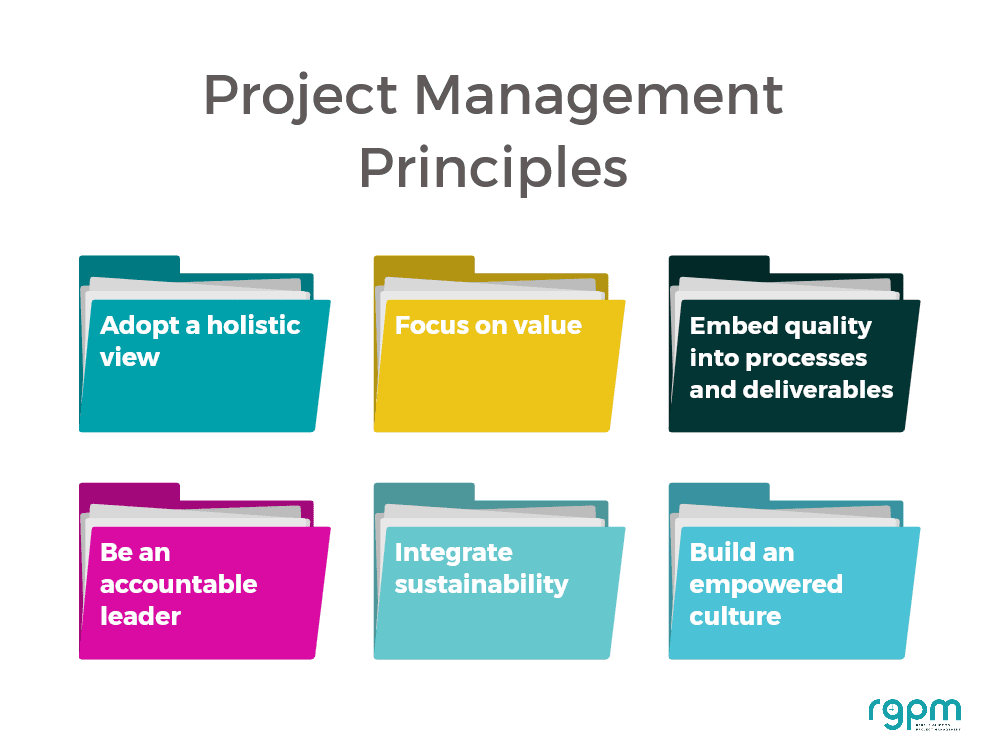
1. Adopt a holistic view
This principle is all about considering interdependencies — what the previous version called Systems Thinking. (And systems thinking is still a thing.)
Whether you call it systems thinking, design thinking, or seeing the business as a holistic enterprise where all the parts hang together: this principle is really about breaking down silos of all kinds and using your role as a project manager to be the glue that holds everything together.
I talk a lot about ‘being the glue’ as a project manager when I’m mentoring people as it’s a big part of the PM role and often difficult to explain.
In our jobs as project managers, we have to look at how the whole organization works and make sure every part is operating as optimally as possible.
Note: This principle also sounds to me like it overlaps with the work of a business analyst, so is that a sign that PMI feels the role of a PM is expanding? I would argue that these are principles for projects, not necessarily a single person in the PM role, so this principle is a great argument for getting a good BA on the team to look at systems interactions and more.
Stakeholder engagement also fits into this principle — ensuring the right people are consulted and involved, and integrating diverse perspectives to give yourself a better chance of success. A communication plan is a good place to start here.
We can lead by example by acting holistically for our projects, but I think other managers in the organization need to live by this principle as well.
2. Focus on value
If projects don’t deliver value, what’s the point of them?
However, we have to determine what ‘value’ means, and it’s going to look different for every project. You might measure it differently too. And it can change throughout a project, especially if you are using techniques like progressive elaboration or iterations to work out what you are doing as you go.
The biggest impact you can make with your project management career is this one: focus on value. Challenge where you don’t see it, and look to get more of it with everything you do.
Look at your Gantt chart or Kanban board with a value-focused lens and see whether what you are doing is actually moving you closer to those business case targets.
3. Embed quality into processes and deliverables
As a PM, you might not have much influence over processes led by the PMO, but you can certainly input and offer feedback to try to shape how work gets done.
You have a lot of influence over how deliverables are delivered in a quality way, so use that influence appropriately to make sure you find the balance between gold plating and getting a decent result.
The Standard talks about quality meaning that stakeholder expectations are met, along with the project and product requirements. It’s also about meeting acceptance criteria for deliverables (you do have those, right?).
For example, calling out scope creep when it happens and sticking to the
A project quality plan could be one of the project management artifacts you create during the project. Define quality standards for your projects and stick to them!
4. Be an accountable leader
I think this one is pretty obvious. As project managers we lead the team and we lead the project through to a successful completion. If you don’t step up and act as a leader then you’re at risk of being seen as an administrator.
- We need to work with:
- Integrity, honesty, fairness
- Self-awareness
- Respectfulness and humility
- Availability (for feedback — and as a servant leader)
- Flexibility and adaptability.
Even if you don’t have a ‘traditional’ leadership role like being the big boss, you can still demonstrate leadership in how you operate with others.
5. Integrate sustainability within all project areas
This principle is new for this latest update, and it’s great to see sustainability called out.
It’s described in the Standard as:
..[M]eeting present needs without compromising the ability of future generations to meet their own needs.
Sustainability is still quite a new concept for teams to be embedding, but you can think of it as finding ways to consider people, the planet, and society while ensuring your project gets delivered.
It shows up in supplier choice, technology choice, and in smart decisions for how you use resources for your project deliverables.
6. Build an empowered culture
Colloboration is literally the thing that gets projects done in the 21st Century. We are using more and more tech tools to get work done. And the tools are getting better and better at helping – if we know how to use them.
Collaboration only works if you have people to collaborate with, so engaging stakeholders in a mature and respectful way is so important for project success.
We are all busier than ever these days, and so it helps to have a bank of techniques for engaging others that fit their working style and what kind of outcome you are looking for.
For more on this, check out Engaging Stakeholders on Projects: How to Harness People Power (published by APM).
I think resilience is also part of this — a resilient team is an empowered team. We need to be adaptable and resilient, and to support our projects and teams in becoming the same.
How do you do that? Start with creating a culture where work/life balance is more than just something people talk about, and go from there.
Your next steps
Those are the principles of project management, as covered by the Standard. How do you measure up? Here are some action steps.
- Have a think about how you perform against each of those principles.
- Next, consider how the principles overlap with your actual project management practice and the tools you use.
- Read about the performance domains for managing projects.
This article first appeared on Rebel’s Guide to Project Management and can be read here: The Principles of Project Management