Disclaimer: I do not work at Spotify, nor do I receive any benefits from mentioning their product.
I’ve been using Daylist, a Spotify feature, for nearly a year now, even though it launched in 2023. And I am still impressed by the psychological mechanisms beneath it. A few weeks ago, Daylist turned a running family joke (“Sad Girl Sundays”) into cross-generational bonding when my mother-in-law opened her Daylist and saw the descriptor:
“old-fashioned coastal grandmother Monday evening.”
It wasn’t random. It was her. And we laughed, because Daylist got her vibe more clearly than she could articulate herself.
Moments like that are why nostalgia is such a powerful emotional anchor. It reminds us who we are, who we’ve been, and sometimes, who we still want to be. And it’s also why Daylist is a masterclass for product marketers..
If you zoom out far enough, you can see one timeless human impulse running across generations: we love anything that helps us understand who we are, especially when it reinforces our ongoing “life story,” as McAdams describes in his work on narrative identity.
That’s nostalgia at work: a psychological resource that boosts joy, strengthens identity, and deepens connection. And when brands tap into it, people lean in. They trust more. They engage more. They return. Daylist on Spotify hits differently. It’s nostalgic, identity-giving, and sometimes hilariously on point.
Let’s take a look at the evolution of this way of understanding who we are, from the original personality quiz to algorithms, and see what each era teaches us about designing for stickiness.
The evolution of identity-as-a-feature
1. The magazine era → Identity as a checklist
Many of us grew up with those glossy quizzes that promised to decode our personality with the help of Cosmo. Seventeen. Tiger Beat. It engaged us with multiple-choice questions, doodled answer keys, cute archetypes, and a little harmless stereotyping.
And these were nostalgic by design. These experiences were built to trigger feelings of familiarity, warmth, memory, and give us identity, no matter how silly the outcome.
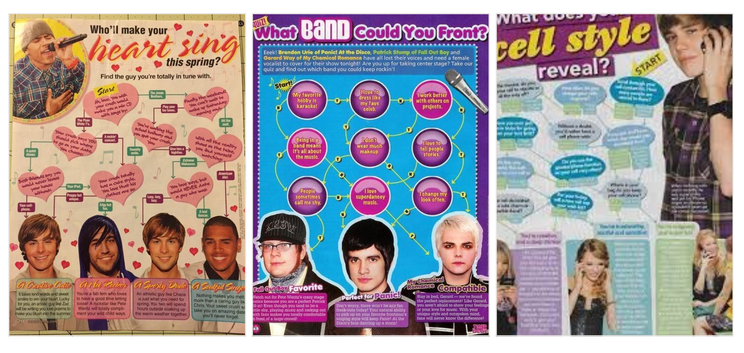
Familiarity decreases cognitive load, which can also ease the use of the product, something that scholars like Zajonc called the mere exposure effect, and those quizzes were familiar rituals..
PMM takeaways:
- Use familiar formats to reduce friction and make new features instantly comfortable.
- Leverage rituals — people return to interactions that feel like warm routines.
- Archetypes simplify complexity, making identity feel approachable.
I’d sit in a stack of magazines with my cousins and aunts. We’d pour a soda, flip to the back pages, circle our answers, and declare our types: “I guess I am a Loyal Romantic after all.”
Identity was static back then, a monthly truth you subscribed to. But the magic was in the format. It was safe. Predictable. Personal enough to feel real.
Facebook/BuzzFeed era → Identity as social performance
Then came Facebook and BuzzFeed. Suddenly, quizzes weren’t only something you did, they were also something you shared.
The genre turned up, funny, hyper-shareable: “Which City Matches Your Personality?”, “Which Dog Breed Are You Actually?”, or “What Mythical Creature Are You?”
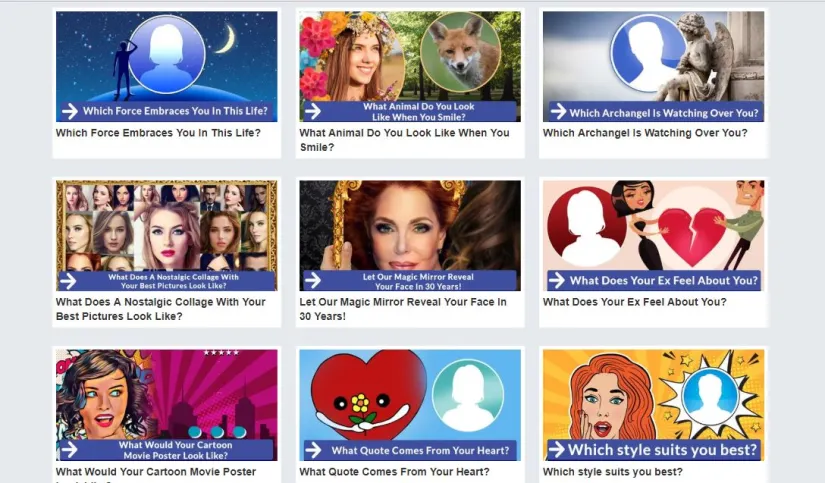
Instead of retro throwbacks, the Facebook-era quizzes tapped into a deeper kind of nostalgia. The kind rooted in autobiographical memory, as Conway & Pleydell-Pearce described, is the system that organizes our lived experience into the story of who we are.
These quizzes didn’t just ask what decade you belonged to; they asked questions that nudged you to remember who you were, who you thought you were, and who you wanted to be.
PMM takeaways:
- Build shareability into the feature, not as an afterthought.
- Use cultural references people already love to create instant familiarity.
- Identity and virality = organic growth engine.
These quizzes borrowed from pop culture we all already loved and fed it back to us in neon-colored archetypes. Identity became social currency. But it was still self-reported. We answered, and the system reflected.
3. Snapchat/TikTok era → Identity as a mood generator
Then everything suddenly got much faster. Do you remember Snapchat filters? TikTok randomizer wheels and Instagram AR quizzes?
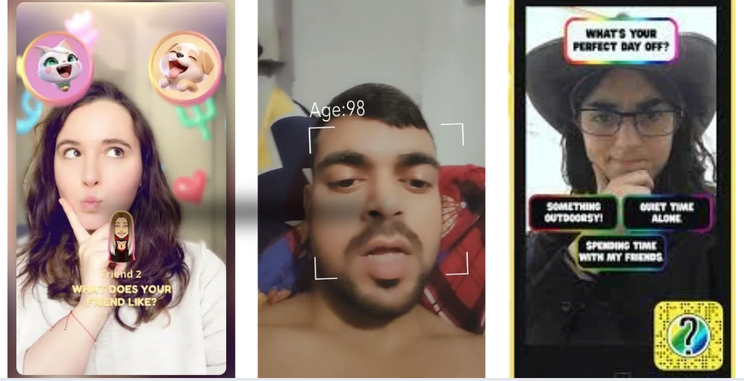
Our identity quickly shifted from “answer these questions” to “look into the camera, and we’ll assign your vibe,” and the nostalgia of this era was primarily aesthetic: the 90s kid, the cottagecore fairy, the dark academia scholar, the vaporwave dreamer.
It was identity-as-micro-aesthetic, echoing Ngai’s (2020) point that in modern culture, vibe outranks definition. But these filters were noisy, chaotic, and often totally random.
And somewhere in that chaos, these games stopped feeling meaningful. As my childhood friendships drifted and social media shifted, the novelty faded.
PMM takeaways:
- Novelty alone doesn’t create habit.
- Micro-identities must feel earned, not random.
- Without emotional anchoring, features become disposable.
These experiences were fun, yes, but often immediately forgettable. Because nothing pulled us back. The platforms served the content to us so effortlessly that we never had to seek anything. And without seeking, there was no emotional anchor, no real identity work happening… just scrolling.
Spotify Daylist → Identity as algorithmic nostalgia
Spotify’s Daylist doesn’t ask permission. There are no tick boxes you’re knowingly selecting. It simply observes.
It’s really this beautiful blend of three things we’re wired to respond to. Familiarity that sparks delight, the kind Zajonc has said, lowers cognitive load and makes us lean in.
Autobiographical memory that adds emotional depth, which Conway & Pleydell-Pearce remind us that this is where our lived story sits. And identity as a dynamic state, not a fixed trait, as Fleeson discusses how we shift between versions of ourselves depending on the moment.
Together, they create an entertaining experience that mirrors us back to ourselves.
That’s why descriptors like: “sad girl sundays”, “optimistic disco morning”, “dramatic confidence dusk” or “old-fashioned coastal grandmother Monday evening” …feel so uncannily on brand. They echo our past and name the present.
Spotify took the emotional comfort of nostalgic quizzes, combined it with the playful aesthetics of TikTok filters, and added a layer of algorithmic intimacy that makes it feel like the app is reading us rather than categorizing us.
It’s one of the first identity tools that seems to understand that identity changes with the hour, almost as if it were setting the soundtrack of our lives.
A real-life proof of the formula:
In our house, we joke about “Sad Girl Sundays.” It’s a weekly bit involving soft indie music, dramatic reflection, and emotional hydration. It was one of my most curated and well-loved playlists served up by the daylist.
Last week, I stumbled upon a great dinner playlist when my in-laws were over, and my mother-in-law wanted to have the link for my special playlist. She loved every single song in rotation, as if I knew how to set her mood.
She wanted to know not only how to get that particular playlist, but how to see what else would pop up. So, we opened her Daylist and there it was.
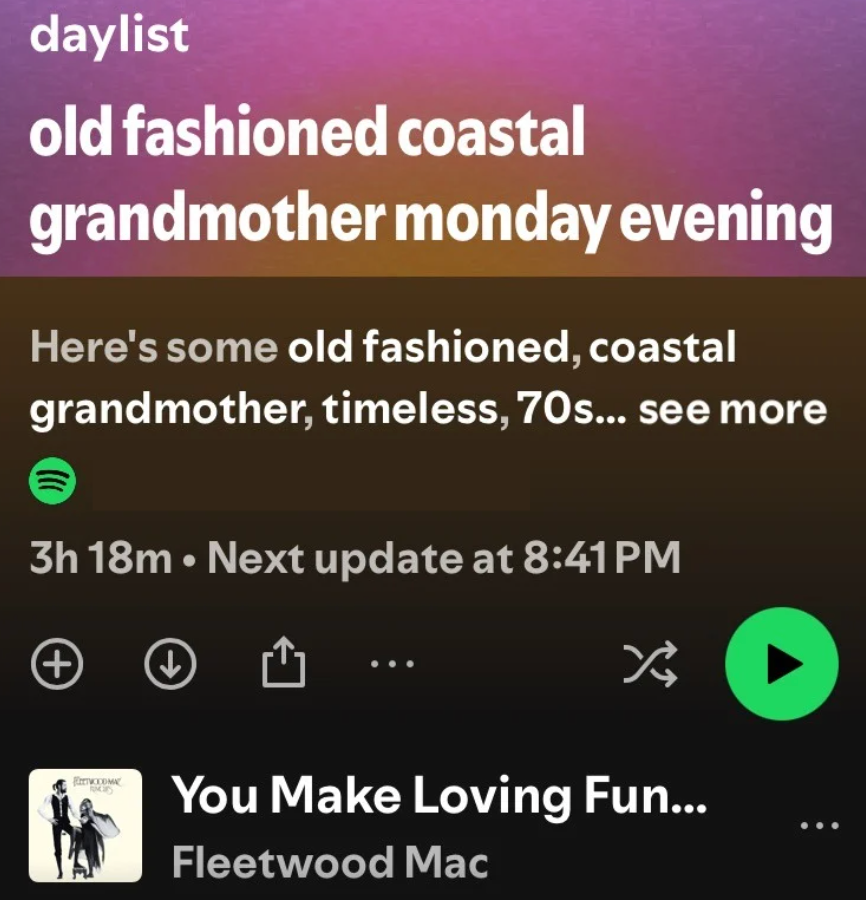
“old fashioned coastal grandmother monday evening.”
She laughed so hard because it wasn’t random. It was her to a tee – 70s nostalgia, beachy, warm energy, and of course, Fleetwood Mac on loop.
And suddenly, my running joke about being a ‘Sad Girl Sunday’ became a bonding moment. We swapped playlists, compared vibes, and discovered overlaps in taste we never knew were there.
That’s nostalgia → identity → connection. That’s what keeps me double-tapping into Daylist multiple times a week to see the tiny reflections of myself I didn’t know I was carrying.
PMM strategies to borrow from Daylist
Spotify cracked a multi-layered formula that we can all learn from:
1. Use nostalgia as a familiar entry point
Nostalgic structures lower cognitive load and build trust.
Tactics:
- Reference familiar cultural forms
- Use archetype-like naming patterns
- Evoke warm memories users already hold
2. Frame identity dynamically, not statically
Static personas are outdated. Daylist captures momentary identity.
Tactics:
- Build identity as states (“Monday Confidence”), not types
- Use time-bound or context-bound descriptors
- Encourage discovery instead of self-reporting
3. Build habit loops with pattern and surprise
The refresh cycle is predictable enough but never boring.
Tactics:
- Use episodic discovery
- Mix consistency with light unpredictability
- Create curiosity gaps (“What’s my vibe this afternoon?”)
4. Prioritize emotional resonance over accuracy
It doesn’t matter if the descriptor is perfect.
It matters if it feels right.
Tactics:
- Choose evocative language
- Mirror user identity and nostalgia
- Design for delight, not diagnosis
5. Make it instantly shareable
Identity is inherently social.
Tactics:
- Create screenshot-ready phrasing
- Make naming ownable and shareable (“Sad Girl Sunday”)
- Encourage cross-generational play
Why this matters
In my opinion, Spotify cracked something the rest of us can learn from: deep-seating a user’s identity in products works best when they blend nostalgia with personalization.
We can learn from this evolution and its well-intentioned design. Magazines gave us the format, Facebook gave us the social layer, TikTok gave us the aesthetic, and Spotify added the insight.
Daylist works because it blends nostalgia, micro-aesthetics, and algorithmic intuition into something that feels both familiar and uncannily personal.
It mirrors who we’ve been, names who we are right now, and gives us a playful way to explore the versions of ourselves we cycle through every day.
As a PMM, I discovered that we don’t always need more data; sometimes, we need more humanity. When familiarity lowers friction, when identity feels earned, and when emotional resonance is baked into the experience, our products can become unforgettable. Spotify proves it.
And so can we.