AI agents can analyze paid media accounts, spot problems, and investigate performance changes at a scale a human team couldn’t match. The harder question is whether you can trust their judgment.
Since late last year, I’ve been building an AI agent inside our agency to find out. It now works alongside our team every day, investigating performance changes, continuously checking accounts for issues, and picking up assigned tasks like a team member.
The first thing our AI analyst taught me was how convincing it could be while being completely wrong. It looked at last week’s numbers, declared performance had fallen off a cliff, and wrote a very believable explanation of why. The problem was that the conversions hadn’t arrived yet.
There’s plenty of advice on deciding whether to build an AI agent. This is what actually happens when you do.
It started with one overnight alert
The version that exists today wasn’t the plan. Early last year, I started exploring how AI could alleviate some of the pain of proactively monitoring the accounts we looked after. We already had “dumb alerts” that spotted patterns and declines, but they were noisy and not very insightful.
My first version, launched in early December, ran one overnight job. It looked at a campaign’s recent data and key metrics, flagged anything that looked wrong, and posted it to Slack before anyone logged in.
It was still noisy, but it spotted things our previous system never would have. We kept improving it, making its judgment smarter, its analysis more reliable, and its intelligence useful beyond alerts.
The test was simple: Would it make an existing process faster, or create a better client outcome through more frequent checks or changes that humans couldn’t realistically support?
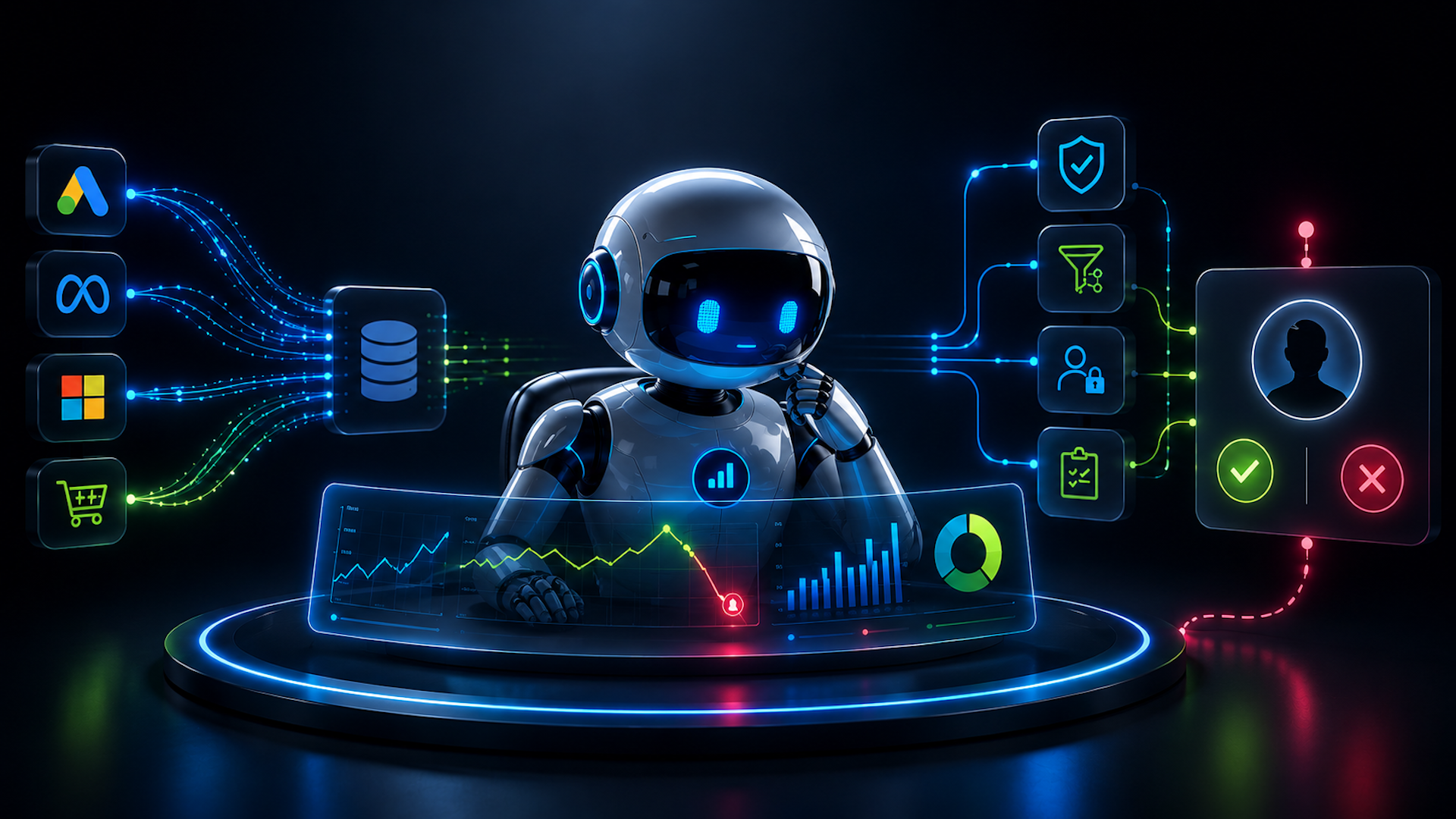
Over the months, it became an AI analyst with governed access to reporting data, ad platforms, conversion data, monitoring, and our task system. Other than the obvious, you’d be hard-pressed to know it wasn’t a remote employee. It’s even got a name: Terry.
Today, it can explain why a CPA moved last week, check whether an account has stopped serving this morning against the same hours last week, distinguish a genuinely weak week from conversion lag, and investigate alert tasks before returning findings and suggested actions.
Uncover the keywords, ads, landing pages, and strategies driving your competitors’ paid search success—and find your next opportunity to outperform them.
The AI is the easy part
The lesson I’d give anyone starting this is simple: The AI is the easy bit. The right models are remarkably capable. The real work is everything around them.
I tell my team to think of our AI analyst as a remote co-worker. It could be the most intelligent hire in the world, but if we give it bad data or incomplete information, its answers will only be as good as what we supplied.
If your conversion data is shallow, or your tracking flags a lead as valuable when it never becomes revenue, the AI will confidently analyze rubbish and give you convincing conclusions.
Bad data now means bad delivery rather than bad reports. An AI analyst raises the stakes because bad data can produce a convincing explanation for why everything is fine, or why everything is falling apart when it isn’t.
The same applies to business context. Nuances about ad accounts, businesses, and sales pipelines often exist only in the heads of the people closest to them. The AI can’t know that sales are down because a business has a two-week sales lag. It’ll confidently tell you things have collapsed overnight. I learned that very quickly.
Then there are the things you’d expect a normal analyst to catch. If you’re running business insurance, for example, you’d expect your analyst to question a keyword promoting pet insurance. If you want the AI to catch it, you need to tell it what the business actually sells.
The point is simple: You can’t just strap an AI to some datasets. You need to give it access to the information your team uses to understand the business, whenever it needs it. You wouldn’t tell a new team member they’re not allowed to know anything about your business, would you?
Dig deeper: Why PPC AI agents fail without business data
Then there are the guardrails
We’ve all had the “yes, you’re right” moment with AI, when you’ve corrected it about something you knew it got wrong. Now imagine that judgment running thousands of times a day. You need guardrails to make its answers trustworthy:
- Access is governed. The system reads only what it’s approved to read and the approved fields. No raw personal data, no open-ended access.
- Recent conversion data is masked by default because immature data produces confident wrong answers.
- Higher-stakes judgments get a second, independent review before reaching a human.
- Recommendations need evidence attached, not vibes.
None of that is glamorous, but it’s the difference between a tool the team trusts and one it ignores. In the most recent two weeks of our changelog, we shipped no new features, just reliability, cost, and correctness work. That’s the reality of building this.
What went wrong along the way
I thought the API would bring the intelligence and I’d just handle the integrations. It turns out there’s plenty of plumbing around it, too.
It was confidently wrong about recent performance
Early on, the analyst would look at last week’s numbers and declare them weak because it had no concept of conversion lag. Believe me, it’s not a great feeling to be told you spent $5,000 yesterday and had no conversions when those conversions simply hadn’t been processed yet.
In financial services, a lead can take weeks to become revenue. Fixing this took months of safe conversion windows, estimated conversions with uncertainty ranges, and calculated maturity windows. Eventually, we added a rule that when the lag pattern isn’t stable enough to model, the system refuses to estimate rather than guess.
It nearly talked itself out of a job
The fastest way to kill an AI assistant is to let it be noisy. We removed duplicate alerts, weekend messages that could wait until Monday, and afternoon panics about campaigns that had simply hit their daily budget cap.
Most of the engineering effort in monitoring turned out to be teaching the system when to stay silent. Otherwise, the team stops listening.
It promised things it couldn’t do
Language models are eager to please. Ours would say it had updated a document or would send a file when it couldn’t do either. It would imply it remembered context it didn’t have or promise to check on something later when it couldn’t.
Those moments erode trust. We had to engineer honesty into the system with rules against promising actions it can’t perform and an open questions list that flags what it doesn’t know.
Dig deeper: Agentic AI and vibe coding: The next evolution of PPC management
Automation has to earn it
This is where most of the industry conversation gets the order wrong. The exciting endpoint is an agent that changes bids, budgets, and keywords on its own. We’ve deliberately not built that yet. The last thing we want is an agent confidently reducing a budget on an account.
We’re starting with read-only analysis. It can make recommendations when asked, but humans still implement them.
A recent agency hire described using Terry as being like having a team of analysts working for him. He’s worked in paid media for more than a decade.
The next step is structured recommendations that are automatically generated, reviewed by a human, implemented through code, and tracked for outcomes. That will let us measure whether the system’s judgment is good enough to make changes and whether it can learn from them.
The models are intelligent, but they haven’t learned from the thousands of decisions you’ve made, successful or not. Some of the best paid media managers know their accounts in ways that go beyond what an API can provide.
Our rule from day one has been simple: Automation doesn’t arrive until the recommendation layer has proven itself. If you can’t measure whether recommendations were right in the first place, automation just does the wrong thing faster. The industry spent a decade learning that lesson with Smart Bidding and bad conversion data. There’s no reason to learn it again with agents.
See where competitors are investing, which keywords drive their results, and how to capture more of the market.
Where I think this is going
The version of Terry that exists in the future will propose exact changes with the evidence attached, escalate higher-risk changes to a human, automate lower-risk ones, monitor what happens next, and automatically roll back what doesn’t work, all within a well-defined strategy and budget limits we’ve set.
I don’t see a future where AI will completely run an account end to end, but it will be a very capable operator working within rules we’ve written. Using a car analogy, we’re just trying to create adaptive cruise control with steering assist, not full self-driving yet.
The job of managing paid media, like most jobs AI touches, is changing from doing the analysis and taking action to directing and judging the systems that do them, and holding them accountable.
It frees up our time for the human elements of the job. Rushing to the end goal would cause far more pain than taking the time to get each stage right.
When Terry was new, it told me performance had fallen off a cliff, and it was wrong. Last week, it flagged a delivery problem before anyone had logged in for the day, and it was right.
The difference between those two mornings wasn’t a better model (although, honestly, it might have helped). It was the data we fixed, the alerts we deleted, the honesty we had to engineer into it, and the automation we refused to build.
Dig deeper: The 4-step roadmap to AI agents for Google Ads