If you’re interested in learning more about active use, I have another article on 5 product strategies to guarantee active use.
One inalienable truth for SaaS is that regular product active usage is the most revealing signal of having achieved product-market fit (PMF).
I see product marketers tending to obsess over the top of the funnel: Positioning, launch campaigns, demand gen, and then hand off to customer success (CS) once the deal closes. That’s a mistake.
The strongest indicator that your PMF is real lives in what happens after activation:
- Are users deepening their engagement?
- Are they discovering features that are relevant to them?
- Are they becoming the kind of customers who expand?
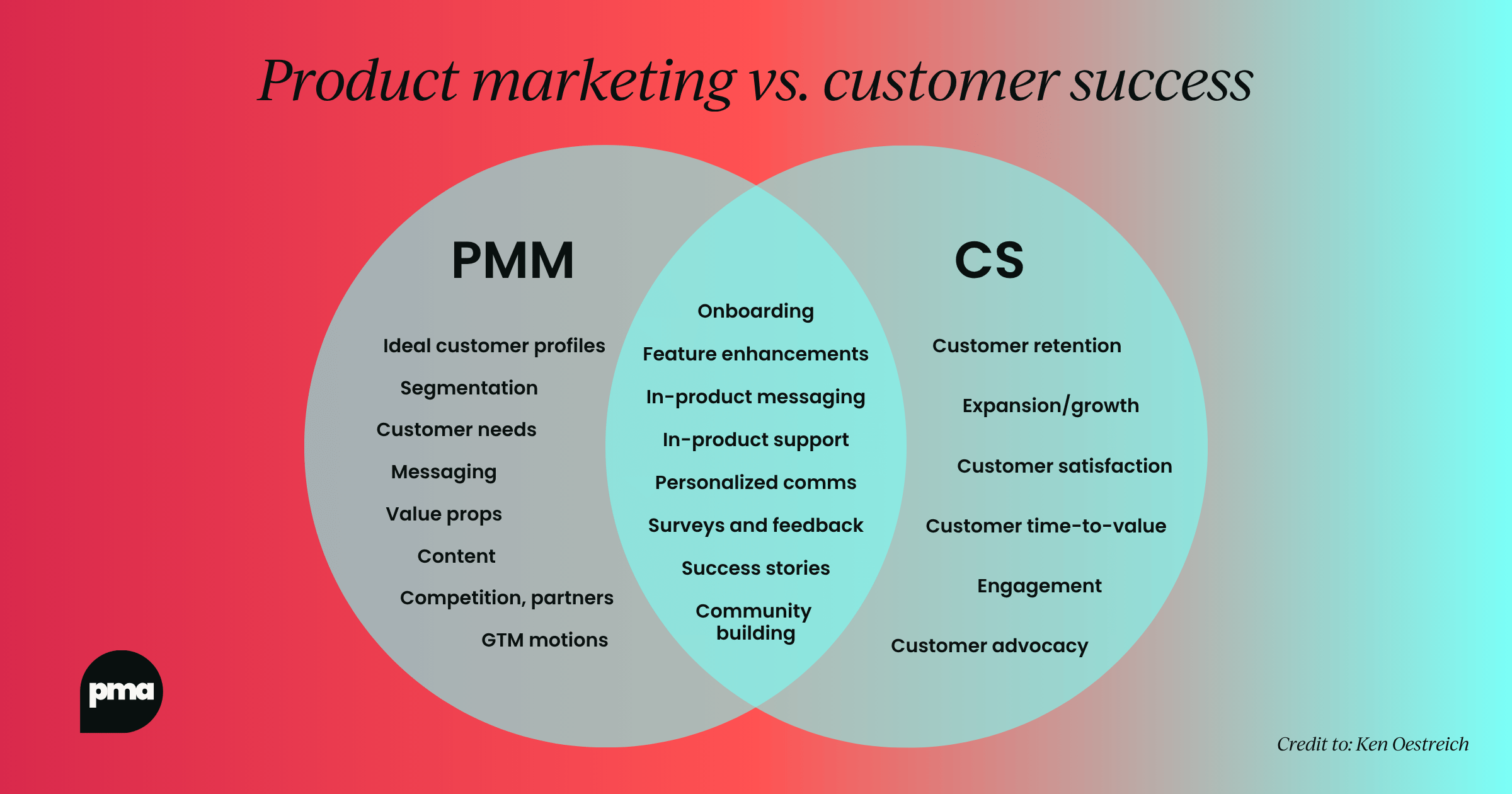
PMM owns the narrative of why your product matters, and that narrative doesn’t stop being relevant once a deal is closed. In fact, PMM can become more important when partnered with CS.
I collected the strategies below, looking through a customer success lens, but if you’re a PMM, treat each one as a collaboration opportunity. Your messaging, combined with CS’s customer intimacy, is one of the most underleveraged pairings in B2B SaaS.
1. Personalized outreach
Personalized outreach: CSMs assigned to high-value accounts should go beyond reactive support; they need to come prepared with usage data, adoption scorecards, and a clear understanding of the customer’s business outcomes so every interaction moves the needle on customer value. This works best on a quarterly cadence with a structured agenda that ties product usage to the customer’s stated goals, surfacing gaps before they become churn risks.
Digital-touch/tech-touch programs: Work well for long tail accounts that don’t warrant a dedicated CSM. You can use automated, behavior-triggered outreach (onboarding sequences, re-engagement nudges, milestone celebrations) to deliver a personal feel at scale.
Customer health scores: Another effective practice, combining usage frequency, feature breadth, support ticket sentiment, and contract data into a composite score that lets CS teams prioritize who needs attention right now.
Executive Business Reviews (EBRs): Include your internal champion and economic buyer, since they anchor the relationship at the decision-maker level… and hopefully create expansion opportunities.
Popular tools:
- ChurnZero focuses heavily on real-time usage alerts and in-app engagement tools that let CSMs intervene at the moment behavior shifts.
- Gainsight is a major CS platform that combines health scoring, playbook automation, and journey orchestration for both high-touch and digital CS motions.
- Totango provides modular “SuccessBLOCs” – pre-built CS programs for onboarding, adoption, and renewal that teams can deploy quickly.
- Vitally offers a lighter-weight, product-led CS platform, popular with growth-stage SaaS companies with real-time health scores and automated workflows.
2. Surveys and feedback
Regular surveys: Conduct surveys to understand user satisfaction and gather insights into areas for improvement. Time these to align to key lifecycle moments: e.g., post-onboarding, post-support interaction, and pre-renewal. Do all of this instead of blasting on an arbitrary calendar (contextual surveys get dramatically higher response rates and more actionable data).
NPS and other surveys: These are most powerful when you close the loop: every detractor response should trigger a workflow that routes to a CSM or support owner within 24-48 hours. Similarly, promoter responses should feed into advocacy and referral programs.
CSAT (Customer Satisfaction Score): Should be measured at the transactional level, e.g., after a support ticket resolution or a feature interaction. This will give you a granular, moment-specific signal that NPS alone misses.
CES (Customer Effort Score): Increasingly popular for SaaS because it measures how easy it was for a user to accomplish a task, which is a strong predictor of retention.
In-app micro-surveys: (One or two pop-up questions embedded contextually within the product) capture feedback while the experience is fresh… without forcing users out of their workflow.
Voice of the Customer (VoC) programs: Aggregate qualitative feedback from sales calls, support transcripts, community forums, and G2/Capterra reviews into a structured taxonomy also belongs here.
Popular tools:
- Delighted provides simple-to-administer NPS, CSAT, and CES surveys with scheduling and real-time dashboards.
- Medallia offers VoC analytics that pull together survey, text, and behavioral signals across every customer touchpoint
- Pendo combines in-app surveys and polls with product analytics to target feedback requests based on user behavior.
- UserVoice provides product feedback management, letting customers submit and vote on features/requests… with direct integration into product roadmap tools.
3. Multi-channel support
Multiple support channels: Can offer multiple support channels such as live chat, phone support, and email to address user issues quickly, but need to be unified behind the scenes. If a customer starts in chat, escalates to email, and then calls, the agent handling any of those interactions should see the full history without the customer repeating themselves.
Knowledge bases: Maintain an up-to-date knowledge base with FAQs, troubleshooting guides, and detailed documentation. These need to be treated as living products, not static doc dumps; assign ownership, track article deflection rates, and continuously update based on support ticket trends and new feature releases.
Community-driven support forums (peer-to-peer): These are high-leverage channels where “power users” frequently answer questions, reducing ticket volume while building customer advocacy and stickiness… and they’re also a HUGE opportunity for deriving customer feedback and product friction points.
AI-powered chatbots and conversational AI: Mostly used for initial engagement, they have matured significantly. Once they’re trained on your knowledge base and ticket history, they can resolve common issues instantly and escalate intelligently.
Popular tools:
- Freshdesk offers a full-featured help desk with AI-assisted ticketing, a knowledge base, and community forum capabilities
- Guru is an AI-powered internal/external knowledge management tool that surfaces answers directly inside the tools and agents that customers already use.
- Intercom combines conversational support with in-app messaging, bots, and a help center
- Zendesk is a widely adopted omnichannel support tool, merging email, chat, phone, and social into a single workspace with a robust knowledge base and AI features.
4. Proactive communication
Feature announcements: Regularly communicate new features, updates, and improvements through email, in-app messages, and newsletters. These comms should be segmented by relevance… e.g., a new API endpoint matters to your developer persona, not to a marketing admin, so blasting the same update to everyone creates noise and trains users to ignore your communications.
Usage tips: Share regular tips and best practices to help users get more value from the product. These are most effective when they’re behavior-triggered rather than calendar-driven: For example, if a customer hasn’t used a feature that’s directly related to their use case, surface a tip at that moment rather than in a generic monthly newsletter.
Automated “time to value” nudges: Triggered when a user hasn’t completed a core activation milestone within a defined timeframe. Turns out these are one of the highest-ROI proactive motions a CS team can run.
Customer lifecycle email campaigns: Tailor these to the user’s maturity stage (e.g., new, active, at-risk, power user), ensuring communications stay relevant rather than generic.
Webinars and office hours: Used for ongoing education, create a scalable, high-engagement channel that also builds community. But again, target these and their topics to specific customer types and roles!
Changelog and product update hubs: For example, publicly accessible, structured release notes that give engaged users a self-serve way to stay current. And, for technical products, this is an expectation from technical users.
Popular tools:
- Appcues is a no-code in-app onboarding flow designer, with announcements and NPS surveys targeted by user segment or behavior.
- Beamer offers an in-app changelog and notification center where users can discover new features and updates
- Chameleon lets product and CS teams build targeted in-app tours, tooltips, and banners without engineering resources.
- Customer.io is a messaging automation platform for behavior-triggered email, push, SMS, and in-app messages across the customer lifecycle.
If you’re a PMM who hasn’t sat in on a QBR lately, that’s your first move. Ask your CS lead to include you in the next round of account reviews. You’ll hear how customers actually describe the value they’re getting (or not getting) in language that’s often strikingly different from your positioning docs. That gap is where your next actions live.
Then, pick one PMM/CS motion from the strategies above (e.g., onboarding emails, feature announcements, health-triggered outreach) and offer to co-own the goal. Build a shared dashboard and a willingness to treat post-sale engagement as a product marketing responsibility, not just a CS one.
The companies that sustain PMF over time aren’t the ones with the best launch playbooks. They’re the ones where the people who shape the story and ensure value is continually delivered.