We all know that backlinks are important. But as search engines become smarter, it’s important to look at other off-page SEO factors, too. Unlinked brand mentions and in-context references to entities like employees, products, and locations are growing in importance.
These metrics are used by Google and Bing to assess trust and visibility. And they’re also crucial in improving visibility on AI platforms like ChatCPT, Gemini, and CoPilot.
In this guide, we introduce the brand-to-links ratio—a useful idea when thinking about how much time, effort, and money to put into building your brand vs. how much to invest in building links.
Ready? Let’s jump in.
The end of “link or nothing” SEO
Gaining followed backlinks has been—and remains—a key part of SEO.
Over time, however, the focus has shifted. Our understanding of Google’s algorithms has improved, and those algorithms have evolved to combat spam. We’re more interested in the quality of links than the quantity these days. And we’re aware that nofollow links should be part of the strategy if you want to avoid penalties.
The SEO toolkit you know, plus the AI visibility data you need.

But is it time we looked beyond backlinks as a primary source of brand authority?
Way back in 2014, Moz founder and search industry veteran Rand Fishkin suggested that brand mentions on the web were treated as “implied links” by Google. He was referencing a patent, though, so it may not have been the case in practice at the time.
Now, however, it looks like brand mentions could have a genuine impact on rankings. We still need links, but it’s time to include unlinked mentions in your strategy as well.
Google’s changing attitude towards backlinks
In the late ‘90s, when Google first came on the scene, backlinks underpinned the way the search engine worked. Their PageRank formula measured the number and quality of links (to an extent) and was a major factor in deciding which sites should rank.
However, Google has downplayed the importance of links several times over the years. In a 2014 video, Matt Cutts—who was head of the webspam team at the time—said:
“Over time, backlinks will become a little less important.”
This makes sense because as Google’s algorithms have become more sophisticated, they’ve started to look at other metrics of quality and trust.
Googlers Gary Illyes, John Mueller, and Duy Nguyen have made similar statements in recent years. Illyes said that links weren’t a top three ranking factor in 2023, and a 2024 spam policy update removed this line in relation to the importance of links:
“Google uses links as a factor in determining the relevancy of web pages.”
Were the comments made to discourage people from using links to manipulate the rankings? Maybe. But Google has repeatedly expressed their intention to reduce the importance of backlinks, and it seems logical to assume they’ll continue to push in that direction.
Dig deeper: Learn more about the history of Google’s attitude towards backlinks.
Brand visibility and entity trust
So, what are the other signals that Google’s currently using alongside backlinks? Two important ones are brand visibility and entity trust.
A recent LinkedIn post from Jeremy Moser, CEO at uSERP, highlighted this point:
“Both Google and Bing value brand mentions + citations in addition to backlinks.
Google uses them as reinforcement to link authority, while Bing can sometimes surface them instead of links when your on-page and entity signals are strong.”
It’s not just the mentions themselves that are important, though. Google uses natural language processing (NLP), machine learning systems that can understand human language, semantic relationships, content themes, and sentiment.
Having lots of mentions of your brand online is great, but where you’re mentioned and in what context matters, too. That’s what contributes to search engines’ trust and understanding of your brand as an entity.
Generative AI platforms like ChatGPT are also looking at similar signals. As ChatGPT prefers to surface Wikipedia and Reddit as sources, it’s not much of a stretch to think that maybe being mentioned on those platforms has more weight as well. Google AI Mode, on the other hand, surfaces a wider variety of platforms.

Let’s say you’ve set up a news and business site called Pique. You don’t have many links yet, but you start getting mentioned in the same context as established publications like Forbes, The Economist, and The Wall Street Journal. Those mentions would give your site a level of legitimacy and trust, and can be used as a ranking signal by the search engines and AI.
So, not only does building your brand as an entity give you more visibility as users explore the web, resulting in higher clickthrough and conversion rates for your brand, it improves your visibility on search engines and in AI platforms, too.
The brand-to-links ratio (BLR)
If search engines and AI platforms are looking at brand visibility and entity trust as well as links, it doesn’t make sense to only measure things that relate to links, like authority score and the number of linking domains.
Instead, it’s time to start including other metrics in the mix. What those are will vary from business to business, but one to consider is something like a brand-to-links ratio. By looking at the proportion of brand mentions to backlinks, you can strive for the right balance to maximize your SEO results.
For instance, let’s go back to our made-up news site, Pique. That site likely has a high brand-to-links ratio as it’s managed to get lots of brand mentions and media coverage, each of which isn’t necessarily accompanied by a link.
What a successful ratio looks like will very much depend on your brand, your industry, and your goals. We look into this in more detail below.
The shift from link graph to entity graph
Search engines have evolved. They aren’t just counting links anymore—they’re mapping entity relationships.
But what does that mean, exactly?
A network of links between websites is one way to understand their relationships and relative importance. Google has a map of all those links—it’s called the “link graph.” But a link graph isn’t the only way of understanding brands.
We’ve already mentioned entities in this guide—they’re crucial to establishing a strong brand-to-links ratio. Entities are all of the nouns related to your business: your staff, your products, related concepts in your industry, and so on. Those entities have relationships as well; multiple sites mentioning your entities is an alternative signal of authority and trust that search engines find valuable.
Those entity relationships are part of a huge database which Google calls the Knowledge Graph. But more generally, we can refer to them as “entity graphs.”
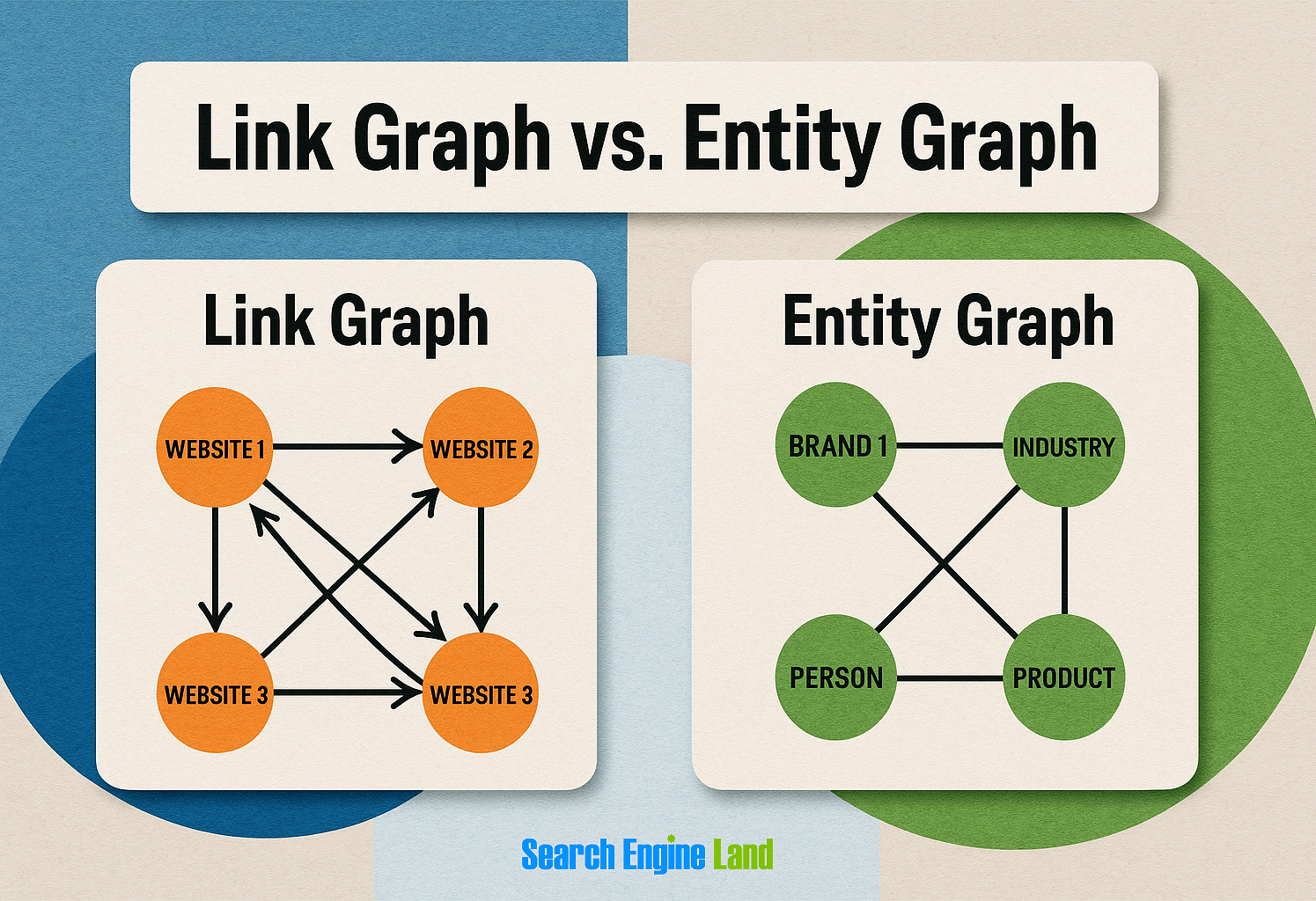
Over time, the importance of entity graphs has increased as search engines use AI to better understand language and semantic relationships. At the same time, the importance of link graphs has fallen due to search engines finding other ways to identify the most relevant results.
Once you add the fact that generative AI platforms also judge brands as entities, their importance skyrockets, especially as AI has become part of ordinary Google searches in the form of AI Overviews.
Entities and E-E-A-T
People can be entities, and those entities tie in with Google’s emphasis on expertise, experience, authoritativeness and trustworthiness—E-E-A-T. Why? Because it’s the people in the business that hold that expertise, not the company itself.
You should have authors on your blog posts and real people on your About Us page. But those people should also be included as entities alongside mentions of your brand elsewhere online.
Adding a quote from a relevant person to your press releases, along with their job title and credentials, is a simple way of creating a valuable entity for your brand.
What is a mention, anyway?
When it comes to terms like “mentions” and “citations,” the emergence of generative AI has changed their meaning slightly.
The word “mention” in an SEO context used to refer solely to the web—usually without a link attached. It was your brand name appearing on a website other than your own, like Pique being mentioned on the Forbes website.
Now, the definition is a little broader.
Mentions or brand mentions: Where the name of your brand appears on a third-party property (for example, a website, in AI search results, on social media).
When people say “mentions,” they usually mean instances where there isn’t an accompanying link, but really, it doesn’t matter if there’s a link or not.
If you want to be more specific, you can use terms like:
- Web mentions: Mentions on third-party websites
- AI mentions: Mentions in generative AI results
- Unlinked mentions: Mentions that aren’t accompanied by a hyperlink
The word “citations” on its own is a little ambiguous these days as well. Ideally, we should be more specific here:
Structured citations or local SEO citations: A type of web mention that includes the brand name, address, and/or phone number (NAP). Structured citations use a standardized format that’s easy for search engines to understand, and they’re useful for local SEO. For example, a listing on Trip Advisor that featured the address would allow Google to tell if the “London Hotel” is actually in London.
AI citations (also known as sources or source citations): Where the brand name or website domain is listed after a piece of information in a generative AI response, showing where the information has come from. For example, if you ask Perplexity if Sean Bean always dies in films, it tells you it’s sourced some of the information in its response from Screen Rant.

Mentions and backlinks from the web and social media can affect traditional SEO in Google search, but they also have a huge impact on how likely you are to show up in AI responses. In essence, gaining more brand visibility on the web and social media feeds demonstrates how authoritative and trustworthy your brand is. Which, in turn, leads to more visibility in SERPs and AI responses.
Co-citation, co-mention, co-occurence, and co-reference
This topic is also a minefield of words starting with “co-”:
Co-citation
A co-citation is when two websites, brands or entities are mentioned together by a third party, which suggests a relationship between those things. “Citation” here has the more general meaning of referring to a source, as this term comes from the world of academic papers.
Co-citation can help Google understand that two brands are part of the same industry. For example, when Ben and Jerry’s and Häagen-Dazs are compared by Reddit users, search engines and AI platforms can understand that these are two of the most popular ice cream brands worldwide.
Co-mention
Similar to but slightly more general than “co-citation,” a co-mention is simply when two entities are mentioned in the same page, paragraph, or sentence, often without a direct comparison or link.
For example, if a user posted a list of their favourite ice cream flavors on Threads, Ben and Jerry’s and Häagen-Dazs might be mentioned, but they aren’t being directly quoted or compared.
Co-occurence
A co-occurrence is when words and phrases appear together in the content of a page or pages. In this way, Google can learn to associate your brand with certain phrases or themes.
For example, Ben and Jerry’s might be associated with things like ice cream, quality, flavor, sustainability, or activism.
Co-reference or semantic co-reference
A co-reference or semantic co-reference is where search engines can understand from the context of the page that two or more different terms refer to the same entity.
For example, in an article about Ben and Jerry’s, “the brand,” “the ice cream manufacturer,” and “the company” could all mean the same thing.
None of these “co-” terms imply that they’re accompanied by a backlink—although they might be!
In a nutshell, they relate to search engines’ and AI’s ability to understand language and the relationships between entities and words thanks to clever systems based on machine learning.
It’s not just how often you’re mentioned, but where and in whose company that matters. They collectively improve overall SEO by building the understanding of your brand as an entity.
If you’re often found alongside other popular brands and in content that’s thematically relevant and includes the right keywords, you’re more likely to be surfaced in relevant results.
Brand mentions as modern authority signals
Let’s look at the importance of brand mentions in terms of both traditional and AI SEO.
Brand mentions and traditional SEO
Although Google hasn’t explicitly said that they’re using web and social media-based brand mentions as an SEO signal, they’ve implied it.
For example, Illyes said this at Brighton SEO in 2017:
“If you publish high-quality content that is highly cited on the internet—and I’m not talking about just links, but also mentions on social networks and people talking about your branding… Then you are doing great.”
Google also has patents related to something called “context scoring,” which looks at how relevant and natural the content surrounding a link is. It makes sense that this could also apply to brand mentions, looking at the words and phrases that appear close to the brand name in the text.
Bing has been even more explicit. In 2016, Duane Forrester said this at SMX West:
“Years ago, Bing figured out context and sentiment of tone, and how to associate mentions without a link. As the volume grows and trustworthiness of this mention is known, you’ll get a bump in rankings as a trial.”
By combining these official statements with what we know for sure about the technologies these companies use, we can make some inferences about what factors are important for SEO:
- The number of mentions
- The sentiment behind the mentions (i.e., whether they’re positive or negative)
- What sites the mentions are on and whether those are themselves trusted
- Co-citations alongside other entities or brands (if two brands or entities appear more frequently or in closer proximity, they may be given a stronger “co-citation weighting,” which could be a stronger signal for SEO)
- Co-occurrence of the brand with relevant keywords and themes
- The inclusion of entities such as employee and product names
- E-E-A-T in relation to the brand and its employees
Whatever the current situation, web and social media mentions are likely to have an increasingly greater effect on traditional SEO as time goes by—particularly as AI becomes more integrated into search.
Brand mentions and AI SEO
The data here is very clear: Brand awareness and mentions on websites and in social media have a big impact on AI visibility.
By “AI visibility,” we mean mentions and source citations in AI-generated responses on platforms like Google’s AI Overviews, ChatGPT, and Perplexity.
A study by Nick Haigler suggests that the more times a brand is searched for online (based on its monthly search volume, or MSV), the better its AI visibility is.

Brand mentions across the web show a similar correlation. We also know that Google’s AI Overviews look at the content surrounding brand mentions, as there’s another context scoring patent related to it.
There’s some less direct information that hints at a correlation between brand mentions and AI SEO performance, too. Semrush’s AI Visibility Index report noted that certain AI platforms have a preference for citing particular websites. For example, as we mentioned earlier in this guide, ChatGPT favors Reddit and Wikipedia.

That doesn’t necessarily mean that ChatGPT weighs web mentions on those sites more heavily, but it wouldn’t be surprising if that turned out to be the case. Being mentioned on those platforms more often certainly wouldn’t hurt.
An example: Semrush recently improved their AI share of voice from 13% to 32%. How? Through a combination of identifying target searches, optimizing existing content, adding new content, and generating brand visibility on platforms such as Reddit and Quora.
Defining the brand-to-links ratio
Put simply, the brand-to-links ratio (BLR) is equal to brand mentions + citations ÷ links.

Say your site has 900 mentions, 100 citations, and 600 links. That’s a ratio of 1,000:600, which can also be expressed as 5:3.
5:3 is a bit cumbersome for comparison, though, and tricky to work out.
That’s why we suggest simply dividing brand mentions and citations by the number of links—a slightly different way of expressing the ratio mathematically. In this case, that gives us a result of 1.67.
Using the division method, a number greater than 1 means you have more brand mentions than links. That’s the expected result here, because you’d expect some mentions to be unlinked, and most links will include a mention, too.
Factors to consider
Back in the day, we’d have just been talking about web and social media citations. A low ratio would have been better, because we were only really interested in links. They were the main factor driving SEO visibility. Web and social media mentions were just an interesting sidenote.
Now, we’re more interested in web and social mentions than before. They drive AI visibility and can even be used as a proxy for visibility across all SEO channels. So a higher ratio might work for you.
You’ll need tools to get the numbers to plug into the formula, and that’s something we explore in more detail below.
Additionally, you’ll need to consider a couple of other factors. For instance, AI mentions and citations are now a thing. Should those be included in the formula?
You may choose not to include them because AI mentions and citations are one of the things you’d seek to influence in having a higher proportion of web and social mentions. AI tools aren’t looking at their own responses to make decisions on which brands and entities to surface.
Also, you should decide whether to use the raw numbers of mentions and backlinks, or the number of pages with links and mentions. If there are five links to your site on one page, does that count as five or one?
Which you choose might come down to the data you have available. The important thing is consistency. If you include raw numbers of mentions and citations on one side of the equation, you should include raw numbers of backlinks on the other side.
What’s a healthy ratio?
What represents a healthy ratio for your site will depend on a number of factors:
- The industry you’re in: Competitive niches may rely more on backlinks and therefore have a lower BLR. Your Money or Your Life (YMYL) sites would be a good example. On the other hand, a skincare brand with a genuine review on TikTok that goes viral could have many more mentions than links, resulting in a higher BLR.
- Your traditional SEO and AI SEO goals: If brand awareness or AI visibility are key goals, the ratio may need to be higher. If traditional SEO is more important, it could be lower.
- How developed your brand is: Newer sites and less-well-known brands may need to focus more on backlinks initially, as links have more direct traditional SEO impact than mentions (for the moment, anyway)
- Your existing domain authority vs. competitors: If you already have a much higher authority from backlinks than competitors, you might be able to afford to put more effort into pursuing mentions and building your brand
While it’s difficult to put an exact number on what ratio is ideal, you want it to be more than 1. Why? Because lower numbers suggest unnatural linking patterns. It would mean you have many links without your brand or domain being mentioned in the text, and that could be a spam signal for Google.
If your BLR is too high, on the other hand, you’re potentially missing out on backlinks you could get from those unlinked mentions via outreach. Or perhaps you’re putting too much effort into branding activities while ignoring the need to generate some backlinks, too.
High and low BLR sites
So what might high and low BLR sites look like?
High BLR sites are visibility-rich and link-light. They’re part of genuine conversations on social media and other platforms, and are likely to be surfaced more often in AI responses.
They may also enjoy higher click-through and conversion rates, thanks to the boost in brand recognition.
Retail brands that get a lot of social media engagement, such as clothing and cosmetics, might fall into this category. It’s safe to imagine that most people who mention Nike in any form on the web are not linking to the corporate site.
Low BLR sites, on the other hand, are link-heavy but weak on brand. This may work well in competitive industries where authority from backlinks is still of primary concern. However, they’re likely to be missing out on AI visibility and brand recognition as a result.
B2B brands like SaaS companies often fit this pattern. For example, online mentions of Basecamp are more likely to be product reviews or walkthroughs than casual mentions by consumers.
Measuring brand presence across surfaces
So, how do you actually work out your brand visibility? There are a number of metrics and tools that can help to do just that.
- Organic brand search: Google Analytics and Google Search Console can give an idea of how often users are searching for your brand and related terms, and how much traffic your website gets from branded queries
- Entity trackers: Tools like Yext use named entity recognition technology that allows you to build your own entity graph for your brand
- Social listening and brand monitoring tools: These tools monitor social media platforms, media outlets, and websites to track mentions and discussion about your brand. Although different tools have slightly different capabilities, some, like Sprinklr, also include sentiment analysis.
- AI visibility tools: Tools like Semrush’s AI Visibility Overview score how often you appear in generative search results. We take a closer look at this tool below.
By combining data from these different sources, you can work out your site’s overall brand visibility index (BVI). This measures the visibility of your brand in relation to your target audience, across multiple channels (e.g., organic search, social media, AI search, brand mentions on the web).
With brand discovery going far beyond organic search these days, having a more holistic view will help you assess performance and identify gaps much more effectively.
Brand visibility workflow
To understand your brand’s visibility and BLR, it’s useful to do a series of audits on your backlinks, entities, and your AI and web visibility.
For the backlink audit, tools like Semrush’s Backlink Audit tool are ideal. They allow you to review link quality, disavow low-quality links, and access overall link metrics.

You can also use Google Search Console to find out the number of backlinks or linking pages pointed at your site, which can be useful for calculating your brand-to-link ratio. However, auditing links here is much more of a manual process.
An entity audit is a useful tool for semantic SEO, which helps Google understand words, their meanings, and the relationships between them. Entities are a key part of semantic SEO because they’re words that Google needs to have a clear understanding of.
The audit can start with a simple look through your site (or just the key pages if it’s very large) to note down the entities you find there—your brand name, employee names, products, locations, and so on.
Track, optimize, and win in Google and AI search from one platform.
Search for the most important of these on Google. Does relevant information come up? Or is there another brand that shares your name that’s taking up the Knowledge Panel on the right side of the Google search?
If you discover any issues or anything missing, consider how to adjust your content to better represent the entities in question. And check your schema markup, too.
For example, when Google was surfacing information about a baseball player instead of the Editorial Director of Search Engine Land in search results, creating a new, simple website about him was part of the solution because it was a single source of truth.
You can also ask ChatGPT for SEO entity suggestions based on your brand, a competitor, or a relevant keyword, and see whether they’re on your site or in third-party content about your brand.
Further reading: To dig a little deeper into entity SEO, take a look at our guide to Entity-based competitor analysis.
Finally, audit your brand’s visibility across various platforms using social listening tools and AI Visibility Overview.

This tool gives key metrics on AI visibility, including mentions, source citations, and monthly audience. But it also gives insights into exactly what content drove those mentions—incredibly useful for working out what part of your content and outreach strategies are working.

Even more importantly, perhaps, are AI prompts where your brand was “missed.” This kind of gap analysis is great for finding opportunities where better content or more relevant web and social media mentions could help you appear for similar AI prompts in future.
Your AI visibility also gives an indirect indication of how strong your brand is on the web and social media—the strength of your brand as an entity on those platforms is one of the key ranking factors for AI SEO.
Overall, it’s useful to look at a variety of tools and metrics and figure out what’s right for your business. It’s clear that organic traffic and website rankings are no longer enough for many brands. Whether you work out your brand-to-link ratio or use another metric, taking a wider view of brand visibility is likely to be beneficial for many brands.
Strategic implications for SEOs and marketers
Why should you care about all this?
Because the times they are a-changin’. You or your organization may already be doing some kind of PR activity, thought leadership, or content syndication. And you may even have leveraged those activities for link building. But now, those things can influence rankings indirectly—even when there is no link.
If you’re completely focused on link building, and all your budget is allocated to that, now’s a good time to step back and assess the landscape. For instance, are you prioritizing traditional SEO at the expense of AI visibility?
Whether your BLR is low or high, it’s a metric that you can compare with what you think might be ideal for your business. Then, compare that with how budgets are split between link building and brand building activities. Is the ratio of budget similar to the BLR you’d like to achieve? If not, is it time to reallocate some of it?
Consider moving from “DA farming”—focusing purely on links from sites with high domain authority—to “entity trust compounding.” That means reducing artificial and potentially spammy link-building tactics, and instead moving to a more sustainable model of building brand awareness and reputation.
Each time your brand is mentioned online, it should ideally reinforce your credibility. That may mean introducing digital PR campaigns that are less focused on links and more on being part of conversations in the places where your audiences live online.
A great example is IKEA’s “The Co-Worker” campaign. They made a game in Roblox where players could work in a virtual IKEA store, with furniture, meatballs, and Blåhaj sharks galore. The response was massive. They generated over 2,000 media articles worldwide, with 16 billion (yes, with a “b”) impressions.

Preparing for the AI-visibility era
Increasing your web and social media brand mentions can have a substantial impact when it comes to visibility on generative AI platforms. As a general rule, high BLR means better AI visibility.
SEOs can’t really afford to just look at metrics like organic traffic, search rankings, and authority score anymore. Not to say that those things aren’t important. But the search landscape is becoming more fragmented, with users turning to AI, TikTok, and other platforms to discover brands to purchase from.
Visibility is more important now—not just on Google, but as a unified metric across the web, AI, and social media.
A focus on metrics like brand-to-link ratio not only helps with AI visibility today, it prepares your SEO for a future where backlinks may no longer matter. AI and traditional search are likely to become more and more entwined, and search engines may shift from backlinks to brand signal weighting in their ranking models.
From backlinks to brand equity
Revolutions don’t happen overnight, but they appear to.
It’s likely there will be a watershed moment in months to come. Those who put the effort into brand building now will be rewarded. And those who don’t could be left behind.
The brand-to-link ratio isn’t anti-link. Links are still important and are likely to continue to be for some time. But it’s pro-brand, and unashamedly so.
The new SEO north star is to be the entity worth mentioning. And being able to measure that is a key part of the equation. Metrics like BLR, AI visibility, and brand visibility index can help.
So, how do you know which metrics you should use? Part of that is knowing who you’re talking to.
Find out more about SEO stakeholders, aligning teams, and proving ROI.