Every construction project starts with a conversation: who’s paying, what’s being built, by when and at what cost. A construction project charter turns that conversation into an official document. It formally authorizes the project, names the project manager, defines the scope and budget at a high level, and identifies the key stakeholders who have a say in how decisions get made. Before a single shovel breaks ground, the charter gives everyone — owner, contractor, subcontractors and project team — a shared record of what was agreed to and who is accountable.
What Is a Construction Project Charter?
A construction project charter is a formal document that authorizes a construction project to begin. It establishes the project manager’s authority to assign resources and make decisions, and it captures the foundational information the project team needs to proceed: project objectives, scope boundaries, estimated budget and schedule, key stakeholders and the risks that have been identified at the outset.
The charter does not replace a construction project contract or detailed specifications — it precedes them. It is written at the initiation phase, before detailed planning begins, and serves as the reference document that later plans are built from. A project charter is used across industries for the same purpose; in construction, it carries additional weight because scope creep and miscommunication between owner and contractor are among the most common sources of cost overrun and schedule delay.
Construction Project Charter vs. Construction Project Plan
These two documents are often confused, but they serve different phases and audiences.
A construction project charter is a short initiation-phase document — typically one to two pages — that formally authorizes the project and defines it at a high level. It is written before detailed planning begins and is approved by the project sponsor or owner. Its audience includes the sponsor, the project manager and key stakeholders.
A construction project plan is a detailed planning-phase document covering schedule, resource assignments, procurement, quality standards, communication protocols and risk responses. It is built after the charter is approved and is far more comprehensive. The charter answers “are we doing this and why?”; the project plan answers “how exactly will we do it?”
| Construction Project Charter | Construction Project Plan | |
| Phase | Initiation | Planning |
| Length | 1–2 pages | 10–50+ pages |
| Audience | Sponsor, stakeholders | Project team, subcontractors |
| Authorizes | The project and the PM | How the work will be executed |
Manage Construction Projects With ProjectManager
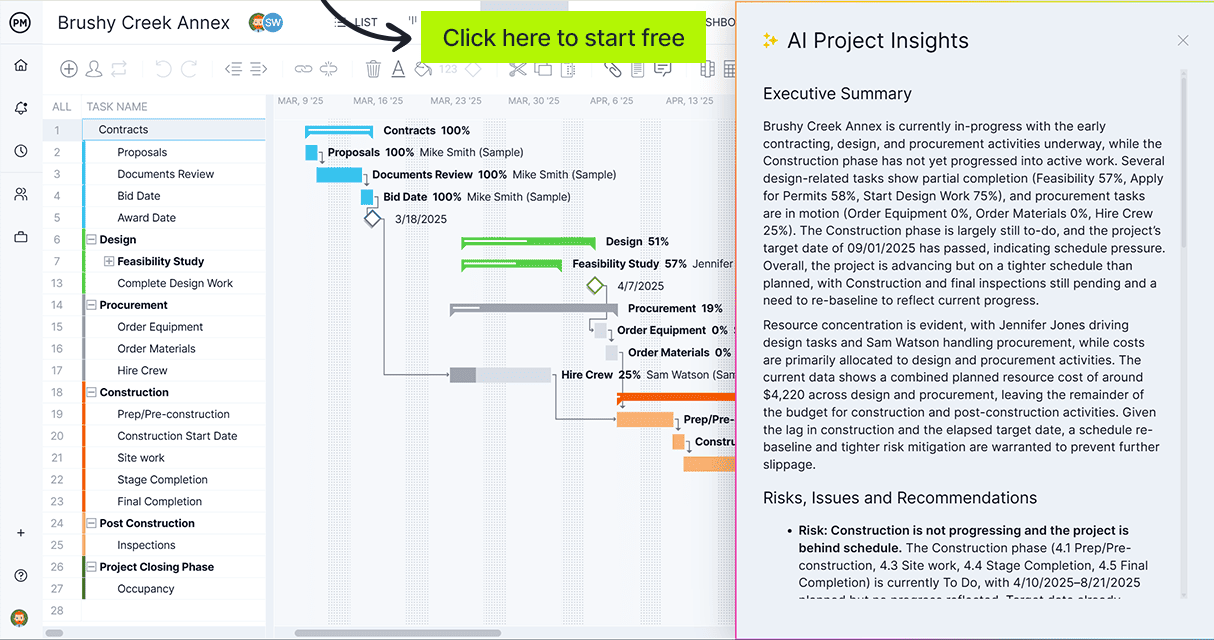
ProjectManager is online project management software with Gantt charts, real-time dashboards and resource tracking built for construction project managers. Try it free for 30 days.
Why Use a Construction Project Charter?
Construction projects involve large budgets, long timelines and multiple parties whose interests don’t always align. A project charter creates clarity at the moment when it costs the least — before the project is underway.
- Establishes the project manager’s authority. In construction, authority over resource allocation and decisions is often contested. The charter formally grants the project manager the authority to direct resources and make project decisions, reducing the risk of jurisdictional disputes mid-project.
- Aligns owner and contractor on scope. Scope disputes are the most common source of construction claims. A charter that defines what is and isn’t included — even at a high level — creates a written baseline that both parties have signed off on before detailed scoping begins.
- Surfaces risks before they become problems. The charter is written when the project team has enough information to identify the most significant risks but before commitments have locked in a response. Documenting construction risks at initiation creates a foundation for the risk register that follows in planning.
- Gives stakeholders a reference point. Owners, lenders, inspectors and subcontractors all interact with a construction project at different points. A charter gives each of them a single document that answers the most basic questions — what is this project, who’s in charge, what’s the budget, when does it finish — without requiring access to detailed plans.
Free Construction Project Charter Template
Rather than building a charter from a blank document, start from a structured format. ProjectManager’s free project charter template is ready to fill in — add your project details, scope, budget and stakeholder list.
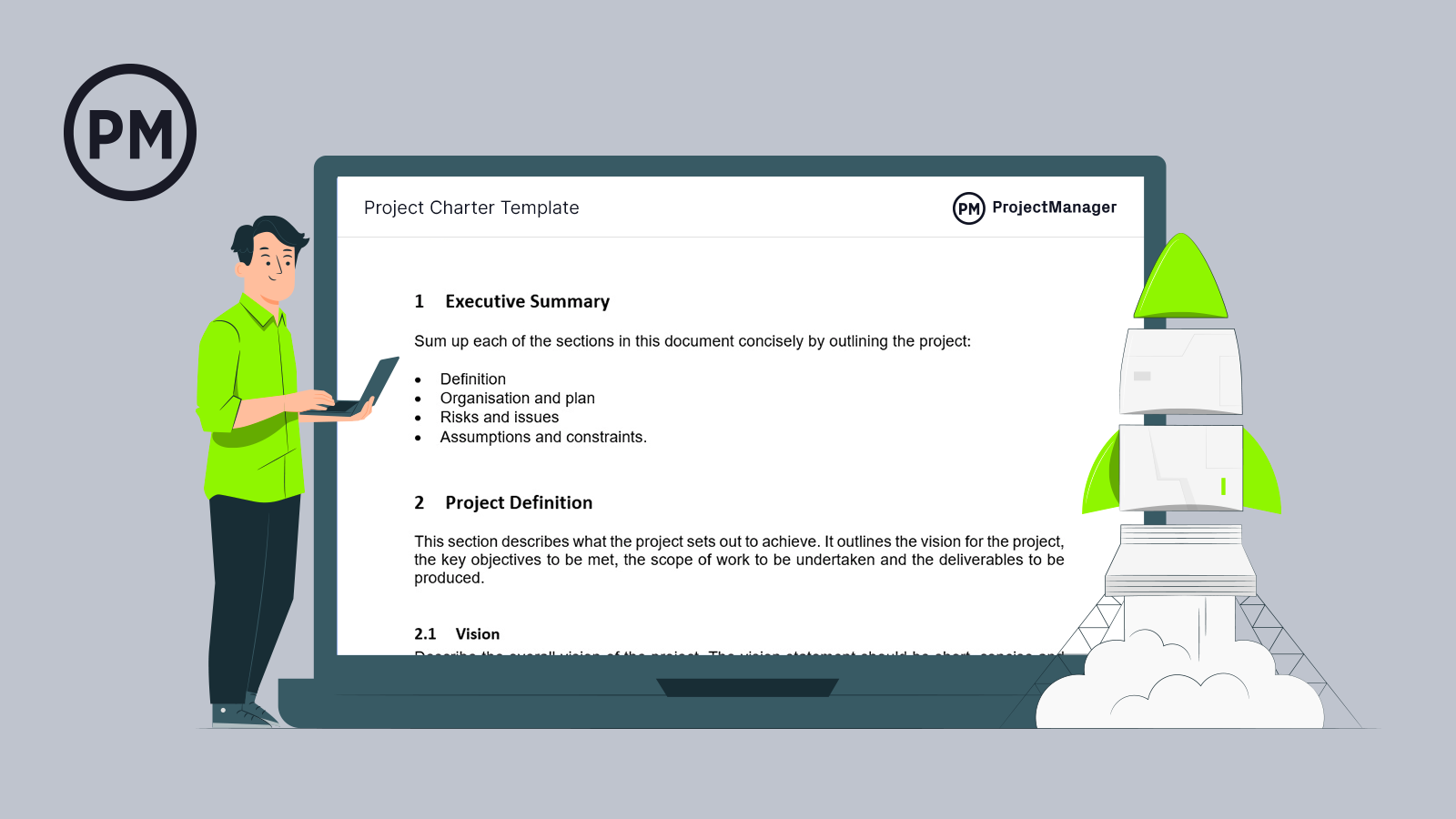
Download it free and adapt it to your construction project.
How to Create a Construction Project Charter
Follow these steps to build a charter that gives your construction project a solid foundation before detailed planning begins.
1. Define the project objective
Write a single statement that describes what is being built, why it is being built and what success looks like. A good construction project objective is specific enough to be verifiable: not “renovate the facility” but “complete a full interior renovation of the 4th-floor office suite, returning a fully functional workspace by September 30.” The objective anchors every subsequent decision in the project.
2. Define the scope at a high level
Identify what is included in the project and — equally important — what is not. In construction, explicitly stating what is out of scope is as valuable as stating what is in. A commercial renovation charter, for example, might specify that structural work is excluded and all finishes are owner-supplied. A clear project scope statement reduces the chance of additions being treated as inclusions later.
3. Estimate the budget and schedule
Record the approved or estimated budget and the target completion date. These are high-level figures at the charter stage — not the detailed cost breakdown or schedule that comes later in planning — but they establish the constraints the project team is working within. If the budget is an estimate pending full design, note that and record the approval threshold at which a revised charter would be required.
4. Identify stakeholders and assign the project manager
List every party with a meaningful stake in the project’s outcome: the owner, the general contractor, key subcontractors, the lender if applicable, regulatory bodies, and end users. For each stakeholder, note their role and the nature of their involvement. Name the project manager explicitly — the charter is the document that makes their authority official.
5. Document key risks and assumptions
Capture the three to five risks most likely to affect the project at the time the charter is written — permitting delays, ground condition uncertainty, long-lead material procurement — and the assumptions the project is being planned on. Assumptions that turn out to be wrong are one of the most common triggers for scope and budget changes; documenting them creates a record that supports change management later.
6. Get sponsor sign-off
The charter is not effective until it is formally approved by the project sponsor or owner. Signature from the authorizing party transforms the charter from a draft document into an official authorization. Some construction projects require sign-off from multiple parties — owner, lender, lead contractor — in which case the charter is the document that captures all approvals in one place.
What to Include in a Construction Project Charter
A construction project charter is a short document. Every element below should fit on one to two pages; if it is longer, it is likely including detail that belongs in the project plan.
- Project title and description — The formal name of the project and a brief description of what is being built or renovated.
- Project objective — A single statement defining the goal of the project and what success looks like.
- Scope summary — What is included and what is explicitly excluded from the project.
- Budget — The approved or estimated total project budget, with a note on whether it is fixed or subject to revision after detailed design.
- Timeline — Target start date, major milestones and target completion date.
- Project manager — Named individual, with a statement of their authority to direct resources and make project decisions.
- Stakeholders — Key parties and their roles: owner, contractor, lender, regulatory contacts, end users.
- Key risks and assumptions — Top risks at time of initiation and the assumptions the project is being planned on.
- Sponsor approval — Signature(s) from the authorizing party or parties.
Construction Project Charter Example
The following example shows how a general contractor would complete a construction project charter for a commercial tenant improvement project.
Project: Tenant improvement — 22nd floor office suite, 400 Main Street
Owner: Meridian Capital Group
Contractor: Summit Construction Group
| Field | Detail |
| Project objective | Complete a full tenant improvement of the 8,400 sq ft 22nd-floor office suite to a move-in-ready condition for a new tenant by November 14 |
| Scope — included | Demolition of existing walls; new open-plan layout per approved drawings; new electrical, HVAC and lighting; flooring, paint and millwork per specifications |
| Scope — excluded | Structural modifications; elevator lobby; exterior glazing; furniture and AV equipment |
| Budget | $1.25M (GMP); contingency of $75K requires owner approval to access |
| Target start date | August 18 |
| Target completion | November 14 (substantial completion); November 21 (final punch list) |
| Project manager | Dana Reeves, Summit Construction Group — authorized to direct subcontractors and approve field decisions within scope |
| Key stakeholders | Meridian Capital Group (owner); incoming tenant rep; city building department; mechanical and electrical subcontractors |
| Key risks | Asbestos identified in existing ceiling tiles (abatement required before demo); HVAC equipment lead time 6–8 weeks; permit approval timeline uncertain |
| Assumptions | Approved drawings delivered by August 11; existing structural slab in acceptable condition; elevator access available Mon–Fri 7am–6pm |
| Sponsor approval | Signed by Meridian Capital Group VP of Real Estate, August 12 |
Manage Construction Projects With ProjectManager
The charter gets the project authorized. Executing it requires tools that connect the authorization to the actual work — a live schedule, resource tracking and progress visibility that doesn’t require a site visit to access.
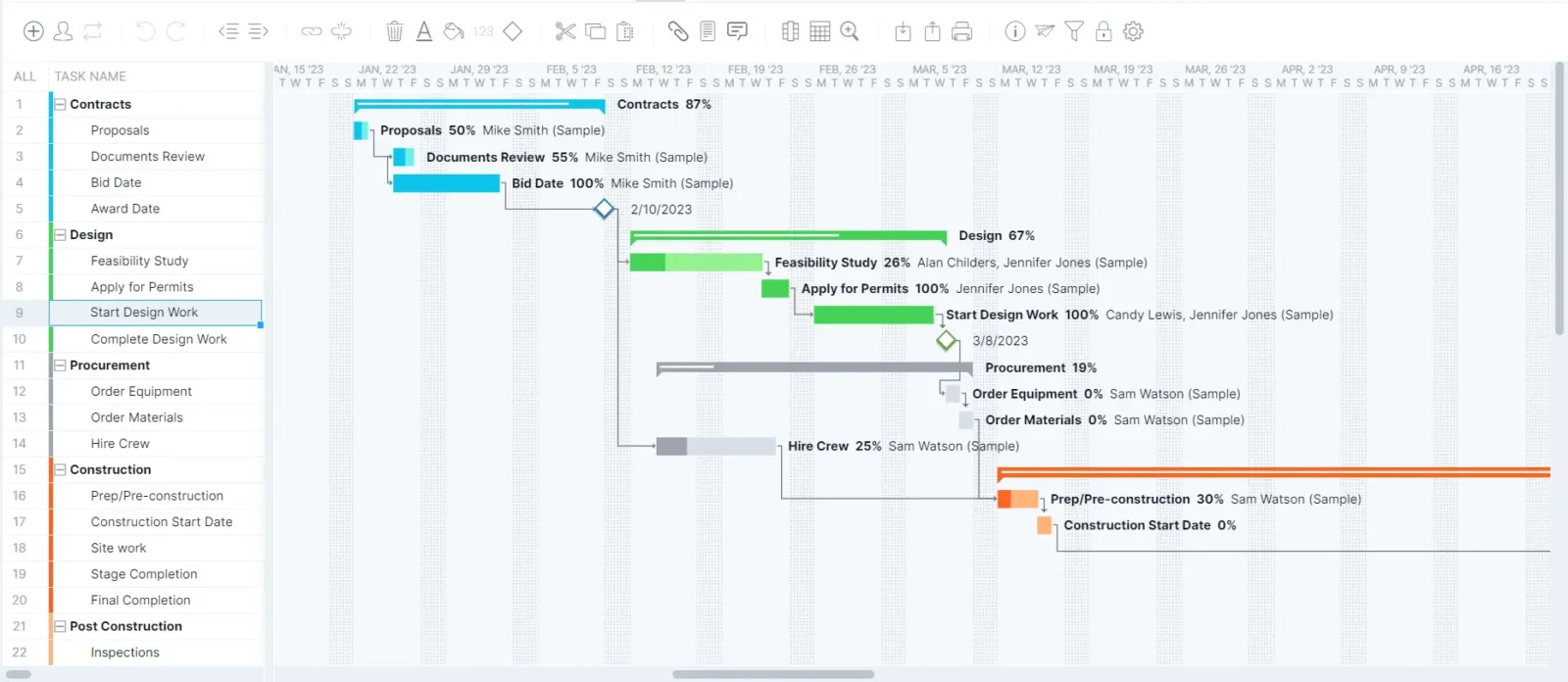
Build and Track Construction Schedules on a Gantt Chart
ProjectManager‘s Gantt charts let construction project managers build their full project schedule — phases, tasks, dependencies, milestones — in one interactive view. Assign tasks to subcontractors, link dependencies and set the baseline from the charter’s approved timeline. When scope changes, the Gantt updates immediately so the impact on the completion date is visible before a change order is drafted. Use it alongside a construction Gantt chart to keep every phase of the project on track from permit through punch list.
Related Content
- What Is a Project Charter? (Template & Examples Included)
- Construction Project Management: A Quick Guide
- Project Scope: Definition, How to Write It and Why It Matters
- Construction Risk Management: A Quick Guide
- Construction Gantt Chart: Benefits, Uses and Free Template
The post What Is a Construction Project Charter? (Example & Template Included) appeared first on ProjectManager.