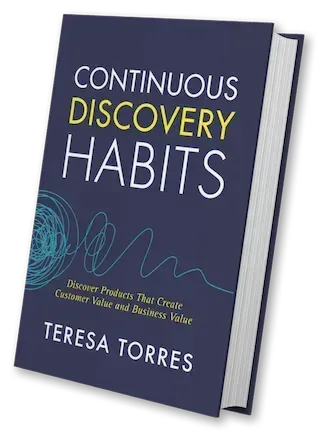
Continuous Discovery Habits turns five this year. And to celebrate we are reading the book together.
Each month, I am releasing an in-depth reading guide that includes:
- The chapters we will be reading
- A preview of the most important concepts we’ll be learning about
- Short videos you can share with friends and colleagues to help spread the ideas
- Individual and team discussion questions to help you absorb and engage with the reading
- Team exercises to help you put the ideas into practice
- Additional reading to help you go deeper on the core ideas
We’ll be discussing each month’s reading in the comment section and we’ll gather quarterly to discuss on a live call.
Joining late? No problem. I monitor the comments on each reading guide throughout the year. Start with the current month or go back to January—whatever works for you. You can ask for help, share what’s working, and connect with other readers at any point.
If you want to participate, grab a copy of the book (or dig up your old copy), share the “Spread the Love” videos, reserve some time to do the team exercises, and register for the community sessions. Let’s do this!
This Month’s Reading
Chapters:
- Chapter 9: Identifying Hidden Assumptions
Estimated reading time: ~28 minutes
This chapter will introduce you to:
- Why we need to test assumptions instead of testing whole ideas
- The five types of assumptions that underlie every product idea (desirability, viability, feasibility, usability, and ethical)
- How to use story mapping to surface hidden assumptions
- How to conduct a pre-mortem to uncover what could go wrong before you start
- How to use assumption mapping to identify your riskiest “leap of faith” assumptions
Need a copy? Grab the book
Share the Love with Friends and Colleagues
We learn best in community. Use the following short videos to share the key concepts from this chapter with friends and colleagues. Invite them to participate in the book club with you.
- 5 Types of Product Assumptions – Product ideas typically depend on five different types of assumptions
- Most teams don’t generate enough assumptions – Why you should aim for 20+ assumptions per idea
- Understanding desirability assumptions – Is your customer willing to do what you need them to do
- Getting started with compare and contrast decisions – Choose the right target opportunity
- Why we test more than one idea at a time – We want to guard against bias
Reflect & Discuss What You Read
When we reflect and discuss what we read, we absorb more of the material. It helps us put what we learn into practice. Don’t skip this step.
This chapter asks us to slow down and examine what we believe. Most product teams rush from idea to implementation, skipping the critical step of questioning their assumptions. This month, focus on developing the habit of identifying what needs to be true for your ideas to succeed.
Individual Reflection
- Think about a recent product idea you worked on. Can you identify 3-5 assumptions you were making? Which assumption category (desirability, viability, feasibility, usability, ethical) did you overlook?
- Do you tend to look for confirming evidence or disconfirming evidence when evaluating your ideas? How might this bias affect what you build?
- Reflect on a time you built something that didn’t work as expected. Looking back, which assumptions turned out to be false? Could you have tested them earlier?
Team Discussion
- As a team, pick one idea you’re currently considering. Try to generate at least 20 assumptions across all five categories. Which category was hardest for your team to generate assumptions for? What does that tell you about your team’s blind spots?
- Walk through a recent product failure or disappointment as a team. What assumptions were at play? If you had done a pre-mortem at the start, do you think you would have surfaced those risky assumptions?
- How does your team currently decide which ideas to pursue? Do you test whole ideas, or do you test underlying assumptions? What would need to change to adopt assumption testing?
Put It Into Practice
Identifying assumptions is a skill that improves with practice. These exercises will help you develop the habit of seeing your own assumptions and questioning them before you invest too much time and energy.
Exercise: Story Map and Generate Assumptions
Time: 60 minutes
Do this: With your product trio
Pick one of the three solution ideas you’re currently considering (ideally from your opportunity solution tree). Story map the idea by identifying the key actors and mapping out each step they need to take to get value from the solution. Remember: Assume the solution already exists—you’re mapping what end-users will do, not how you’ll build it.
Once you have your story map, go through it step by step and generate assumptions. For each step, ask:
- Desirability: Does the user want to do this? Are they willing to do it?
- Usability: Can the user find what they need? Do they understand what to do?
- Feasibility: Can we build this? What technical assumptions are we making?
Aim for at least 15-20 assumptions. Don’t worry about whether they’re perfectly phrased—just get them out.
Exercise: Assumption Mapping
Time: 20 minutes
Do this: With your product trio
Take the assumptions you generated in the story mapping exercise (or pick 10-15 assumptions from a current idea). Create a two-by-two grid with one axis labeled “Strong Evidence → Weak Evidence” and the other “Less Important → More Important.”
Quickly place each assumption on the grid based on:
- How much evidence do we already have for this assumption?
- How important is this assumption to the success of our idea?
Move fast—spend no more than 10 minutes placing all your assumptions. The goal is to position them relative to each other, not to be perfectly precise.
Identify the 2-3 assumptions in the top-right corner (most important + weakest evidence). These are your “leap of faith” assumptions—the ones you’ll want to test first.
Go Deeper: Additional Reading
If you prefer an audio summary of this month’s reading, including the book chapters and the following resources, I’ve included an audio version for paid subscribers at the bottom of this post.
Related In-Depth Guide
Supplementary Reading
- How Compare and Contrast Decisions Lead to Better Product Outcomes
- Stop Asking Whether or Not Questions
- Discovering Solutions: Quickly Determine Which Ideas Will Work (And Which Won’t)
- Evaluating Solutions: The 5 Types of Assumptions that Underlie Our Ideas
Other Voices
- User Story Mapping by Jeff Patton
- Assumption vs. Hypothesis—To the Death! by Tristan Kromer
- The Iteration Imperative by Jens-Fabian Goetzmann
Our Live Discussion Schedule
Our live discussion sessions are for paid subscribers. Sessions are not recorded. Invitations will go out to Supporting Members and CDH Members two weeks before the scheduled event. But reserve the time on your calendar now.
- Thursday, September 17, 2026: 9am-10am PDT
- Wednesday, December 16, 2026: 9am-10am PST
Audio Summary
This summary was produced by NotebookLM. The sources supplied were the book chapters as well as all of the additional reading.
This article is part of the CDH Book Club celebrating the 5-year anniversary of Continuous Discovery Habits. See all book club posts