There’s a fine line between a friendly “Hi Bianca” and a message that knows too much. When personalization crosses that line, it stops being helpful and becomes intrusive.
AI makes it easier than ever to cross this boundary, quickly and at any time.
Once that happens, the harm isn’t just a technical glitch. It’s emotional. Customer trust begins to fade quietly, often before you see any change in the numbers.
A little backstory
Last year, I was promoted to Senior Director. The biggest change wasn’t a corner office or the fancy title. It was what happened to my LinkedIn inbox.
Almost overnight, it filled up with messages offering everything from event chocolates and branded t-shirt designs to all kinds of “AI-powered” tools. Audio messages, videos, long emails, short ones, they all started the same way: “Hi Bianca!”
Suddenly, I was everyone’s ICP just because of a title bump.
Some messages were clearly written by people. Others didn’t feel that way. A few were so specific they made me pause and wonder how much was actually known, and how much was simply inferred.
Don’t get me wrong. I’ve worked in product marketing for ten years now, reporting to either Product, Marketing, or Sales. This latter experience made me see firsthand how tough cold outreach can be, and how often personalization is the main tool people have. I truly respect the craft and often thank BDs for reaching out.
But hardwired politeness can become a liability now that outreach is all automated.
Thanks, mom… (she’s a teacher).
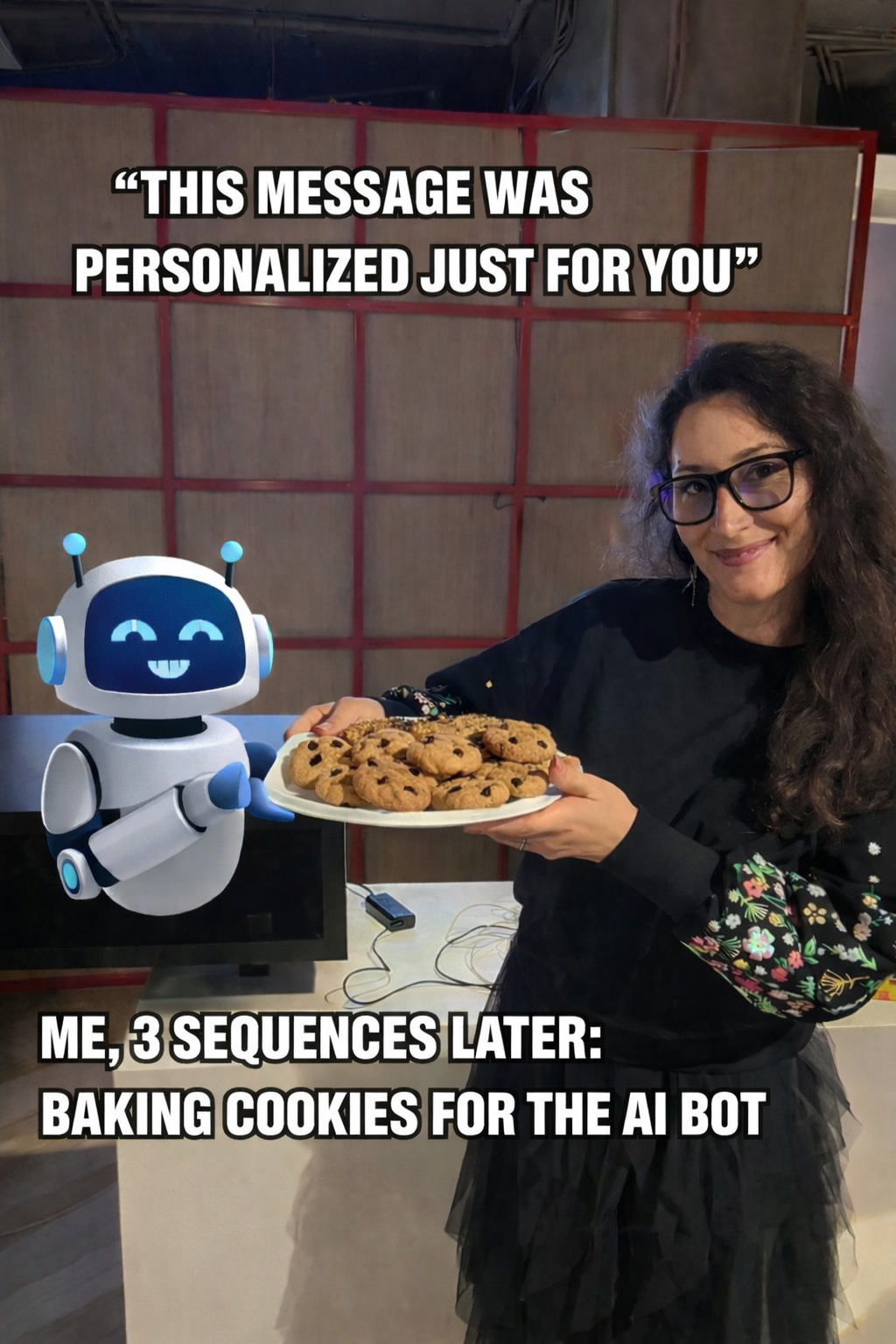
I realized that if this keeps up, I’ll end up befriending and baking cookies for sales bots.
This raised a bigger question in my head: how do we create personalized customer experiences without losing trust or crossing privacy boundaries?
When personalization stops feeling helpful
Personalization is meant to make experiences better – more relevant, more efficient, and more human.
And often, it does.
Product Marketing Alliance has already explained the practical side of personalization, from onboarding and lifecycle emails to advertising and social media. When used carefully, these methods reduce churn and make products stand out in busy markets.
But there’s an important question we don’t ask enough: just because we can personalize, should we?
The personalization paradox
Users expect personalization. They also expect privacy. In fact, 71% of users say they would stop supporting a company that mishandles their sensitive information, yet 82% of consumers respond positively to brands that advertise products they find useful.
In other words, people want relevant experiences without feeling watched. They want brands to understand them, but not look too closely. And that boundary isn’t static. It shifts over time and across regions.
Working across U.S. and European markets made this obvious to me early on. What feels perfectly acceptable in one region can feel invasive in another. Regulation plays a role, but culture matters just as much.
As I’ve written before with my adtech doppelgänger Bianca Galan, privacy and trust are the new currency in digital advertising. As a result, the line between helpful and creepy keeps moving, often faster than dashboards or attribution models can keep up with.
What privacy-first environments taught us early
Some industries were forced to confront this tension long before it became a mainstream conversation.
During my years in digital audio advertising technology, privacy was never just a future issue – it was something we dealt with every day. Audio is a deeply personal environment. It’s part of people’s routines and private moments, like cooking, running, and going to the gym. When personalization goes wrong in this space, it doesn’t just underperform. It feels intrusive.
That’s why many audio strategies are developed without depending much on third-party cookies or invasive tracking. Instead, they focused on context, timing, and creative fit, not on knowing exactly who the listener was. Podcasting is a good example, where relevance depends far more on context, tone, and story than on targeting people by identity. That’s one of the reasons podcasting belongs in your GTM stack.
This isn’t unique to audio. Audio simply makes the risks visible faster.
Personalization isn’t about identity. It’s about intent.
One of the most common misconceptions about personalization is that it starts with identity.
In practice, the better question is often simpler: what is this person trying to accomplish?
Intent changes depending on the situation, while identity stays the same. Context shows you what problem someone is likely trying to solve. You don’t need a detailed profile to give a respectful, relevant experience.
Three layers of personalization that don’t creep people out
Over time, I’ve learned to think of personalization in layers, since not every type carries the same risk.
Contextual relevance is the safest layer: timing, environment, lifecycle stage, and content alignment. In advertising, this might mean not showing acquisition ads to existing customers.
In product, it could mean adapting onboarding based on role or use case. In audio, it’s about aligning tone and message with the moment or even the mood someone’s in based on the songs they listen to. This works, and it barely registers.
Personalization based on consent. This includes preferences users share, settings they control, and choices they remember making. Zero-party data isn’t just better for compliance – it’s also clearer for people. They understand why their experience changed.
Experience-led personalization. This third layer is not about tailoring messages based on someone’s past behavior or profile, but shaping how a message shows up in a given moment.
In immersive channels like podcasts, relevance is driven less by the listener’s identity and more by how the message is conveyed. Tone, pacing, and narrative fit matter because they determine whether the message feels natural in that context, so the delivery doesn’t feel jarring or out of place.
The same principle applies to go-to-market decisions shaped by product strategy. Personalization doesn’t always mean saying more or offering more. Often, it’s about removing friction, simplifying choices, and guiding users toward the right action at the right time.
When personalization crosses the line
Most personalization mistakes don’t happen because of bad intentions. They happen when companies reveal more than users expected, focus on being precise instead of making people comfortable, or mix up accuracy with what’s appropriate.
When a message starts to sound like it’s watching instead of responding, users feel exposed and uneasy. The experience becomes awkward, even if the metrics appear to be briefly favorable.
Privacy isn’t a legal checkbox. It’s a CX decision that product marketing should have a say on.
Compliance keeps companies out of trouble, while trust keeps customers around.
Privacy choices shape how safe people feel engaging with a brand, and in channels that feel more personal, that safety matters more than raw conversion rates. This is where product marketing plays a critical role.
PMMs sit at the intersection of product, marketing, CX, and sales. We help decide not just what can be personalized, but how it’s explained, when it’s used, and when it’s better left alone. Sometimes, the most strategic decision is choosing not to personalize at all.
A simple gut-check before you ship
Hey {{contact.firstname}},
You’re a busy {{contact.jobtitle}}, and you’re about to kick off a new personalized campaign for {{company.name}}. Before you do, ask yourself a few questions:
- Would this surprise the customer?
- Could we explain it in one honest sentence?
- Does it improve the moment, or interrupt it?
- Would this feel appropriate in a more privacy-sensitive market?
If you hesitate when answering, your users will probably do the same.
That’s a wrap
Personalization is here to stay, especially with AI technology. But tracking people without a good reason, being too precise, and doing things just because we can are already losing their appeal.
The teams that succeed will create relevant experiences with care. They’ll make products and messages that feel helpful, not intrusive. And they’ll understand that once trust is lost, it’s hard to win back.
Sometimes, the most human approach is to do less.
While personalization isn’t always fully in a product marketer’s control as companies grow, PMMs still have a seat at the table. We help shape the strategy, set the guardrails, and decide where relevance adds value and where restraint is more important.