


I am always going a million miles an hour. At any given time, I have way too many irons in the fire. And there’s inevitably more that I want to do. It’s easy for me to just put my head down and grind out the work.
But no matter how busy I get, I always reserve some time in December to run a structured personal annual review where I reflect on the past year and plan for the year ahead.
I’ll be honest. I almost never stick to the plan. But that’s not the point.
The point is to look back, reflect on the year, and be deliberate about what I want for the year ahead. I can’t predict the future. So I don’t worry too much about getting all the details right.
Why I Do A Personal Annual Review
My annual review is a check-in with myself. It creates space for me to assess what I’d like to do more of and, more importantly, what I’d like to do less of. It allows me to slow down and dream a little.
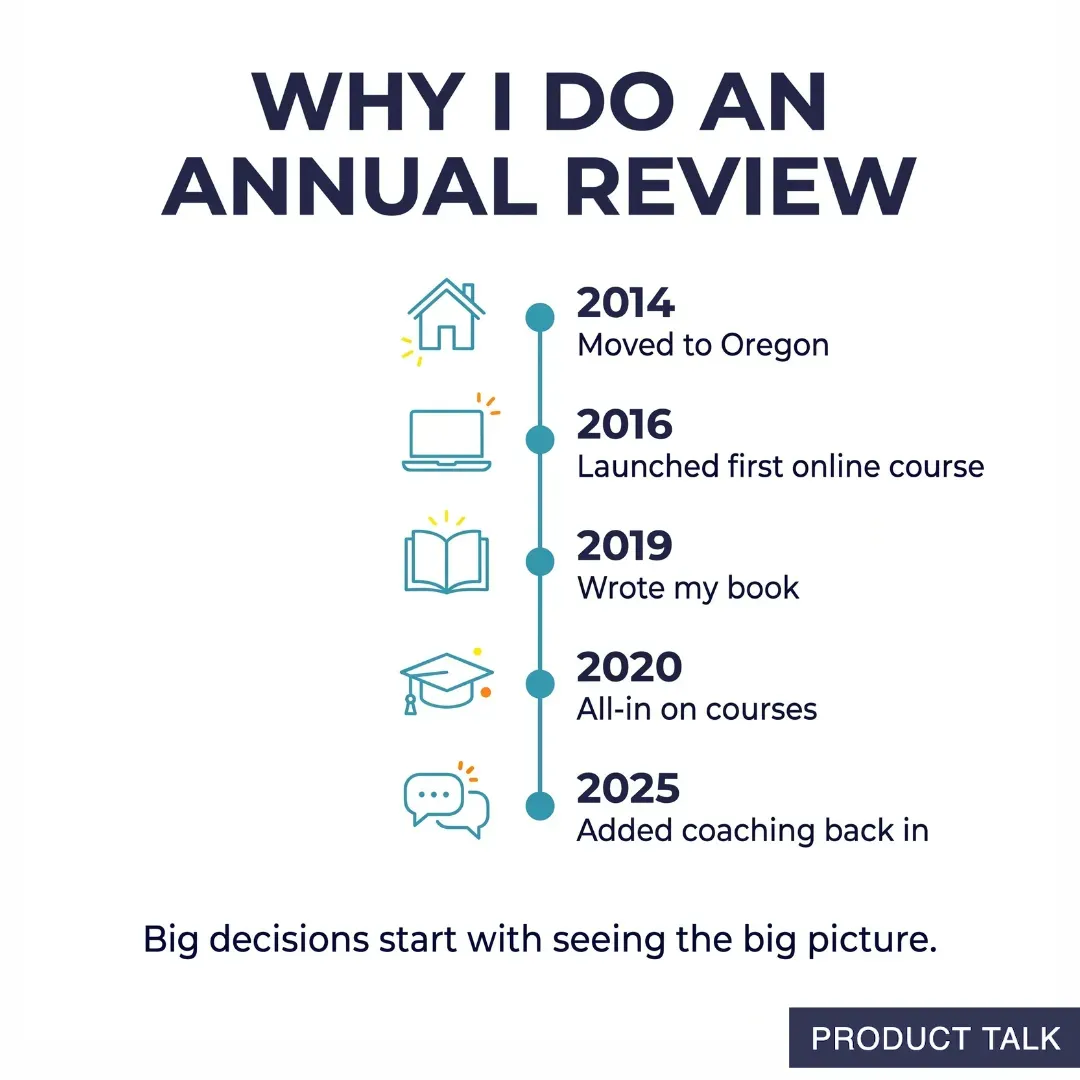
Some of the most impactful decisions I’ve made in my life have come from my annual review. In my 2014 annual review, I decided to move to Oregon. In 2016, I decided to launch my first online course. In 2019, I decided it was time to finally write my book. In 2020, I decided to go all-in on courses and stop coaching. In 2025, I added coaching back in.
Each of these felt like a big, consequential decision. They were decisions that would have been hard to make if I hadn’t first slowed down to look at the big picture. That’s what I get from my annual review.
This past weekend, I started my 2026 review. I like to complete my review over several weeks. Doing the reflection exercises over time allows me to really ponder what’s working and what’s not. I like letting it simmer.
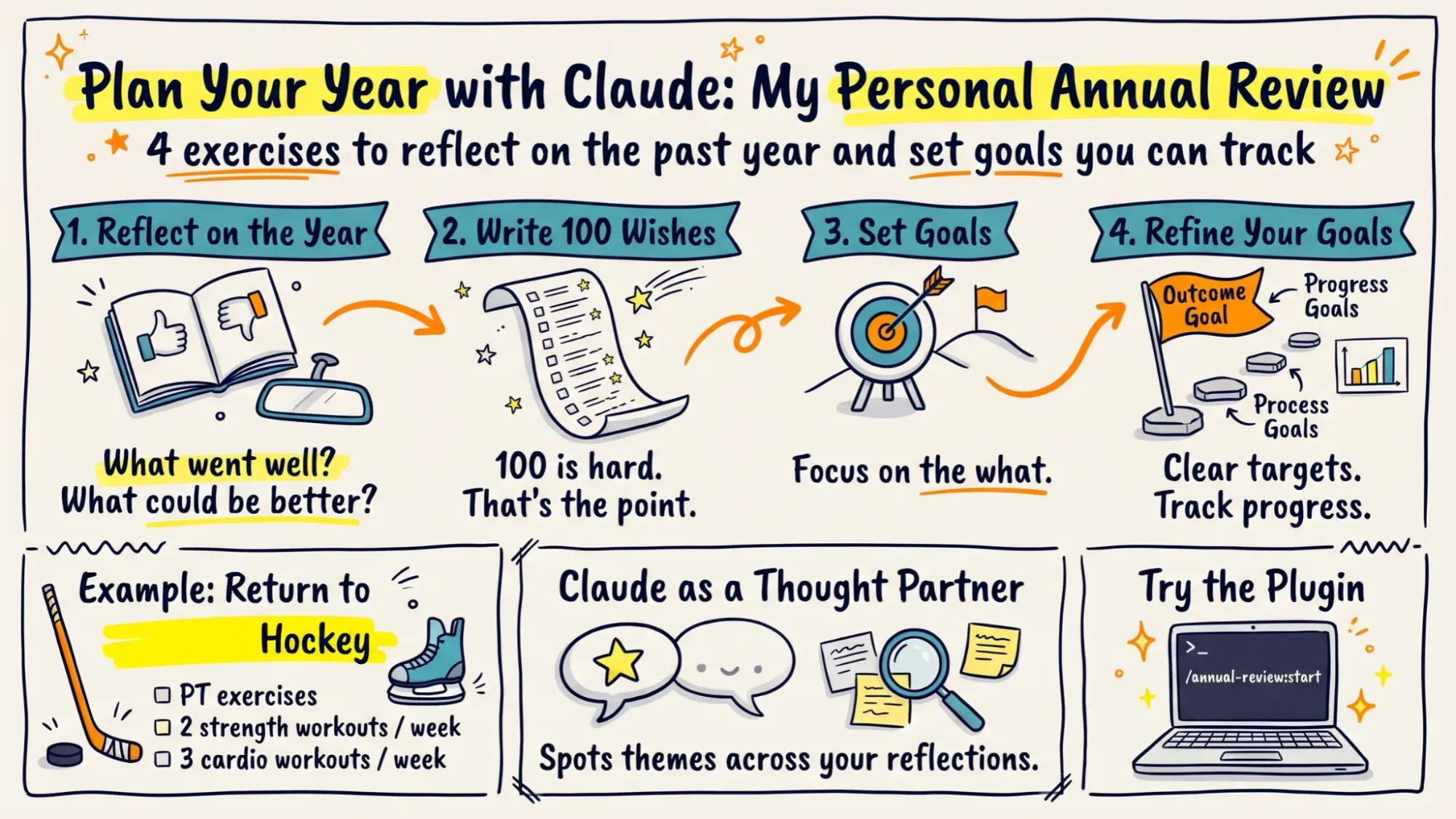
This time I decided to do my review with Claude. I was curious if Claude would spot trends in my reflection that I might miss. I also thought it might push me to be more thoughtful about translating outcome goals into process goals.
And I thought it would be fun to share the process with you. So I packaged it up into a Claude Code plugin.
Let’s dive into how it works.
My Annual Review Process: 4 Key Exercises
I do a very structured annual review. I find this allows me to go deep and really reflect, rather than doing just a surface-level review.
I first decide what categories of life I want to review. For example, this year, I’m reviewing work, relationships, health, finances, hobbies, travel, and learning. But you can pick whatever categories matter most to you.
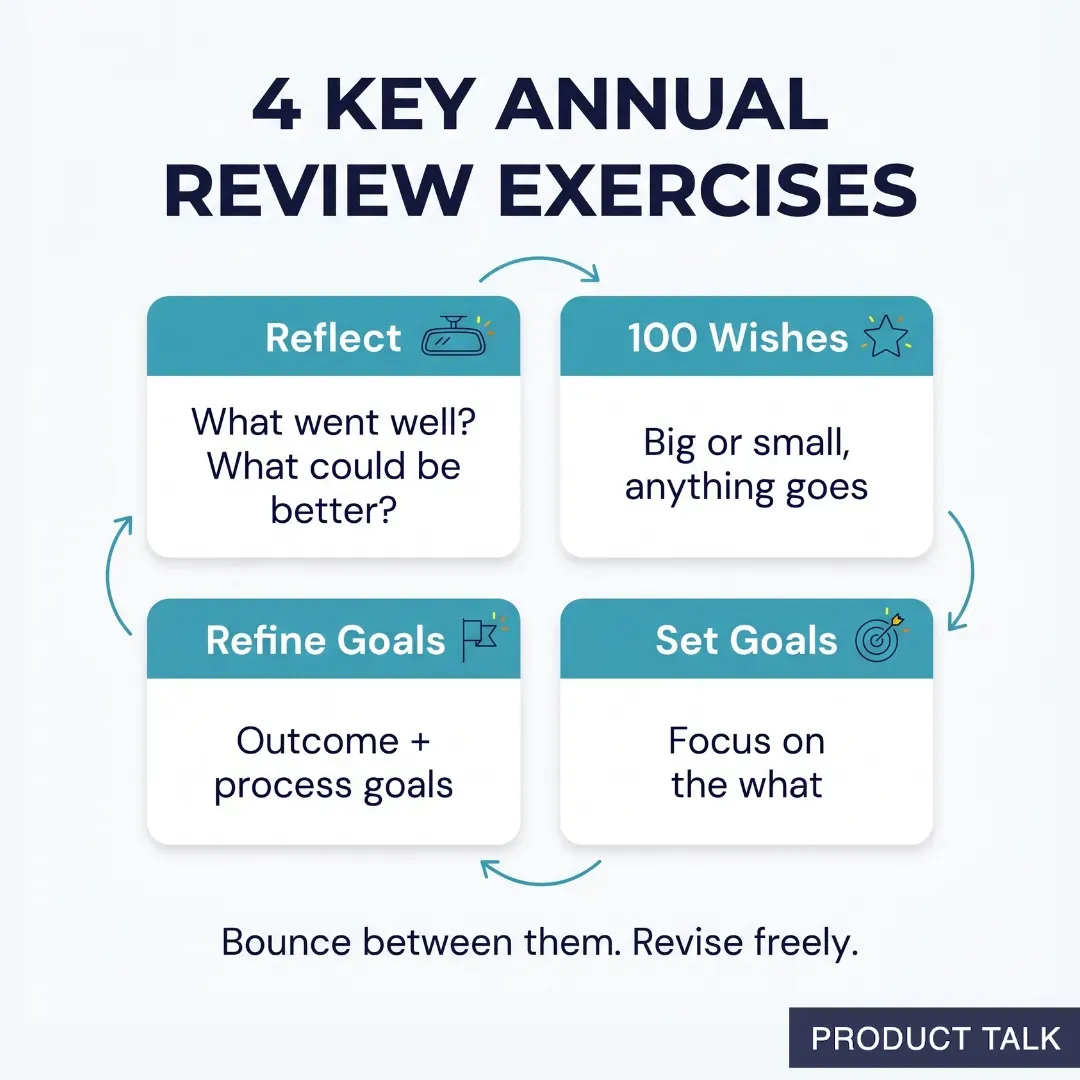
My review consists of four key exercises:
- Reflect on the past year. For each category, I evaluate what went well and what could have gone better. If I set goals for the category, I also review how I did against my goals.
- 100 wishes. This one might sound silly. But every year, I write up a list of 100 wishes for the future. Wishes can fall into a specific category, they can span categories, they can be things I want, things I want for others, they can be big or small. Anything is fair game. 100 is hard. That’s the point. This exercise really forces me to think about what I want out of life. And because I do it year after year, I learn a lot about myself when I see what wishes repeat and which are fleeting.
- Set goals. I then set goals for the categories I want to focus on for the upcoming year. In this step, I just try to articulate what I want. I don’t worry about whether it’s a well-formed goal or how I might reach it. I just focus on the what.
- Refine those goals. Once I’ve identified my goals for the year, I refine them. This is where I frame each goal as an outcome goal (what I want to happen) and a set of process goals (what I’ll do to get there). I also try to set clear targets and define how I’ll track progress along the way.
These four exercises aren’t isolated activities. I tend to jump back and forth between them throughout my review period. I might set a goal in one category and refine it before I’ve even reviewed another category. I change my mind a lot. I often commit to too many goals. Some goals I want to track and measure; for others, I just want to wing it.
The structure comes from doing all of the exercises. But how you go through them doesn’t need to be rigid. The exercises should get you thinking. They should inspire action. They should help you get excited for the year ahead.
As long as they are doing that, you can bounce around. Revisit different elements. Revise to your heart’s content.
An Example from Last Year’s Review
Here’s what this looks like in practice.
At the end of 2025, I was still struggling with post-ankle-surgery recovery. I had surgery in March and was in a boot until late May. Over the summer, as I was returning to activity, I got tendonitis in my calf. By December, I still wasn’t skating.
When I reflected on the year, I captured the following:
- I was grateful to be walking and back on a bike. But I was frustrated that I still couldn’t skate or cross-country ski. Any activity that involved a boot put pressure on the plate in my ankle and was painful.
- I wished:
- to return to hockey
- to return to cross-country skiing
- for my ankle pain to go away
When it came time to set goals, I set the following:
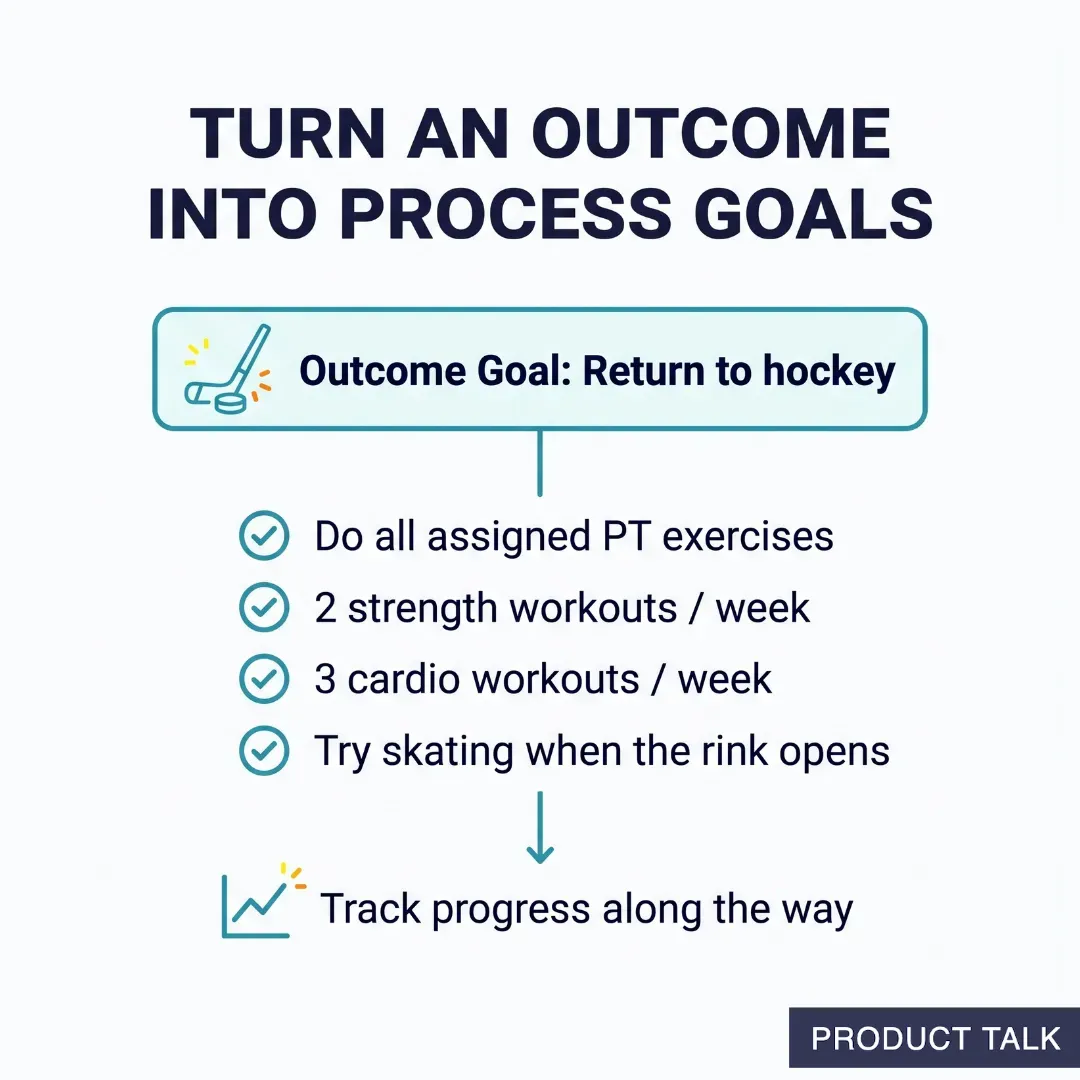
Outcome goal: Return to hockey
Process goals:
- Do all of the exercises my physical therapist assigned.
- When cleared:
- Do 2 full-body strength workouts each week.
- Do 3 cardio workouts each week: 1 easy, 1 interval, 1 endurance.
- Try skating when the rink opens in October, and if the pain persists, have the hardware removed.
It’s now the end of 2026, and as part of this year’s review, I just reflected on this goal. I wasn’t able to successfully return to hockey. I did do all of my PT and I stuck to my training goals (for the most part), but a few weeks ago, when I was able to get back on the ice, I still had too much pain from the hardware.
So this past week, I had a second ankle surgery. This time they removed the plate and thirteen screws. With some forced downtime, I started my review early and built this plugin. I’m writing this blog post from the couch, recovering with my ankle elevated.
I’m hoping to get back on the ice for skating in December and back to hockey in January or February.
This is one of my health goals. I repeat this process for each of the categories that I decide to focus on for the year. All it takes is some time to reflect and a way to take notes.
This year, I chose to do it with Claude because I wanted a thought partner. Claude pulled out themes from across my reflection that helped me think about the year differently.
For example, it highlighted that across several of my categories, I had fun building software. I know that I’ve created a lot of software for work this year, but I also built custom software for my finances, a road trip app to support our new camper lifestyle, and an economic model to evaluate NHL player contracts.
It surprised me how much software I built purely for fun. I’ll definitely be leaning into this even more next year.
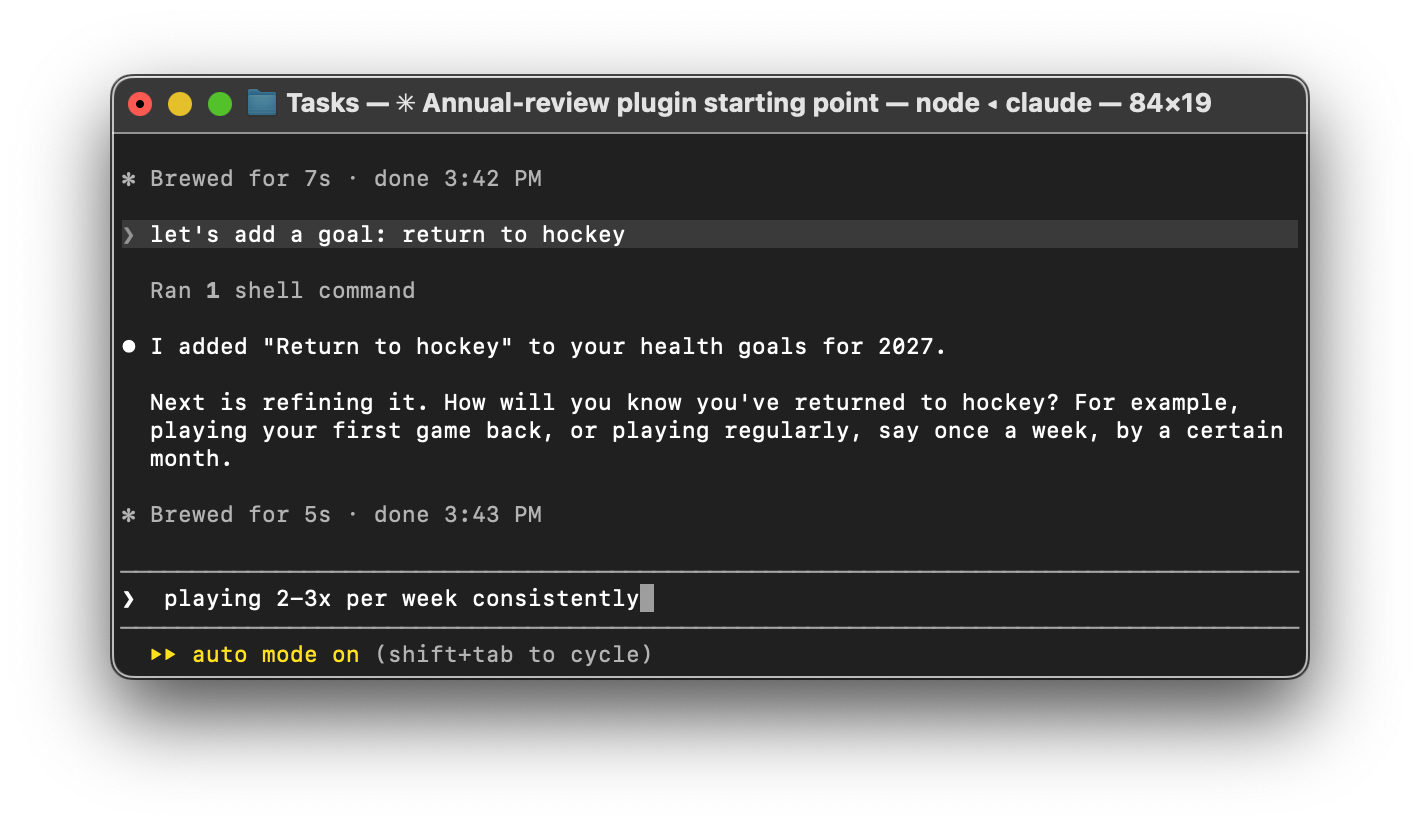
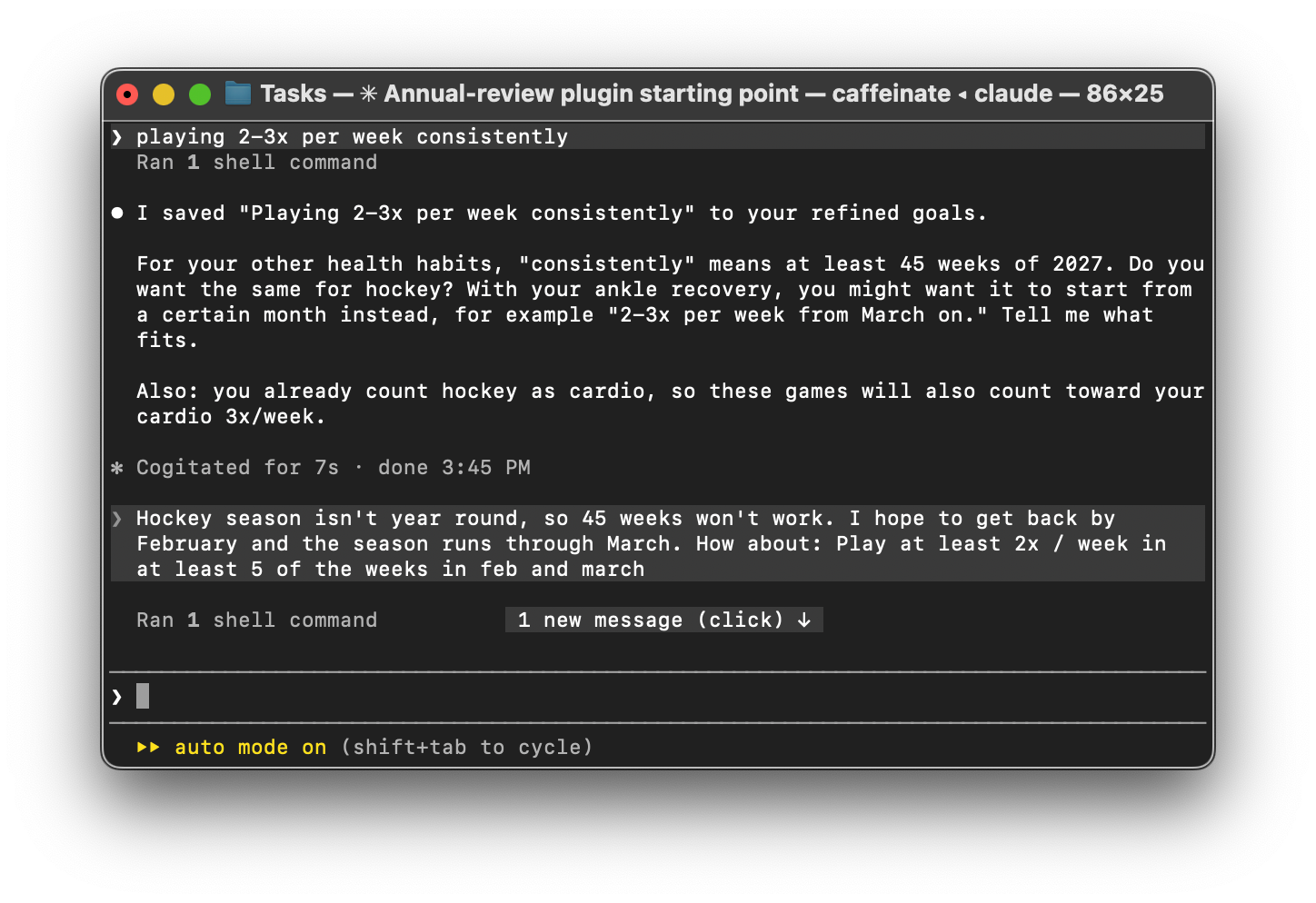
Claude helped me turn outcome goals into concrete process goals.
Claude also pushed me to create better process goals and encouraged me to think through how I’ll track progress on those goals. In the above screenshots, you can see that once again, I’m setting a “return to hockey” goal, and Claude encouraged me to get specific about what that means. It also suggested that I use my existing fitness-check-in skill to track it.
How to Install the Annual Review Plugin
If this sounds like something you would be interested in trying, I’m making the plugin available to all subscribers of Product Talk (free or paid). You can grab it here.
Audio Version
The audio version is only available for paid subscribers.


