



A lot of my team’s product marketing work in the past few years has focused on one gap: customers bought the product, but the people who needed to use it weren’t always using it.
In a sales-led enterprise, a signed contract proves someone wanted the product. It cannot, however, guarantee that the end users will use it and keep coming back to it, leading to (hopefully) a bigger contract the next year.
In self-serve products, the person who pays is usually the person who uses. In enterprise B2B, there are often three groups. The buyer signs the contract and is accountable for business value. The admin must provision, configure, and switch the product on. The end user must fit it into a workflow that already works well enough.
Adoption often doesn’t fail because customers lack awareness. It fails at a specific moment of friction in one of those handoffs. Product marketing’s job is to find that moment and make the next successful behavior easier.
Where adoption stalls between buyer, admin, and user
The buyer wants visible business outcomes. The admin wants a safe, manageable rollout. The end user wants a better way to do one specific job. A rollout that looks successful to the buyer can still mean one more tool for the end user to manage. A careful, staged deployment that keeps the admin comfortable can push the user’s first win out by months.
The buyer stops driving adoption after the sale
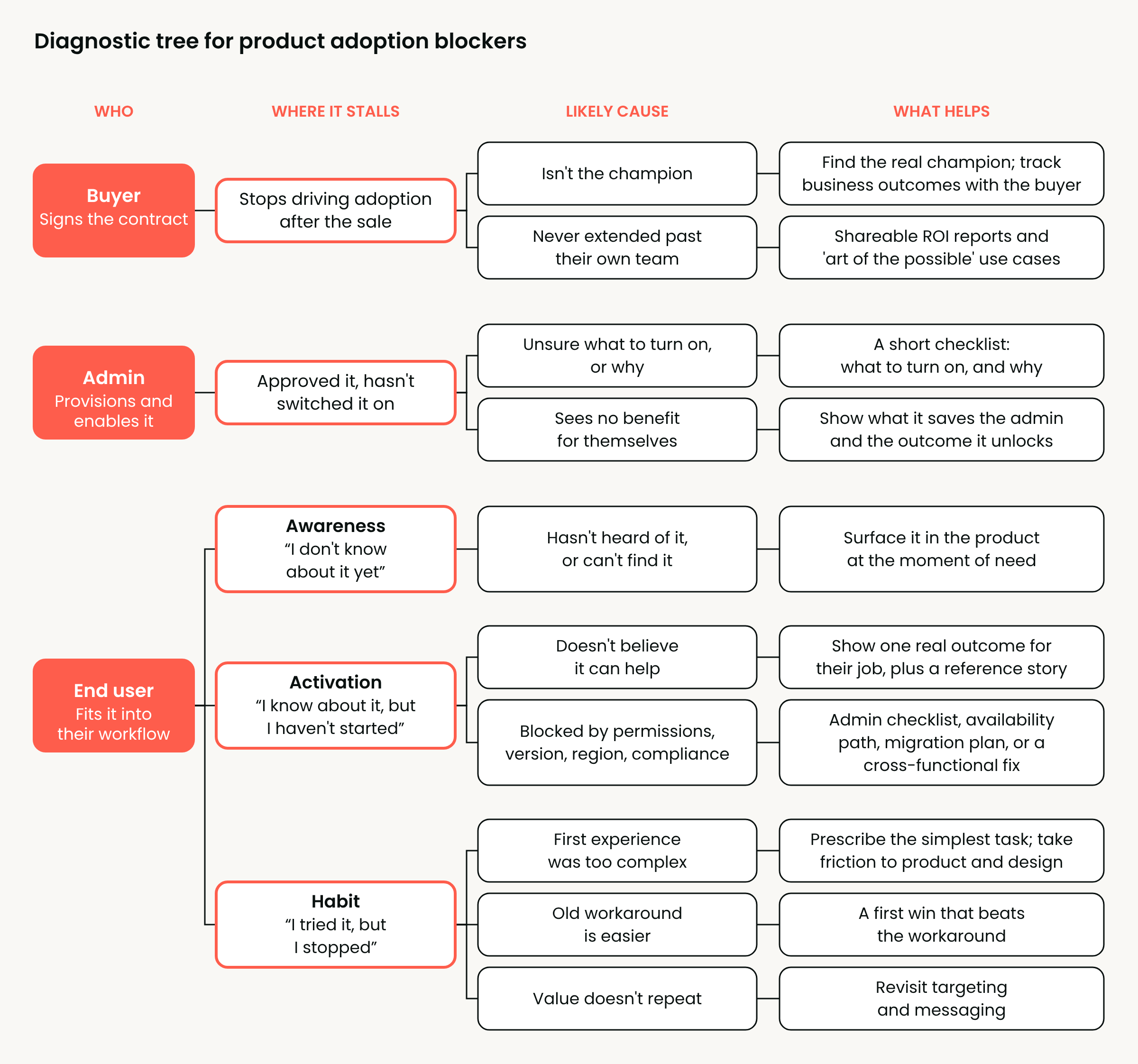
The buyer may not be the champion or may never extend the product past their own team, limiting expansion. What helps: find the real champion, track business outcomes with the buyer after the sale, and give the champion shareable ROI reports and “art of the possible” use cases to take to other teams.
The admin approved it but hasn’t switched it on
Licenses bought but never provisioned usually point here. The admin may see no use case of their own. What helps: a short checklist of what to turn on and why, plus a clear picture of the end-user outcome the admin unlocks.
We learned this while rolling out an AI capability. Awareness among users and admins had improved, but activation was still lagging. Interviews showed that admins understood the user benefit but didn’t see what was in it for them. We changed the messaging to show how enabling the capability reduced work for admins themselves, and activation improved immediately.
What is stopping the end user
Who is stuck tells you where to look. What is stopping them tells you which intervention fits. End users stall at one of three stages, and each needs a different fix:
- Awareness: “I don’t know about it yet.” They haven’t heard of the feature or can’t find it. Surface it in the product at the moment of need.
- Activation: “I know about it, but I haven’t started.” The blocker is either belief (show one real outcome for their job, backed by a reference story) or access: permissions, version, region, or compliance. Access may require an admin checklist, a clear availability path, a migration plan, or a cross-functional fix
- Habit: “I tried it, but I stopped.” The first experience was too complex, or the old workaround was easier. Prescribe the simplest task they can complete, take the friction to product and design, and if value doesn’t repeat, revisit targeting and messaging.
Teams tend to call all three “adoption” and answer all three with the same campaign.
Diagnose before you build a campaign
Most adoption programs start with a solution: a webinar series, an onboarding email track, a getting-started page. Start with the broken behavior instead.
Map your funnel to the three stages to see which one you have. Then ask your product managers, who usually hold the telemetry:
- What single behavior, not a feature count, tells us someone has adopted?
- Where do users drop off in the first 30 days? Is it a cliff or a slow fade?
- What do the users who did adopt have in common: role, team size, the event that got them started?
Next, talk to the users most teams skip: people who tried and stopped, or had access and never started. Customer success, community channels, and accounts with idle licenses will lead you to them. Asking why they aren’t using it gets you “we haven’t had time.” Ask about the last real attempt instead:
- Walk me through the last time you tried it. Where did you stop, and what did you do instead?
- Whose permission or help did you need internally? Did you get it?
- If it disappeared tomorrow, what would you miss, and what would you be relieved about?
That last question is an uncomfortable one, but it can surface both the value the product has created and the friction users aren’t otherwise volunteering.
Not every adoption problem is a marketing problem
Sometimes the right answer is a product change, not another campaign. One failure that’s easy to mistake for an awareness problem is hidden friction in the product itself.
We once rolled out a key feature and were surprised by the low uptake.
Customer interviews showed the experience was the problem: users didn’t know they had to take extra steps to get where they needed to be. That was a content fix in the short term and a design fix in the next sprint.
Listen for the difference between “I don’t understand the product” and “I understand it, but using it takes three approvals.” The first is a messaging problem. The second is a workflow, product, or adoption-system problem that more messaging won’t fix.
|
Adoption problem |
Who needs to act |
|
Awareness or messaging |
PMM |
|
Onboarding |
PMM and product |
|
Permissions or provisioning |
Admin or IT, with the account team |
|
UX friction |
Product and design |
|
Missing capability |
Product and engineering |
|
Value realization |
PMM with customer success and the account team |
A strong PMM diagnoses which problems messaging can solve and brings enough evidence to get the right team to solve the rest.
Treat adoption as behavior change
Awareness is often already solved: users know the product exists. They just haven’t changed what they do on a normal day. People don’t abandon a trusted spreadsheet or script for a tool that is merely better in general.
So supplement feature tours with prescriptive first steps. Pick one job the user already does, show one path through the product, and get them to one result in their first session. That result has to beat the workaround. If you can’t describe the first win in a sentence, your users can’t find it either.
Then design for the moments people get stuck: the first data connection, the first result that doesn’t look right, the first handoff to a colleague. Put help where those moments happen: the product, the docs, the community forum. A nurture email three weeks later is too late.
Earn the right to own adoption
Product marketing doesn’t get handed adoption; customer success, account teams, and product all have a claim to it. PMM earns a seat by solving problems the following two groups have:
Practitioners.
Use the verbs of their work, not the adjectives of a launch. Technical audiences want the how more than the why: real examples, demos, and docs, reviewed by your PMs and sales engineers. One inaccurate command in a getting-started guide costs more trust than a polished page earns.
Account teams.
Sales, customer success, and solutions architects own the relationships, and an adoption program that goes around them gets shut down, usually for good reasons. Customer success often knows which accounts are stalling and why, but can’t cover accounts without a dedicated CSM.
Turn that field knowledge into programs that reach every account: adoption content for uncovered accounts, a usage snapshot before each QBR, and shared definitions of activation and adoption.
Measure behavior, not engagement
Email opens, webinar attendance, and content views show that people saw something, not that anyone changed what they do. Stronger evidence is the activation behavior you defined in discovery, repeat usage, cohort behavior, and, where appropriate, retention and expansion. Track it across the customer base, not one hero account, and compare users who completed the prescriptive first step with those who didn’t.
Be honest about the limits. Customers who engage with your content may have adopted the product anyway, so present your impact as correlation and influence unless you have a stronger causal design.
An account team will tune out “the campaign generated thousands of engagements.” It will listen to “we found a drop-off between activation and first use, changed onboarding, and saw usage rise in the targeted cohort.”
Start with three conversations
You don’t need a new program to start, just three conversations:
- Ask your product managers what one behavior tells you a user has adopted.
- Ask customer success which accounts bought but haven’t provisioned, and which have provisioned but aren’t using.
- Talk to users who tried the product and stopped, or had access but never started.
You’ll know who is stuck in your top accounts and what is stopping them. Pick one stuck moment, one audience, and one prescriptive first step. Build for that moment, measure the behavior, and take the result back to the account team.
The goal isn’t to get more people to hear about the product. It’s to make the next successful behavior easier than the old workaround.


