This is part two of a three-part series on how HubSpot transformed with AI. Part one covers how we build with AI. Part three is how we operate as an AI-first company.
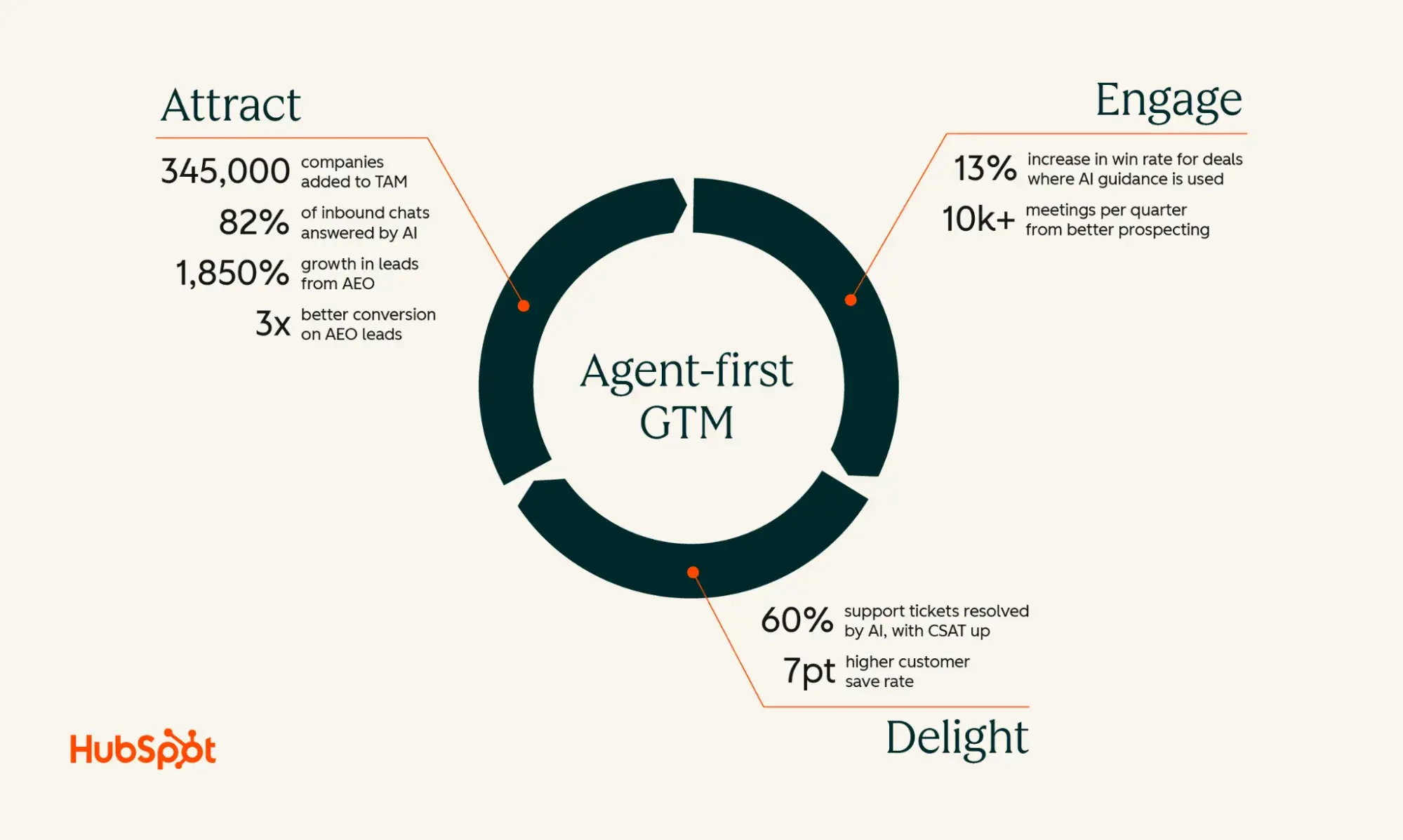
Over the past three years, we have systematically rebuilt how we attract, engage, and delight customers by creating a new go-to-market model. With AI, we have added hundreds of thousands of companies to our total addressable market, grown qualified leads from answer engines by 1,850%, and now book over 10,000 meetings per quarter through personalized outreach, with a 13% increase in win rate for deals where guided selling is used.
Today, we run an Agent-first GTM: a flywheel where agents are doing real work at every stage and humans are operating with higher impact, connecting more deeply with customers.
Attract: Finding the right customers faster
The top of our funnel looks nothing like it did three years ago. Where we once relied on form fills, content leads, and inbound chat teams, we now run a demand engine powered by AI.
Rebuilding it required three bets: finding the right companies, converting the ones who showed interest, and showing up where buyers have moved.
The first bet started with the Demand Agent. It identifies our Ideal Customer Profile (ICP) and finds new companies that match it. The agent enriches those contacts with signals from a variety of data sources, and generates a prospect value score for every account: a prediction of both likelihood to close and expected ARR. Last year, Demand Agent added 345,000 accounts to our total addressable market – accounts that reps would otherwise have lacked sufficient data to pursue.
Next we looked at automating the process once a prospect shows interest. We built Inbound Agent, a chatbot on our website that handles 82% of all inbound chats with zero human involvement. The agent qualifies visitors, handles competitive questions, uses propensity scoring to identify real buying intent, books meetings with our sales reps, and closes what it can. It’s now beginning to sell HubSpot Starter when there is a clear fit.
The third bet was about a different kind of buyer entirely, one who hasn’t raised their hand yet, but is asking questions elsewhere. We moved early on Answer Engine Optimization (AEO), and built AEO Agent to make HubSpot visible and credible in AI-generated responses from tools like ChatGPT and Perplexity. HubSpot is now the most visible CRM in LLMs. Qualified leads from AI-generated answers grew 1,850% between Q1 2025 and Q1 2026. Those leads convert at up to 3x the rate of traditional search.
Engage: Enabling deeper customer connection
Converting interest into pipeline is where we have invested heavily. We built agents and assistants at every stage of the sales motion, each teaching us something we didn’t expect.
The first lesson came from our Prospecting Agent. We assumed email sequences would do most of the work. They didn’t. Only a small percentage of meetings get booked through email alone. So we rebuilt the agent to orchestrate across all channels: tracking intent signals, generating personalized multi-touch sequences, and creating tasks for reps at the right moment. Today, AI-personalized outreach books over 10,000 meetings per quarter.
The next lesson came from active deals. We started by building a single place where reps could see everything about a deal like risk scores and similar-won deals. It was useful, but we learned reps didn’t just want a dashboard. They wanted to ask questions. So we built Guided Sales Assistant, a native conversational interface that lets reps interrogate their pipeline the way they would ask a colleague: what’s the risk on this deal, how did we win in similar situations, what should I do next? This context is helping drive results: we are seeing a 13% increase in win rate for deals where AI guidance is used.
We also built for the evaluation stage in the buyer journey. A pre-sales agent handles complex technical questions that would otherwise require a specialist. A Demo Agent spins up a tailored demo environment on the spot, customized to the prospect’s specific industry, geography, and company size. These features remove friction at moments that used to slow deals down.
Delight: Scaling success and support with AI
When we brought AI into the delight stage, support found product-market fit almost immediately. Customers got faster answers, our team got capacity back, and CSAT increased. Our Customer Agent now resolves roughly 60% of our internal support inquiries without human intervention. For businesses thinking about where to start with AI, we recommend support. The results are predictable and the path to value is the fastest.
But customer success was a different story. The path to AI was less obvious and the outcome more surprising. Instead of replacing human connection, agents have enabled deeper connection.
The problem we were solving was attention. CSMs carry large books of business and can’t give every account the focus it deserves. The question they ask most often is: which accounts should I focus on today?
Our Customer Success Assistant answers that question. It identifies who needs attention and why, drafts the outreach, and flags opportunities to drive deeper engagement. More than 80% of our CSMs use it every week. What we noticed wasn’t just efficiency. CSMs using the assistant are having better conversations, grounded in context, focused on outcomes, and happening before customers even have to ask for help. The result: a 7-point higher customer save rate.
For customers without an assigned CSM, our Digital Success Agent guides them through the product, recommends next steps based on usage patterns, and surfaces new capabilities.
The Agent-first GTM flywheel
This is what Agent-first GTM looks like in practice, and it continues to evolve with new experiments every day.
-Apr-27-2026-04-39-33-1796-PM.png?width=650&height=366&name=image%20(8)-Apr-27-2026-04-39-33-1796-PM.png)
The most important part is what it means for our teams. Marketers now reach each customer with something relevant. Reps walk into every conversation with full context. CSMs know exactly who needs them and why. Every team gets better at accomplishing their goals.
That’s because no agent is working alone. Demand Agent expands who we can reach. The Inbound Agent converts those who have expressed initial interest. AEO captures buyers who were never in our funnel at all. Prospecting Agent and Deal Assistant accelerate the deals that matter. Customer Agent and the Success Assistants keep customers longer and help them get more value. That is the flywheel. And it gets stronger with every interaction.
We built the Agent-first GTM with twenty years of data, hundreds of thousands of customers, and a front-row seat to how the best teams in the world market, sell, and serve. That’s why we’re sharing our approach.
A note on availability: Many of the capabilities described in this series are a mix of HubSpot-built tools, third-party agents, and custom integrations. Some are available in HubSpot: AEO features, data enrichment to drive demand, and agents for customer support and prospecting. Assistants like Guided Sales Assistant and our Customer Success Assistant can also be built as custom assistants.
We’re a larger company than most of our customers, and some of what we’ve built reflects that scale. That’s always been our model: prove it on ourselves first, then build it for customers. Our commitment to innovation means we learn faster, and those learnings go directly back into the product so our customers don’t have to figure it out alone.