

We love sharing the accomplishments of the Google AI communities over the month. We appreciate all the hard work and dedication of our community members. Without further ado, here are the key highlights!
JAX & TPU

Pre-training Decoder-based Tiny LLM with JAX and TPU (Colab notebook) by AI GDE Sungmin Han (Korea) details the process of pre-training a decoder-based Tiny LLM. It covers data processing, model architecture, and implementation details and provides a hands-on understanding of LLM design/training, focusing on engineering questions like framework transition (JAX vs. PyTorch), modern architecture comparison, and data engineering for large text datasets.
[⭐43+] nanoGPTJAX by AI GDE Aakash Kumar Nain (India) is a project inspired by Karpathy’s nanoGPT and nanochat, but built everything from scratch in pure JAX (on both GPUs and TPUs), avoiding higher-level third-party model/training libraries.jax-gs by AI GDE Muhammad Ghifary (Indonesia) is a JAX-based implementation of 3D Gaussian Splatting. It’s restructured with a clean, modular architecture in the jax_gs package.
jepa-jax by AI GDE Saurav Maheshkar (UK) is a JAX-based implementation of the JEPA model.
AI GDE Minho Ryu (Korea) contributed to the JAX ecosystem by merging PRs:
– Synchronize grain/python/experimental.py with grain/experimental.py
– Support auto-tune for setting grain_worker_count
– Implementation of the Best Fit packing algorithm into Grain Pipeline
– Implementation of the Warmup-Stable-Decay Learning Rate Scheduler
https://medium.com/media/560e61550cb026a4d0a49cf65a704d74/href
Teaching Gemma Model To Show Its Work Through Reasoning With Tunix (video) by AI GDE kondwani nyirenda (Zambia) is a submission to Google Tunix Hack. He demonstrated training Gemma 2 2B-IT to generate step-by-step reasoning using Tunix and the GRPO algorithm. The video provides an essential overview of the hackathon’s goals and the technical requirements for using GRPO on Kaggle TPUs.
Scale SciPy with jax.shard_map (slides) by AI GDE Sho Tanaka (Japan) covered the shift from pmap to shard_map and demonstrated its application in a distributed Gaussian Process Regressor.
ml-switcheroo by AI GDE Samuel Marks (US) is a universal compiler for DL ML frameworks. It enables loss-less conversion between distinct levels of the ML stack: from high-level frameworks (e.g., JAX/Flax↔PyTorch) to intermediate representations, down to hardware assembly, and even into visual documentation formats.
Agentic AI — ADK & Protocols
https://medium.com/media/78bcf9db9ab0b8a0f217753300689b50/href
[👀123.2k+] Google’s New Universal Commerce Protocol by AI GDE Sam Witteveen (Singapore) takes a look at the new Universal Commerce Protocol (UCP) for enabling agentic commerce. It covers what it is, how it works, and places that you might see it being used.
Building Interoperable AI Business Agents with UCP: DevBooks Agent Implementation Analysis by AI GDE Evan Lin (Taiwan) analyzes an UCP-based technical bookstore agent and demonstrates how it works. It explores the UCP and A2A communication, focusing on the business agent and its implementation using ADK. He defines agent capabilities, UCP handshake protocol, and shares a practical demo of purchasing a technical book.
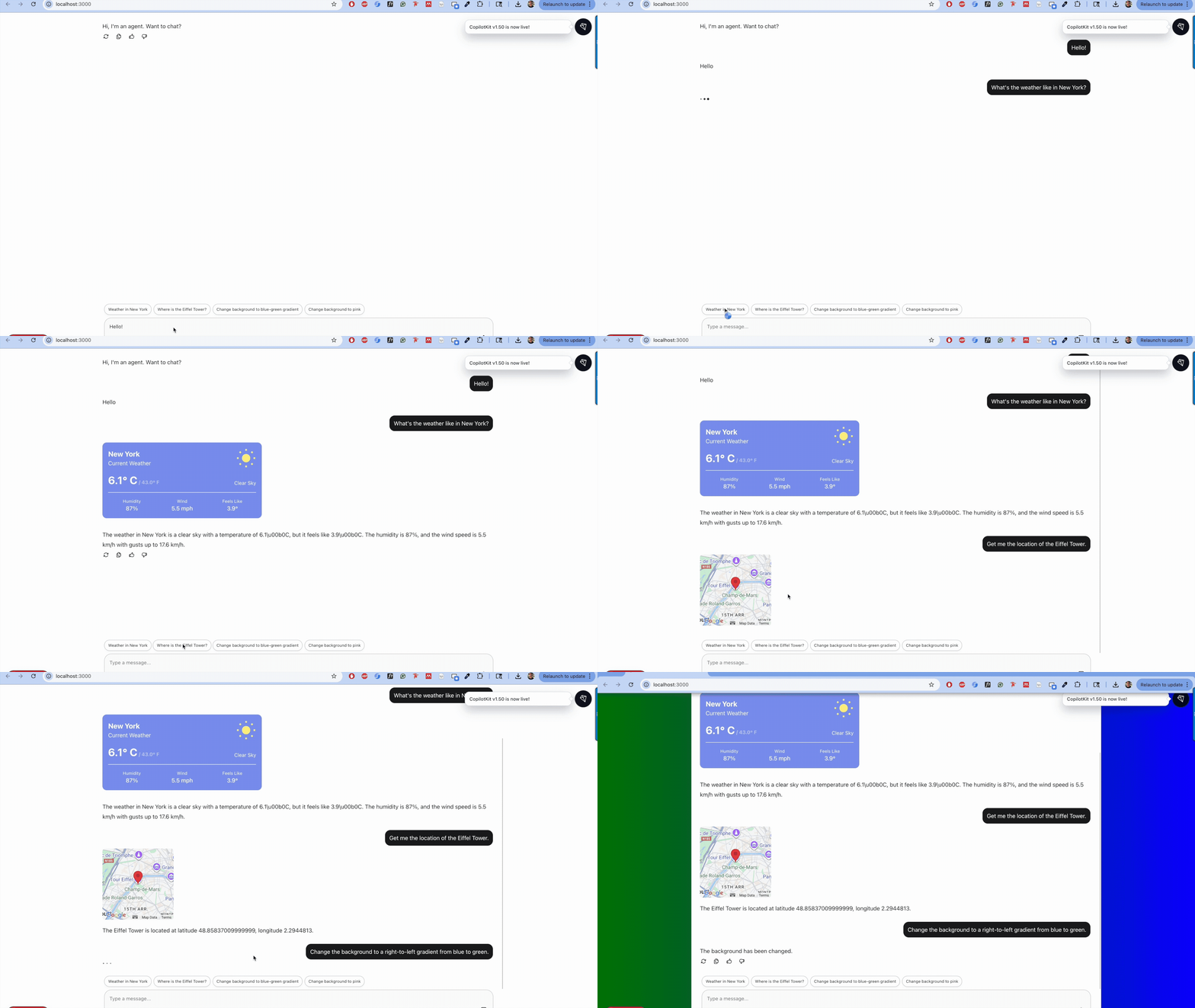
LINE Bot AP2 Integration Series — Part 1, Part 2 (repository) by AI GDE Evan Lin (Taiwan) discusses the implementation of a Credential Provider for a LINE Bot AP2 integration using Gemini and Python. It addresses initial security concerns by introducing a three-tier payment architecture with encrypted storage and one-time payment tokens to prevent replay attacks and exposure of sensitive information.
Architecture of Trust: Defending Against Jailbreaks and Attacks using Google ADK with LLM-as-a-Judge and GCP Model Armor by AI GDE Linh Nguyen (Vietnam) discusses the shift to probabilistic, intent-driven agentic AI and associated vulnerabilities like Prompt Injection. It details how to engineer an “Architecture of Trust” to defend against jailbreaking and system manipulation attacks, including session poisoning, and highlights the importance of safety guardrails and multi-layered defense strategies.
LINE Bot Architecture Overhaul: From if/elif Hell to Multi-Agent Orchestration by AI GDE Evan Lin (Taiwan) refactored his linebot-helper-python project’s from a complex if/elif structure to a multi-agent system using ADK, migrating to an A2A architecture to improve maintainability, testability, and extensibility. This involved splitting responsibilities into specialized agents and implementing an orchestrator for intent detection and routing.
[👏74+] Implementing Long Term Memory for Google ADK using Cognee by AI GDE Tarun R Jain (India) focuses on why developers are bullish about utilizing Knowledge Graphs for memory, covering key aspects like deterministic reasoning, multi-hop queries, temporal awareness, state evolution, and persistent state across sessions, and proposes using memory as a tool with ADK.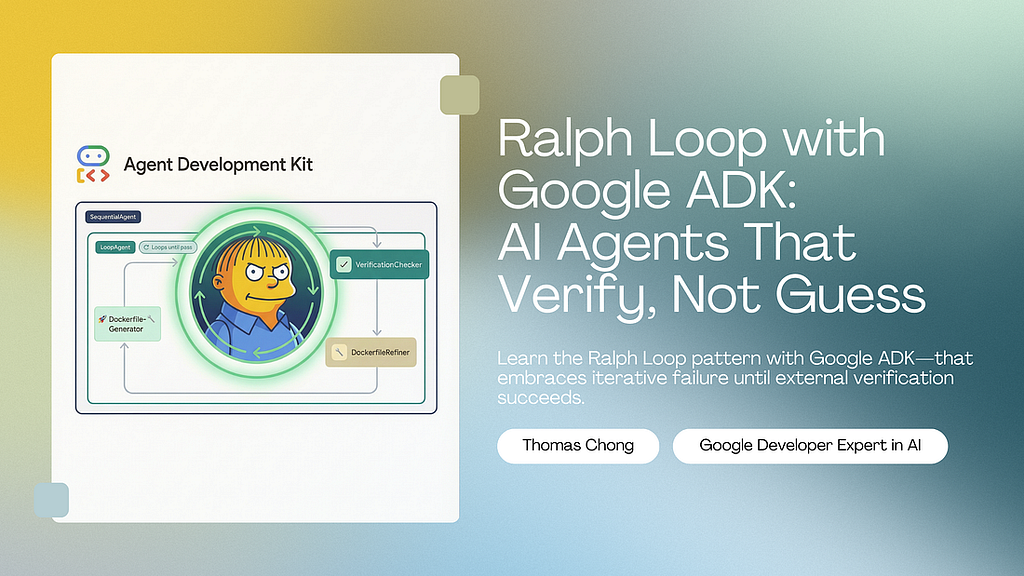

Building GraphRAG Agents with ADK by AI GDE Siddhant Agarwal (India) and Romin Irani (Googler) is a codelab guiding you how to build a multi-agent investment research system using ADK, Neo4j, Graph Database, and MCP Toolbox. Learn to create intelligent agents that understand context through graph relationships, deliver accurate query responses, and orchestrate specialized agents to answer complex questions.
Gemini

#AI Sprint [Featured on Google for Developers blogs✨] Beyond the Chatbot: A Blueprint for Trustable AI: A team of GDEs in the US developed a trustable AI system for real-time driver guidance at Thunderhill Raceway using Antigravity and a split-brain architecture. The system leverages Gemini Nano for quick reflexes and Gemini 3 for strategic analysis, with Neuro-Symbolic Training method ensuring physics-grounded, context-aware advice. Among AI GDEs, Jigyasa Grover, Lynn Langit, Margaret Maynard-Reid, Rabimba Karanjai, and Vikram Tiwari participated in the team.

Gemini 3 Flash: Agentic Vision in LINE Bot — AI Image Annotation and More by AI GDE Evan Lin (Taiwan) introduces an implementation of Agentic Vision in a LINE Bot using Gemini 3 Flash. He explains how the AI can “see” images and actively “write” Python code for enlargement, cropping, annotation, and covers the project’s technical core, functional design, and development experience.
Mastering Live Sports Data with Gemini 3 (repository) by AI GDE Connie Leung (Hong Kong) explores retrieving Premier League 2025/2026 player statistics using Gemini 3 Flash Preview, URL context, Grounding with Google Search, and structured output. It details lessons learned from extracting data and using Google Search to fill in missing information.
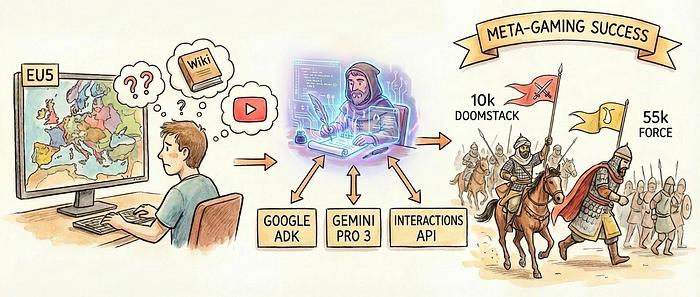
Building an AI Tutorial Assistant for Europa Universalis V by AI GDE Ertuğrul Demir (Turkey) shares how he tackled the steepest learning curve in strategy gaming by utilizing ADK, Gemini 3 Pro, and the Interactions API to build an AI-powered tutorial assistant.
Visual Design-to-Production System by AI GDE Omotayo Aina (UK) is an AI-powered system that transforms UI mockups, wireframes, or screenshots into production-ready frontend code. It uses a multi-agent architecture built with ADK and powered by the Gemini models to automate the designer-to-developer handoff process.

Gemini Deciphers Nuremberg Chronicle Mystery by AI GDE Kalev Leetaru (US) successfully deciphered 500-year-old handwritten Latin annotations, called roundels, in a copy of the 1493 Nuremberg Chronicle. His another article, Gemini 3 Video-To-Infographic: Turning A Russian TV News Walkthrough Of The Terminator Tank Into A Technical Infographic, explores using Gemini 3 Pro to convert a Russian TV news video about the “Terminator” tank into a detailed technical infographic. It also discusses challenges with text legibility and orientation during rendering, and attempts to refine the output quality.
Automated YouTube Question Bank Extraction: Building a 10k-Scale Dataset with Gemini 2.5 Flash (repository) by AI GDE Yu-wei Liu (Taiwan) details an automated pipeline using Gemini 2.5 Flash to extract and structure Q&A data from Taiwanese variety shows. It covers incremental updates, metadata processing, and multimodal AI analysis to bridge the gap in localized training datasets for LLMs.
Antigravity

#AI Sprint [👏122+] Building an AI-Powered web APP to manage 2K+ Jira support tickets with Gemini and Antigravity by AI GDE Hugo Zanini (Brazil) is a blog post introducing his project, Help Insights. It is a full-stack app (FastAPI + React) powered by Gemini to automate the analysis of overwhelming Jira support ticket volume. It categorizes 1.2k tickets in under 90 seconds, identifies patterns, and reduces weekly analysis time by 95%. This project demonstrates that Gemini enhances human judgment rather than replacing it. Help Insights is open-sourced as a blueprint for building AI-powered PM tools. Check it out here: Help Insights (Hi👋) repository.
https://medium.com/media/edfe5687157ea2c62605e341f81302c6/href
#Agent Skills Vibe Coding with Antigravity using Skills and MCPs by AI GDE Tarun R Jain (India) is a video introducing Agent Skills in Antigravity and how to use it. He also shows how to customize MCP servers in Antigravity.
How to Build a Real Project from a PDF Using Gemini 3 and Google Antigravity (repository) by AI GDE Yucheng Wang (China) walks you through how to construct a real project from a PDF by leveraging the capabilities of Gemini 3 and Antigravity.
How to Build an AI-Powered Flutter App with Google Antigravity: A Hands-On Tutorial by Anna Muzykina (Germany) demonstrates an agentic workflow using Antigravity and Gemma 3n to plan, code, and test a glassmorphic Flutter application through natural language prompts.
Gemini CLI
#Agent Skills Refactoring a Blog Review Prompt into Reusable AI Agents by AI GDE Connie Leung (Hong Kong) details refactoring a complex blog review prompt into reusable AI agents using Gemini CLI. The article transitions from a monolithic Custom Command to modular Agent Skills (repository) for improved maintainability and efficiency. And it covers building a skill suite for grammar, syntax, and active voice review.
https://medium.com/media/b8461090c3d8f434c420d3ef5a520d07/href
#Agent Skills Supercharging Your AI Agent with Skills by AI GDE Allen Firstenberg (US) dives into the emerging world of Agent Skills, an open standard for extending the capabilities of AI coding assistants like Gemini CLI. They explored their function, compared it to MCP, and demonstrated custom skill installation using the skills CLI while also discussing standardization and security considerations.
[👏61+] MCP Implementations Across Programming Languages by AI GDE William McLean (US) summarizes MCP implementations across various programming languages, with working demos.Kaggle

From Accuracy Scores to Real-World Trust: How Kaggle Community Benchmarks Are Redefining AI Evaluation by AI GDE Gabriel Preda (Romania) introduces Kaggle Community Benchmarks, as a new open platform that puts the power of model evaluation in the hands of the global AI community.

Noesis — Your learning mate by AI GDE Sungmin Han (Korea) is a browser-based learning companion, designed for active learning. It utilizes Gemini Live and Gemini 2.5 Flash for low-latency multimodal perception to detect and organize learning signals into persistent notes. By leveraging Gemini 3 Pro to generate structured explanations, quizzes, and dialogue, it supports formative assessment and teaches how to think, not just consume answers. This project is a submission to the competition, Google DeepMind — Vibe Code with Gemini 3 Pro in AI Studio.
The Kaggle Book (2nd edition) by AI GDE Luca Massaron (Italy) has updated content and new chapters on Kaggle Models, time series, and Gen AI competitions for practical skill development.
Introduction to Large-Scale Language Models with Kaggle by AI GDE Shotaro Ishihara (Japan) is a Japanese book that covers fundamental usage to advanced techniques for boosting performance in practical NLP. It provides perspectives useful for both competition participants and engineers/researchers interested in LLMs.
#Keras Introduction to Green, the medicinal plant classification model with MobileNetV2 and Focal Loss (Kaggle notebook, repository) by Armel Yara (Cote d’Ivoire) details how to use TensorFlow and Keras with Focal Loss to build a lightweight, real-time medicinal plant classifier optimized for limited datasets and mobile deployment.
ODML
[👏61+] Architectural Evolution and Implementation Strategy of the LiteRT CompiledModel API by AI GDE Kartikey Rawat (India) explores the lifecycle of the LiteRT CompiledModel API, the mechanics of AOT vs. JIT compilation, and the critical importance of zero-copy memory architectures in achieving real-time inference latency. It also provides implementation guidelines for C++, Kotlin, and Python environments, supported by empirical performance data demonstrating the efficacy of NPU offloading for Gen AI workloads.
[Jan 2026] AI Community — Activity Highlights and Achievements was originally published in Google Developer Experts on Medium, where people are continuing the conversation by highlighting and responding to this story.


