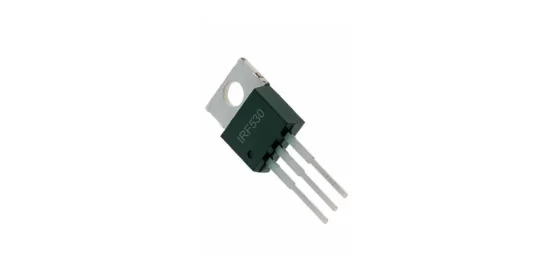
IRF530 is an N-channel MOSFET (100 V, 14 A) with low on-resistance (0.16 Ω). It’s commonly used in motor control, switching power supplies, audio amplifiers, and relay circuits. Packaged in TO-220 for easy mounting and heat dissipation.
IRF530 Features
- Type: N-Channel MOSFET
- Max Drain-Source Voltage (VDS): 100 V
- Continuous Drain Current (ID): 14 A (at 25°C)
- Pulsed Drain Current (IDM): Up to 56 A (brief peaks)
- Gate Threshold Voltage (VGS(th)): Typically 4 V (easy gate control)
- Low On-Resistance (RDS(on)): Approx. 0.16 Ω (efficient switching, reduced heat)
- Power Dissipation (PD): Up to 88 W (with proper heat management)
- Switching Speed: High-speed, ideal for PWM circuits
- Package Type: TO-220 (easy mounting, good heat dissipation)
- Built-in Diode: Integrated body diode for flyback protection
- Thermal Management: Requires heat sink in high-current applications
- Logic-Level Compatible: Suitable for standard Arduino or microcontroller interfaces (but best driven with gate driver for full performance)
IRF530 pinout

IRF530 Pin Configuration
| Pin Number | Pin Name | Function |
|---|---|---|
| 1 | Gate (G) | Controls MOSFET On/Off state |
| 2 | Drain (D) | Connects to load or positive side |
| 3 | Source(S) | Connects to ground or negative side |
Pinout Notes:
- Hold IRF530 with metal tab facing away, pins downwards. Pins numbered 1-3 from left to right.
- Gate pin receives switching signal from controller (like Arduino or MOSFET driver).
- Drain pin connects directly to your load (motor, LED strip, etc.).
- Source pin typically connects directly to system ground.
- The metal tab connects to Drain internally, so remember to insulate it if needed.
IRF530 Applications
- Motor Control: DC motors, stepper drivers, speed regulators
- Power Switching: High-current switches, relay replacements
- Audio Amplification: Audio amplifier output stages
- DC-DC Converters: Buck converters, boost circuits
- LED Lighting: PWM-based brightness control, LED strip drivers
- Solenoid and Relay Driving: Reliable switching for inductive loads
- Inverters: Power inverter circuits, UPS systems
- Robotics: Motor controllers, actuator drivers
- Battery Chargers: Controlled charging circuits
- Automotive Electronics: Power management modules, auxiliary circuits
IRF530 Equivalent
Here are practical, straightforward equivalents for the IRF530 MOSFET:
- IRF540: Similar voltage rating (100V), higher current capability (33A), lower on-resistance (0.077Ω). Great if your circuit demands more current.
- IRF520: Same voltage (100V), slightly lower current rating (9.2A), higher on-resistance (0.27Ω). Good for lighter loads or lower current scenarios.
- IRFZ44N: Lower voltage rating (55V), much higher current (49A), and significantly lower on-resistance (0.0175Ω). Ideal for low-voltage, high-current circuits.
- IRLZ44N (Logic-Level): Lower voltage rating (55V), logic-level gate drive (works directly with Arduino), high current capacity (47A). Excellent if you need direct microcontroller control without a dedicated MOSFET driver.
- IRF630: Higher voltage rating (200V), lower current capability (9A), higher on-resistance (0.4Ω). Select this if your application requires higher voltage tolerance.
Always confirm pinouts and gate drive requirements when substituting MOSFETs.
IRF530 MOSFET Audio Amplifier Circuit
This circuit is a Class AB MOSFET Audio Amplifier, built around the IRF530 (N-channel) and IRF9530 (P-channel) MOSFET transistors, designed for high-quality audio output.

Input Stage:
- The input audio signal first enters a transistor-based driver stage (commonly BC546/BC556).
- These bipolar transistors amplify the low-level audio input and provide enough voltage and current to drive the gates of the MOSFETs effectively.
Output Stage (IRF530 & IRF9530):
-
Uses a complementary push-pull configuration:
- IRF530 (N-channel MOSFET) handles the positive half-cycle of the audio waveform.
- IRF9530 (P-channel MOSFET) handles the negative half-cycle.
-
This complementary setup ensures efficient amplification by smoothly alternating current through the speaker.
Biasing and Feedback:
- The MOSFET gates are biased using resistor-diode or transistor networks.
- This biasing keeps both MOSFETs slightly conducting (idle current), eliminating crossover distortion for clearer sound.
- Resistors and capacitors form a negative feedback network, stabilizing gain and frequency response.
Power Supply and Protection:
- Powered typically by a ±30–35 V DC supply, enabling output power around 50–100 W RMS into standard 4–8 Ω speakers.
- Source resistors (around 0.1–1 Ω) balance current through MOSFETs and limit excessive current surges.
- Capacitors at input/output prevent unwanted high-frequency oscillations and provide stability.
- Additional diode protection can be included for thermal runaway prevention.
Overall, this IRF530-based MOSFET amplifier circuit efficiently delivers clean and powerful audio output through balanced transistor stages, careful biasing, and effective feedback and protection measures.
Conclusion
The IRF530 MOSFET is a handy component for efficient switching and amplification in your electronics projects. Choosing the right equivalents, checking pin connections, and managing heat properly will help you achieve stable and reliable performance.