In the rapidly evolving world of Large Language Models (LLMs), the focus is shifting from massive cloud-based monsters to lean, efficient Small Language Models (SLMs) designed to run entirely on-device.
Recently, I built ModelGarden-QNN-LiteRT, an Android application that serves as a technical playground for comparing these models. Today, I’m deep-diving into the core technologies — including Qualcomm’s QNN NPU acceleration — that make on-device AI a reality.
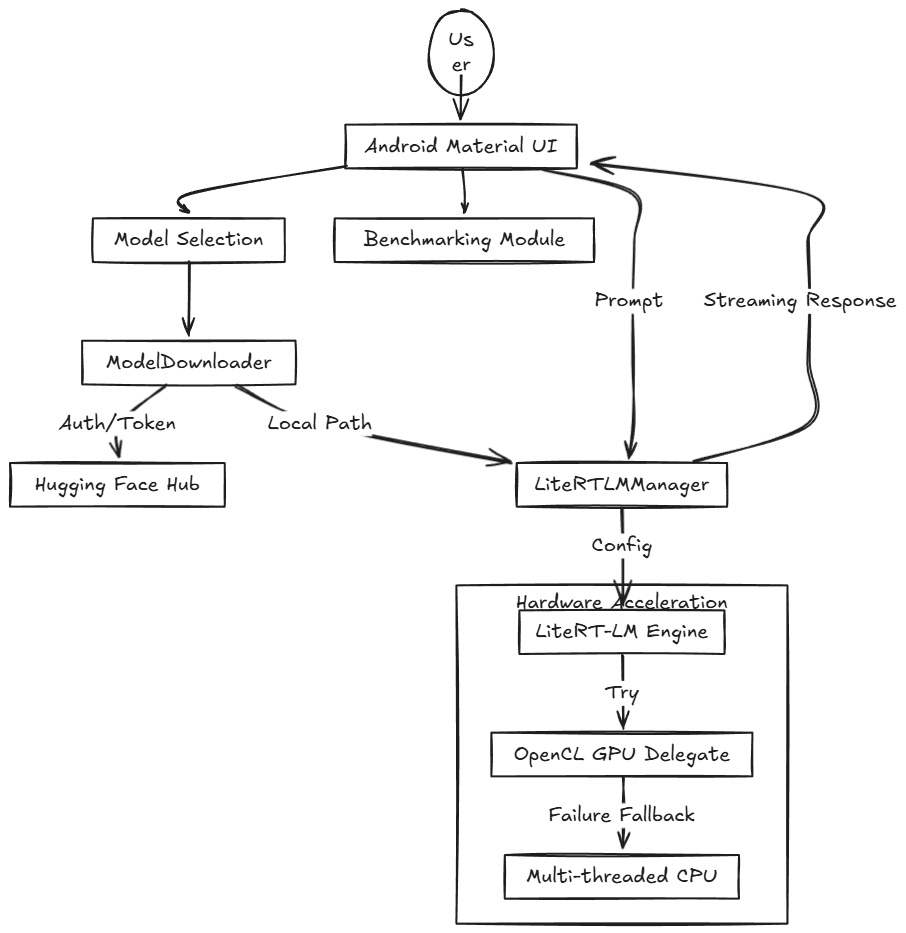
🏛️ System Architecture
To understand how the models run so efficiently, we need to look at the three-layer stack: Application, Engine, and Hardware.

🔩 The Framework: Google LiteRT-LM
To run these models, we use LiteRT-LM, Google’s dedicated on-device AI runtime. Specializing in sequence-to-sequence generation, LiteRT-LM manages the complexities of LLMs:
- Singleton Engine & Stateful Sessions: Effortlessly manages shared model weights while supporting independent KV Caching for multiple concurrent chat histories.
- Intelligent Memory Management: Implements copy-on-write and context-switching for the KV cache to ensure sub-second Time To First Token (TTFT).
⚡ The Powerhouse: Qualcomm QNN & Hexagon NPU
The “QNN” in our project stands for Qualcomm Neural Network SDK. On modern Snapdragon processors (like the Snapdragon 8 Gen 3 or Snapdragon X Elite), this is where the magic happens.
How QNN Integration Works:
LiteRT-LM interfaces with the Qualcomm AI Engine Direct (QNN) via a specialized hardware delegate. When the engine initializes, it looks for the QNN driver (libQnnHtp.so) and attempts to offload the entire model graph to the Hexagon Tensor Processor (HTP).
Why the NPU is a Game Changer:
- Massive Parallelization: The Hexagon NPU is a fused AI accelerator. It isn’t just a CPU core; it integrates scalar, vector, and tensor accelerators designed specifically for the math that powers LLMs (matrix multiplications).
- Performance vs. Power: Running an LLM on the CPU can drain a battery in minutes and cause thermal throttling. The HTP achieves up to 100x more performance-per-watt than a standard CPU.
- Low Latency Inference: By utilizing the HTP’s micro-tile inferencing, the model can generate tokens at speeds far exceeding the GPU, reaching over 50+ tokens/sec on compatible 4-bit quantized models.
Our app’s GPU -> CPU fallback logic acts as a safety net, ensuring the app remains functional even if the specific model ops aren’t yet supported by the device’s current QNN driver version.
Model Deep-Dive: Gemma 3n (The Nested Giant)
Gemma 3n is Google’s state-of-the-art mobile-first model, featuring two major architectural innovations:
1. MatFormer (Matryoshka Transformer)
A nesting doll structure that allows a single model to contain smaller, fully functional sub-models. This enables “elastic inference” — the ability to dynamically adjust size based on task complexity or available NPU resources.
2. Per-Layer Embeddings (PLE)
PLE moves the model’s massive token embeddings from the high-speed VRAM to the CPU, processing them in parallel. This allows a 2B-level model to run on devices with as little as 2GB of available RAM without sacrificing quality.
🌪 Model Deep-Dive: Qwen 3 0.6B (The Speedster)
Qwen 3 from Alibaba is a masterclass in dense architecture scaling, optimized for the highest possible throughput.
1. Grouped Query Attention (GQA)
Traditional attention mechanisms are memory-bandwidth hogs. Qwen 3 uses GQA to share Key/Value heads across multiple Query heads, slashing the memory traffic between the SoC and the RAM.
2. Thinking Mode & Dual-Stream Reasoning
Despite its 0.6B size, Qwen 3 supports the “Thinking” mode, allowing it to generate internal chains of thought before responding. With a 32k context window and SwiGLU activations, it is built for long-form, coherent conversations on tiny hardware.
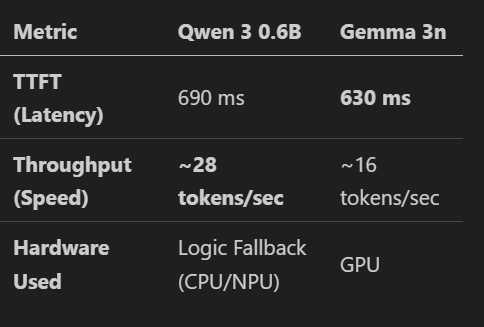
📊 The Showdown: Benchmarking Results
We tested both models on a Samsung Galaxy S25 Ultra:
Analysis
- Gemma 3n wins on response depth and detail, making it the better choice for knowledge-intensive reasoning.
- Qwen 3 wins on absolute speed, making it the perfect conversational companion where speed is parity with human thought.
Conclusion
By leveraging Qualcomm’s QNN acceleration and the Nested/Dense architectures of the latest SLMs, strictly on-device AI has moved from “experimental” to “feature-ready.” We’ve built a Model Garden that proves you don’t need the cloud for elite performance.
👉 Explore the Project on GitHub
Built with Google LiteRT-LM & Qualcomm QNN SDK.

Benchmarking the Edge: Gemma 3n vs. Qwen 3 on Android with LiteRT-LM was originally published in Google Developer Experts on Medium, where people are continuing the conversation by highlighting and responding to this story.