The importance of selecting the right software development framework for building a successful digital product can hardly be overestimated. The simpler to use and the more performant the chosen framework or tool, the easier it is for software developers to turn their projects into reality.
When it comes to choosing the best cross-platform mobile app development framework, many programmers opt for Flutter.
Flutter is considered to be one of the top cross-platform frameworks. Statista states that in 2024, it was ranked among the 15 most used frameworks worldwide.
Meanwhile, its popularity is continuing to grow year after year: in 2023, 46% of software developers used Flutter for cross-platform development, whereas in 2019 this figure reached only 30%.
But what makes Flutter incredibly popular, and why do software developers keep choosing it when building their cross-platform mobile apps? Let’s find out what helps Flutter app development services to excel and what the benefits of Flutter apps are for businesses.
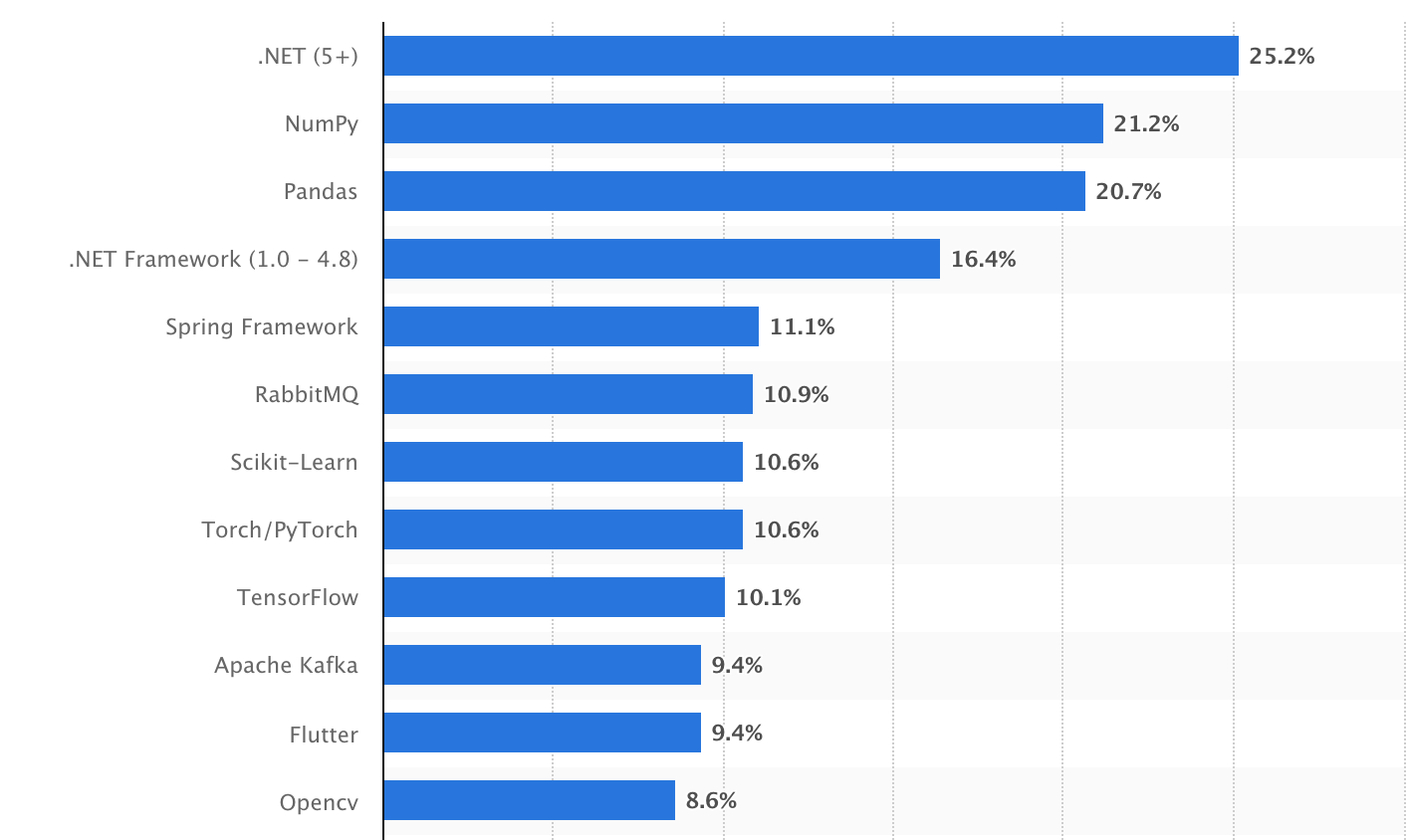
Most Used Libraries and Frameworks Among Developers, 2024 (Statista)
What Is Flutter?
Flutter is a free open-source mobile development framework released by Google in 2017. It works great for building multiplatform apps from a single codebase that look perfectly on screens of any size and run smoothly on any device.
This harmony is achieved with the help of two framework components – its SDK (Software Development Kit) and an extensive library of reusable UI (User Interface) components.

Unlike most frameworks that use JavaScript for building UIs, Flutter offers software developers its own object-oriented programming language – Dart, which is simple to pick up for those programmers who already use JavaScript.
The main IDEs software developers implement for building mobile apps are Android Studio and Visual Studio Code (VSCode). These full-featured IDEs offer a wide range of extensions and plugins, making app development an effortless journey.
Although the choice of frameworks for Flutter is not limited to just two options, some software developers may use IntelliJ IDEA, Eclipse, Atom, and others.
Flutter App Development Advantages
Flutter offers a rich blend of software development features that can be individually found in other frameworks. Being combined together into one Flutter package, currently, they represent the best software-development suite that allows the creation of robust, native-like, and performant cross-platform solutions.
Let’s have a closer look at these features and how they help Flutter keep the leading position in the mobile app development market.
Faster Code Development
For fast code development, Flutter provides software developers with an outstanding feature called Hot reload. With Flutter’s Hot reload, software developers don’t have to constantly restart the application to see the changes they’ve implemented.
This way, they can track the changes practically immediately without modifying their current app state.
Custom UI of Any Complexity
Flutter allows creating outstanding UI designs for Android and iOS devices, using a single code base and a rich set of components and libraries. Therefore, it saves developers much time on design and development work.

Moreover, it incorporates an extensive range of its own custom widgets. For example, it follows the principles of Material Design when developing Android apps and Cupertino for iOS.
Using Flutter widget sets means that software developers don’t have to deal with native system components of a particular platform. Instead, they can quickly choose ready-for-use widgets and create native-like UIs on their apps.
Own Rendering Engine
A robust set of features in Flutter requires strong support. For this, the framework has its own rendering engine – Skia. The engine is written in C/C++, which makes Skia particularly fast and performant.
For example, Flutter apps empowered by Skia can show 60 frames per second on most devices and 120 frames per second on devices that support Flutter.
Skia renders UIs onto a platform-provided canvas and can run practically on any platform. As a result, software developers don’t have to create any additional bridges and platform-specific components to render its UI.
This saves the time spent on adjustment of app UIs, ensures consistent app performance and layout on diverse gadgets, as well as makes the development process much simpler and easier to do.
Strong Community Support
Flutter has a strong, established community that’s been steadily growing since 2017. For example, according to dev.to, there are over 63.8k followers on Reddit, 78,544 questions were asked about the framework on StackOverflow, 144k stars, and 16.3k forks on GitHub.
Meanwhile, Flutter creators constantly hold community events, including Flutter Engage France, Spain, Turkey, North America, and many others.
Clear Documentation and Great Resources
It won’t take much time for software developers experienced in JavaScript or any other C-like language to learn Dart, as it has a very similar structure to JS. Another helper is an effective plugin manager pub.dev that includes many examples on how to use styles, animations, and perform various actions.
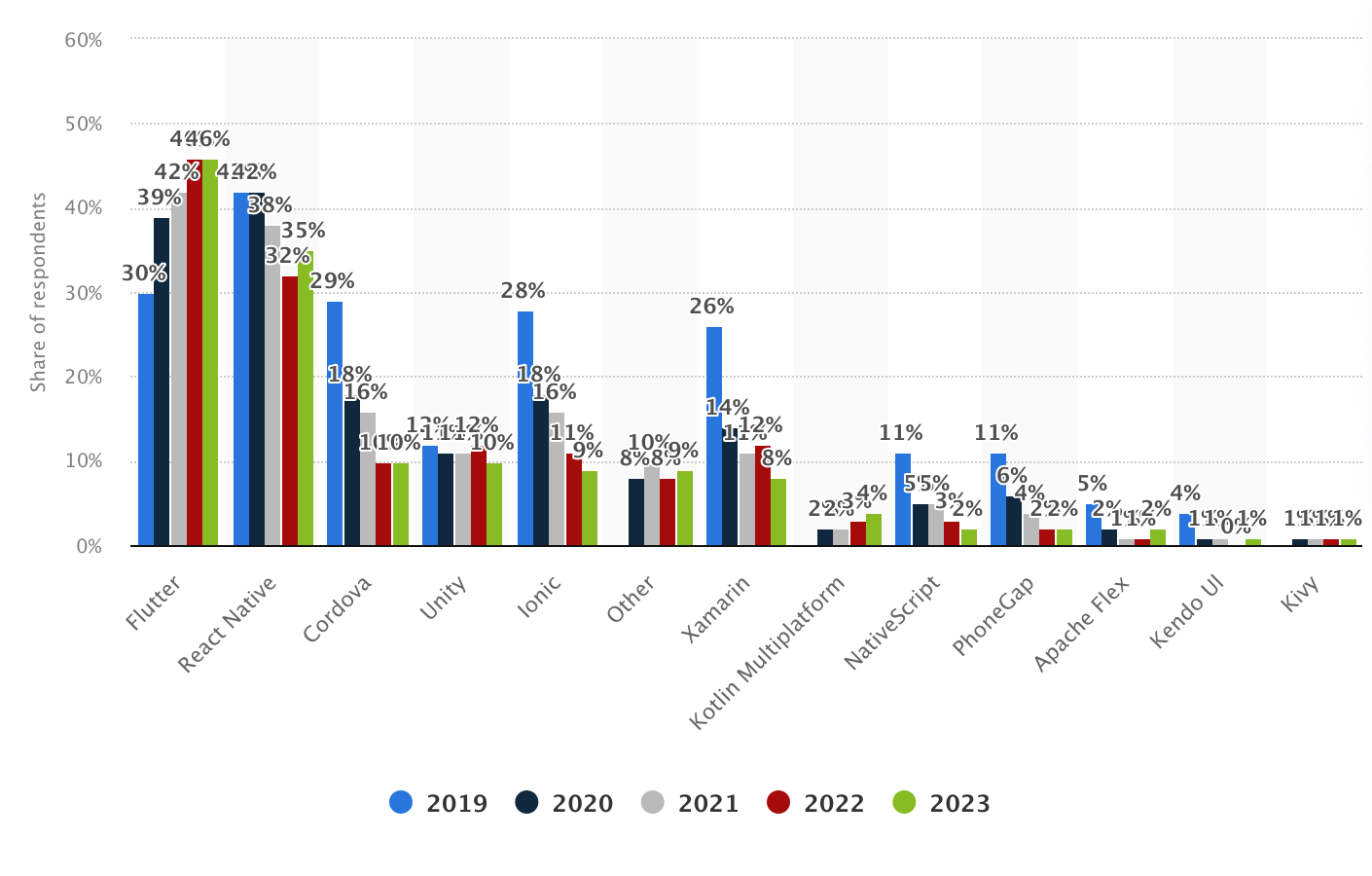
Cross-Platform Frameworks Used by Developers from 2019 to 2023, Statista
Is Flutter a Good Choice From the Business Perspective?
When choosing a framework for creating their business app, companies have to consider many aspects – platform stability, its performance, how easy it’ll be to hire software development specialists for the chosen solution, and much more. Here are the main reasons why many businesses opt for Flutter.
Fast MVP Development and Quick Time to Market
Being a cross-platform framework, Flutter allows software developers to start app development for several platforms practically simultaneously. Moreover, it’s much faster to create new features for the requested app in Flutter compared to other cross-platform frameworks.
With Flutter, it’s just a matter of weeks for a small team to deliver an MVP product version and release it to the market. After the MVP release, the framework will remain a simple-to-use and robust framework despite the growing complexity of the developed solution.

Rich and Attractive UI
Flutter creators from Google made everything possible and even more to enrich their framework with the most attractive and diverse widgets. This way, the developed solution will always look professional and have the attractive look of a native app.
Cost-Effectiveness
Businesses don’t have to pay twice for the developed app when it comes to releasing it on several platforms. Software developers have to write the codebase just once and run it on the targeted platforms.
Easy to Find High-Quality Developers
Flutter is a rapidly growing in popularity cross-platform framework that significantly facilitates software development activities. Many software developers switch to Flutter to avoid diverse application development hurdles.
Moreover, this framework already has a well-settled community, and Flutter creators do everything to popularize it further among programmers.
Is Flutter Suitable for Scaleups?
When developing software, many companies reach a point where an MVP is no longer enough, and the product needs to scale without losing quality or control over costs. At this stage, Flutter proves to be a worthy option.
With a single codebase for multiple platforms, developers can release new features faster, have smaller teams, and maintain a uniform user experience as the product grows.
From a technical perspective, Flutter supports scalable architectures, modular code organization, and modern state management approaches. When enforced correctly, Flutter applications can tolerate rising user loads, expanding feature sets, and frequent updates without becoming difficult to maintain.
Flutter is also a good choice for scaleups planning international expansion. Its uniform UI across platforms, stable performance, and wide device support help guarantee stable behavior and don’t impose limitations that would slow down growth.
Is Flutter Good for Enterprise Applications?
Similar to scaleups, many companies choose Flutter for enterprise applications because it allows developers to create complex, multiplatform solutions, yet keep development predictable and painless.
For large organizations that need to support iOS, Android, web, and sometimes desktop applications at the same time, Flutter’s single codebase remarkably reduces duplicated effort and simplifies long-term maintenance, especially when multiple development teams are involved.
From a technical perspective, Flutter supports enterprise-level architectures, such as clean architecture, layered or modular designs, and feature-based code organization, which makes it easier for developers to scale large codebases, isolate business logic, and manage dependencies across teams.
Also, Flutter integrates well with existing enterprise ecosystems. Developers can connect Flutter applications to ERP systems, CRM platforms, internal microservices, and legacy backends using REST APIs, GraphQL, or gRPC.
For example, enterprise dashboards, internal workflow tools, field service apps, or customer portals can all be built in Flutter while relying on existing backend infrastructure.
Flutter also supports secure authentication flows, including OAuth 2.0, SSO, and token-based authentication, which are common enterprise requirements.
Performance and reliability are also critical considerations in enterprise environments. Flutter’s rendering engine guarantees consistent UI behavior across platforms, reducing platform-specific UI flaws.
With proper optimization, Flutter applications run large datasets, live updates, and complex UI interactions, such as dynamic forms, data-heavy tables, and custom visualizations.
On top of that, Flutter fits well into enterprise development processes and tooling. Developers can integrate Flutter projects into CI/CD pipelines, run automated unit, widget, and integration tests, and enforce code quality standards across teams.
That said, enterprises should be aware that some newly released platform-specific features may not be immediately available in Flutter. In such cases, developers can create custom native plugins in Swift, Kotlin, or Java to bridge the gap.
This hybrid approach allows enterprises to benefit from Flutter’s productivity but still access low-level platform capabilities when necessary.
Challenges and Disadvantages to Know About Flutter
Despite its many strengths, Flutter comes with several challenges that developers and decision-makers should be aware of before choosing it for a project. Understanding these limitations early helps avoid unrealistic expectations and downsizes technical risks in the long run.
One common concern is the fear of Google discontinuing product support. While Google has a history of shutting down some products, Flutter is actively developed, widely adopted, and used in Google’s own products.
From a technical standpoint, Flutter has a strong open-source foundation and a growing ecosystem, which lowers dependency on a single vendor. Still, for long-term enterprise or mission-critical systems, this risk is often discussed during technology selection.
Another problem is the difficulty of hiring truly senior Flutter developers. Although many developers are familiar with Flutter, fewer have deep experience building large-scale applications with complex architectures, performance optimization, and platform-specific integrations.
For enterprise or long-lived products, teams often need developers who understand not only Flutter widgets, but also native iOS and Android development, memory management, and advanced debugging.
Flutter can also lag behind native SDKs when it comes to newly released platform-specific features. When Apple or Google introduces new APIs, system behaviors, or UI components, Flutter support usually arrives later through framework updates or community plugins.
In cases where early access to platform features is critical, developers may need to implement custom native plugins in Swift, Kotlin, or Java, which adds complexity to the codebase.
Another limitation is app size, especially for simple applications. Flutter includes its own rendering engine and runtime, which increases the base size of the app compared to fully native solutions.
While this is rarely a problem for feature-rich products, it can be a disadvantage for lightweight apps where download size is a pivotal metric.
Performance tuning can also require extra effort in complex scenarios. Although Flutter delivers strong performance by default, applications with heavy animations, large lists, real-time data streams, or intensive background processing require careful optimization.
Developers need a good understanding of Flutter’s rendering pipeline, widget rebuilds, and memory usage to avoid UI jank or excessive resource consumption.
Finally, debugging platform-specific issues can be more complex than in purely native development. Since Flutter abstracts many platform details, diagnosing issues related to OS behavior, device-specific bugs, or native plugins may require switching between Dart, native code, and platform tools.
Flutter vs Other Technologies
When choosing a cross-platform framework, it’s important to understand how Flutter compares to other popular technologies. Each framework has its strengths and trade-offs depending on the project conditions, team expertise, and long-term goals.
Flutter vs. React Native
React Native, developed by Meta, has been a popular choice for cross-platform mobile apps for years. It uses JavaScript and allows developers to write code once for iOS and Android.
However, Flutter generally offers better performance and more consistent UI because it uses its own rendering engine (Skia) rather than relying on native components. Flutter also provides a richer set of customizable widgets and smoother animations out of the box.
React Native can be a better fit for teams with strong JavaScript experience or projects that need to share code with existing web applications. Flutter, on the other hand, stands out when UI consistency, complex animations, and fast iteration are prerogatives.

Flutter vs. .NET MAUI
.NET MAUI is Microsoft’s framework for creating cross-platform apps using C# and .NET. It’s ideal for teams already invested in the Microsoft ecosystem and works well for enterprise applications.
Flutter has a more mature ecosystem for cross-platform UI, stronger community support, and a larger selection of plugins and third-party packages. It also provides faster development cycles due to hot reload and a highly flexible widget system.
.NET MAUI, in turn, can be more suitable for organizations that heavily rely on existing .NET infrastructure or need deep integration with Microsoft services.
Flutter vs. Kotlin Multiplatform
Kotlin Multiplatform focuses on sharing business logic between iOS and Android, but keeping the UI native for each platform. This approach allows developers to use platform-specific UI capabilities but requires separate UI development for each platform.
Flutter differs by providing a single codebase not just for business logic but also for the entire UI, which greatly reduces development time and provides a consistent design across platforms.
Kotlin Multiplatform can be a better choice when maximum native performance or adherence to platform-specific UI patterns is required, whereas Flutter excels in fast development and cross-platform UI uniformity.
Flutter Development with SCAND
SCAND offers comprehensive Flutter development services, helping companies build high-quality, scalable, and visually engaging cross-platform applications.
Using Flutter’s single codebase approach, SCAND’s developers can deliver solutions for iOS, Android, web, and desktop, reducing development time and costs without compromising performance or design.
With extensive knowledge and experience with Flutter, SCAND delivers projects regardless of their complexity, whether it is an MVP, a prototype, or enterprise-level apps.
Our developers use robust architectures, state-of-the-art state management systems such as Bloc or RiverPod, and integrate them effortlessly with existing systems and APIs.
SCAND also prioritizes UI/UX excellence. Our team designs custom, pixel-perfect interfaces, implements complex animations, and guarantees consistency across platforms, all while maintaining optimal app performance.
For enterprises and scaleups, we provide full-bodied solutions with secure authentication, data protection, offline capabilities, and support for CI/CD workflows.
Whether a startup needs rapid MVP development or an established company requires a scalable enterprise application, SCAND’s Flutter development services provide a balance of speed, quality, and cost-effectiveness.
Our developers also offer continuous support and optimization, guaranteeing apps remain performant and up-to-date as technologies evolve.
By choosing SCAND for Flutter development, companies gain a partner capable of delivering end-to-end solutions with the flexibility, reliability, and innovation that Flutter enables.
Bottom Line
Although Flutter only recently emerged on the cross-platform app development market, it is already successfully competing with such big names as React Native, Xamarin, and others due to its extensive set of UI elements and high efficiency.
Many businesses turn to Flutter as this framework ensures app consistency, development simplicity, and cost-effectiveness. Apart from that, the framework offers robust components and features that make business apps look classy and attractive as well as deliver outstanding performance.
The post Flutter App Development: Why You Should Choose Flutter for Your Project appeared first on SCAND.
![[boost]](https://prodsens.live/wp-content/uploads/2025/02/31263-boost-380x250.png)