Public policy is under pressure. Governments must respond faster to complex challenges — climate change, digital governance, public health — while working through dense regulations, fragmented evidence, and competing priorities. Speed matters, but so do rigor, transparency, and trust.
PolicyPilot is an AI-powered policy innovation assistant built for the GDE AI Sprint to explore how agentic AI can support modern policymaking. It shows how AI for social good can augment human judgment, helping policy teams move from ideas to actionable proposals more efficiently and with greater confidence.
PolicyPilot is powered by Gemini 3 and uses Agent-to-Agent (A2A) collaboration to coordinate specialized agents for research, regulatory interpretation, policy comparison, and drafting. Development happens through the Gemini CLI, while Antigravity serves as a hulked-up agentic IDE for designing and stress-testing multi-agent workflows. The system runs on Vertex AI, providing scalability, security, and production-grade reliability.
By combining multi-agent reasoning with real-time analysis, PolicyPilot turns policy design into an interactive, data-driven process — illustrating how next-generation Gemini agents can help build more agile, evidence-informed, and socially responsible governance.
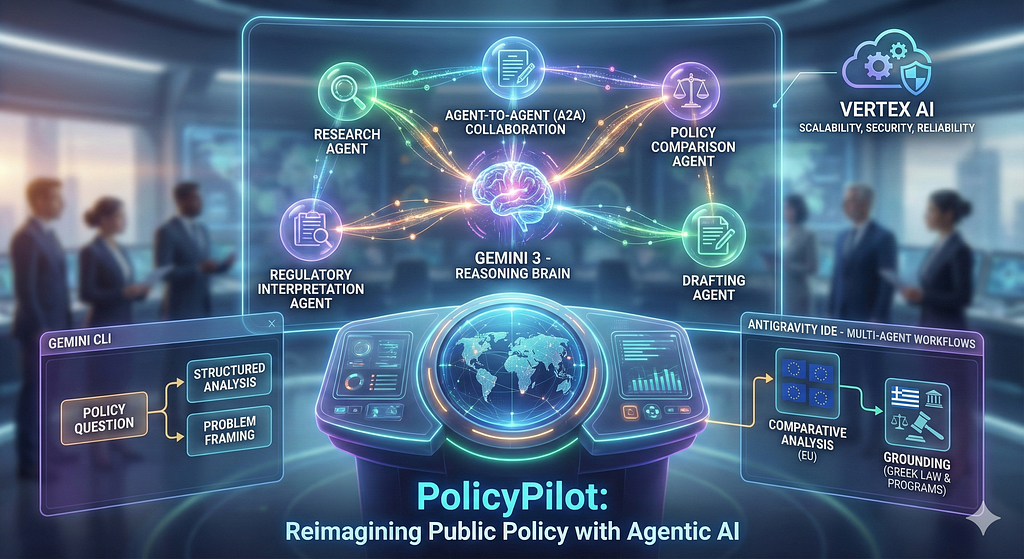
How PolicyPilot Works: From Question to Policy Insight
PolicyPilot is designed around a simple idea: policymakers should be able to ask complex questions and receive structured, evidence-based policy insights — step by step, transparently, and with human judgment always in the loop.
The following three short videos walk through a complete policy analysis workflow, showing how PolicyPilot supports public-sector decision-making from the initial question to legal and programmatic grounding.
Video 1 — From Policy Question to Structured Analysis
Policy analysis starts with a question — but poorly defined questions lead to weak outcomes.
In the first video, the user begins by asking a policy question in plain language. Instead of rushing to answers, PolicyPilot focuses on structuring the problem first. It clarifies the policy scope, identifies objectives, and surfaces the key dimensions of analysis — economic, social, regulatory, or environmental.
This is made possible by Gemini 3, which acts as the system’s shared reasoning brain, allowing the agents to maintain context, handle complexity, and reason step by step. Specialized agents coordinate through Agent-to-Agent (A2A) collaboration, each contributing to problem framing, while the workflow is orchestrated through the Gemini CLI, ensuring transparency and reproducibility. The result is a clearly defined policy problem, forming a solid foundation for evidence-based decision-making.
https://medium.com/media/a9ae27f0c7b482eb492a3bfbbd1becb2/href
Video 2 — Learning from Other EU Countries
Good policymaking rarely happens in isolation.
The second video shows how PolicyPilot performs comparative policy analysis across the European Union. The system examines how other countries have addressed similar challenges, highlighting different regulatory approaches, policy instruments, and observed outcomes.
Here, A2A collaboration allows multiple agents to work in parallel across jurisdictions, while Gemini 3’s synthesis and abstraction capabilities enable meaningful comparison across diverse policy contexts. Antigravity, acting as a hulked-up agentic IDE, coordinates and stress-tests these multi-agent workflows to keep the analysis structured and coherent. Rather than ranking countries or copying solutions, PolicyPilot helps surface alternatives, trade-offs, and policy design patterns that can inform better national decisions.
https://medium.com/media/0be30023effbfa3d7feb04b7c427bfd1/href
Video 3 — Grounding Policy Options in Greek Law and Programs
Even the best policy ideas must be legally and institutionally feasible.
In the final video, PolicyPilot grounds the analysis in the Greek legal framework and public programs. It identifies relevant laws, regulations, and existing instruments, helping policymakers assess what is currently possible and where reform or new interventions may be needed.
Specialized agents interpret legal and programmatic material using Gemini 3’s controlled reasoning, ensuring alignment with the earlier analytical steps. The entire workflow runs on Vertex AI, providing the scalability, security, and reliability required for real public-sector environments. This step bridges the gap between analysis and implementation, ensuring that policy proposals are not only analytically sound, but also grounded in real-world governance structures.
https://medium.com/media/2a735a962d0adf86041f358cf268dff3/href
Conclusion
PolicyPilot is just one example of what can be built today using agentic AI systems powered by Gemini 3, Agent-to-Agent collaboration, and production-grade infrastructure on Vertex AI. Together, these tools make it possible to design AI systems that go beyond single-turn answers — systems that can reason step by step, coordinate specialized capabilities, and support complex, real-world workflows.
With this stack, developers and institutions can build domain-aware assistants, decision-support systems, and analytical co-pilots that are transparent, controllable, and aligned with human decision-making. Tools like the Gemini CLI and Antigravity enable teams to design, test, and refine multi-agent workflows, making complex reasoning processes reproducible and auditable — critical requirements for public-sector and high-stakes environments.
PolicyPilot demonstrates how these capabilities can be applied to public policy, but the same approach can extend to many domains where complexity, accountability, and trust matter: regulation, urban planning, sustainability, health, and beyond. As agentic AI matures, the real opportunity lies not in automating decisions, but in building systems that help people think better, compare options more clearly, and act with greater confidence.

PolicyPilot: Reimagining Public Policy with Agentic AI was originally published in Google Developer Experts on Medium, where people are continuing the conversation by highlighting and responding to this story.