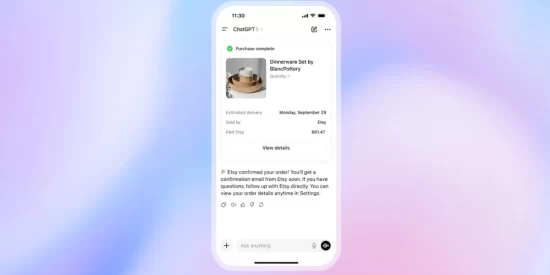
OpenAI has rolled out ChatGPT Instant Checkout, a feature that lets users complete purchases directly within ChatGPT. At launch it supports Etsy merchants in the U.S., and Shopify integration is on the roadmap.
What makes this different from a simple “Buy button” is the underlying technology: the Agentic Commerce Protocol (ACP), co-developed with Stripe. ACP is an open standard that defines how AI agents can safely handle purchases on behalf of users while merchants retain control.
This article takes a technical look at how Instant Checkout works, what ACP supports, and why this matters for developers and merchants building the next generation of commerce systems.
What Instant Checkout Supports Today
ChatGPT Instant Checkout is still early and intentionally limited. At launch it supports:
- Availability: U.S. only
- Merchants: Etsy sellers live, Shopify support coming
- Transaction scope: Single-item purchases only (no cart yet)
- Costs: Merchants pay a commission, users pay no extra fees
- Ranking: Instant Checkout does not influence organic product ranking
- Fulfillment: Merchants remain responsible for fulfillment, refunds, and support
From a user’s perspective, the flow looks like this:
- The user asks ChatGPT about a product.
- ChatGPT shows results (from Etsy today, Shopify soon).
- An inline Buy button appears.
- The user clicks, confirms, and pays using credentials stored in ChatGPT.
- The merchant backend processes the order as if it came from their normal channel.
This simplicity hides the complexity of the design behind it.
The Agentic Commerce Protocol (ACP)
The Agentic Commerce Protocol is the foundation of Instant Checkout. Instead of building a closed “in-house” checkout, OpenAI and Stripe designed a protocol that could, in theory, be adopted by other AI agents and commerce platforms.
Key principles
- Permissioned actions: every transaction requires explicit user approval
- Scoped tokens: tokens are restricted to merchant + amount + session
- Merchant sovereignty: merchants maintain control of inventory, pricing, and customer communication
- Minimal data sharing: merchants only receive the data needed for fulfillment, nothing more
- Extensible standard: ACP is open source, so anyone can audit or extend it
Integration paths
-
Stripe merchants
- If you already use Stripe, enabling ACP is minimal — in some cases as little as one line of code.
-
Shared Payment Token API
- A generic API for merchants using other processors, enabling delegated payments.
-
Delegated Payments Spec
- For complex checkout flows, subscriptions, or regulated industries, ACP defines a spec developers can extend.
-
Open-source protocol
- ACP lives in the open, which lowers vendor lock-in and invites ecosystem growth.
Technical Flow of a Transaction
Let’s break down how a single-item transaction works from a systems perspective:
-
Product surfaced
- User asks ChatGPT for a product.
- ChatGPT queries an index of merchant data and surfaces eligible results.
-
Token issuance
- Merchant issues a scoped payment token via API.
- The token defines merchant ID, amount, and currency.
-
Agent mediation
- ChatGPT presents the option to the user.
- User explicitly approves purchase.
-
Payment execution
- ChatGPT forwards the scoped token to Stripe (or another ACP-compatible processor).
- Payment is captured.
-
Fulfillment
- Merchant backend receives the order payload.
- Fulfillment, returns, and after-sales follow normal merchant processes.
This separation ensures that ChatGPT never becomes the “merchant of record” — it mediates but does not replace.
Developer Implications
For developers, ACP introduces new considerations:
1. Conversational commerce as an interface
Checkout no longer requires a web form. Instead, the agent is the interface. That changes how developers design checkout flows, error handling, and confirmation states.
2. Payment tokenization patterns
ACP relies on scoped tokens that are time-bound and limited in use. This reduces fraud but requires developers to handle issuance and validation carefully.
3. Merchant backends stay in control
Developers must design APIs to handle incoming order payloads from ChatGPT. That means mapping conversational orders into existing ERP or Shopify flows without breaking accounting, inventory, or fulfillment.
4. Extensibility opportunities
ACP being open means developers can build:
- Monitoring tools for agent-driven sales
- Fraud detection middleware tailored to conversational orders
- Adapters for non-Stripe processors
- Analytics pipelines for agent commerce activity
Current Limitations
Instant Checkout is limited, and developers should be aware of the constraints:
- No multi-item carts — only single SKUs can be purchased
- No subscriptions — recurring billing not supported yet
- No native returns in ChatGPT — merchants must handle returns externally
- Geography — only U.S. for now, with future rollout unclear
- Ranking — ACP does not guarantee exposure, only transaction handling
These constraints are important because they shape what developers can build today.
Security and Compliance Considerations
Security is central to ACP’s design:
- Scoped tokens prevent replay attacks or token reuse
- Explicit confirmation protects against silent transactions
- Encrypted token exchange keeps data safe between agent and processor
But additional compliance layers matter:
- GDPR/CCPA — AI agents mediating transactions will need clear privacy disclosures for EU and California
- PSD2 (Europe) — Strong Customer Authentication may require adjustments if ACP expands to EU merchants
- Data minimization — merchants must handle reduced payloads, which may affect CRM or analytics
For developers, this means preparing for multiple compliance layers if building globally.
Building With ACP: Example Scenarios
Here are some scenarios where developers can start experimenting:
1. Minimal Stripe merchant
- Already on Stripe Checkout
- Enable ACP with one line of code
- Orders from ChatGPT appear as normal Stripe transactions
2. Custom Shopify setup
- Shopify store with a custom checkout flow
- ACP integration via Delegated Payments Spec
- Requires mapping tokens to existing order system
3. Non-Stripe payment processor
- Merchant using Adyen or PayPal
- Build adapter for Shared Payment Token API
- Extend ACP to handle custom processor logic
4. Analytics and monitoring layer
- Build middleware to log ACP transactions
- Provide dashboards for agent-driven sales
- Correlate ChatGPT sales with web or POS data
Future Outlook
Where is Instant Checkout heading? Likely expansions include:
- Multi-item cart support — enabling full basket purchases
- Subscriptions — recurring billing with scoped tokens
- More regions — expansion beyond the U.S.
- Voice integration — conversational checkout in ChatGPT mobile apps or smart devices
- 3rd-party adoption — other AI agents adopting ACP beyond ChatGPT
For developers, this means ACP could become the de facto standard for agent commerce.
Risks and Open Questions
-
Discoverability
How will merchants optimize products for ChatGPT ranking? Will an equivalent of SEO for agents emerge?
-
User trust
Will customers trust ChatGPT to mediate payments? Studies suggest design and transparency matter.
-
Fraud
Could attackers exploit conversational contexts to trick users into approving payments?
-
Data access
Merchants receive minimal data — is this enough for CRM and marketing?
-
Ecosystem adoption
Will other agents (Perplexity, Anthropic, Google) adopt ACP, or will competing standards fragment the ecosystem?
Why This Matters
ChatGPT Instant Checkout is limited today, but it signals a shift:
- From web-first commerce to agent-first commerce
- From closed platforms to open standards (ACP)
- From merchant lock-in to merchant sovereignty
For developers, the opportunity lies in tooling, adapters, monitoring, and compliance around ACP.
Conclusion
ChatGPT Instant Checkout is the first mainstream implementation of the Agentic Commerce Protocol. Right now it’s U.S.-only, single-item, and Stripe-first — but the architecture is open and extensible.
For developers, the takeaway is clear:
- Learn ACP’s design
- Start experimenting with scoped tokens and delegated flows
- Consider building adapters, monitoring, or compliance tooling
- Prepare for a future where AI agents initiate more transactions than websites
Agent-first commerce is just beginning. The code, standards, and practices we build today will shape how customers buy tomorrow.