
A strategic plan tells you where your organization is going over the next three to five years. A strategic action plan tells you what your team does next week to get there. The gap between a well-crafted strategy and the outcomes it was designed to deliver is almost always an execution problem — not a strategy problem. Organizations that document strategic goals without a concrete action layer to support them tend to revisit those goals at the next planning cycle and find they’ve drifted. A strategic action plan closes that gap by converting a strategic objective into a schedule with named owners, deadlines and measurable outcomes.
What Is a Strategic Action Plan?
A strategic action plan is a structured document that translates a single strategic objective into the specific tasks required to achieve it. For each task, it defines who is accountable, what needs to be done, when it must be completed and what resources are needed. Where a strategic plan is a multi-year directional document, a strategic action plan is the operational layer beneath it — the mechanism by which strategy becomes execution.
Strategic action plans are typically built for a quarter or a fiscal year. A company with four strategic objectives for the year may build four separate strategic action plans, each owned by a different department or initiative lead, each with its own task list and milestones. This is a core discipline of project management at the organizational level.
Strategic Action Plan vs. Strategic Plan
These two documents work together but serve different purposes, and confusing them leads to plans that are long on vision and short on accountability.
A strategic plan is a multi-year document that defines where the organization is going: mission, vision, strategic objectives, competitive positioning and long-term financial goals. It answers the question: what kind of organization do we intend to be, and what will we prioritize to get there?
A strategic action plan is built for a single objective within that strategic plan. It answers the question: what specific work needs to happen this quarter or this year to advance that objective, and who is responsible for each piece? A project charter often precedes it, authorizing the initiative before the action plan maps out the tasks.
| Strategic Plan | Strategic Action Plan | |
| Scope | Organization-wide | Single objective or initiative |
| Time horizon | 3–5 years | Quarter or fiscal year |
| Audience | Board, leadership, investors | Department leads and team members |
| Primary content | Vision, mission, goals, SWOT | Tasks, owners, deadlines, resources |
Execute Your Strategic Action Plan With ProjectManager
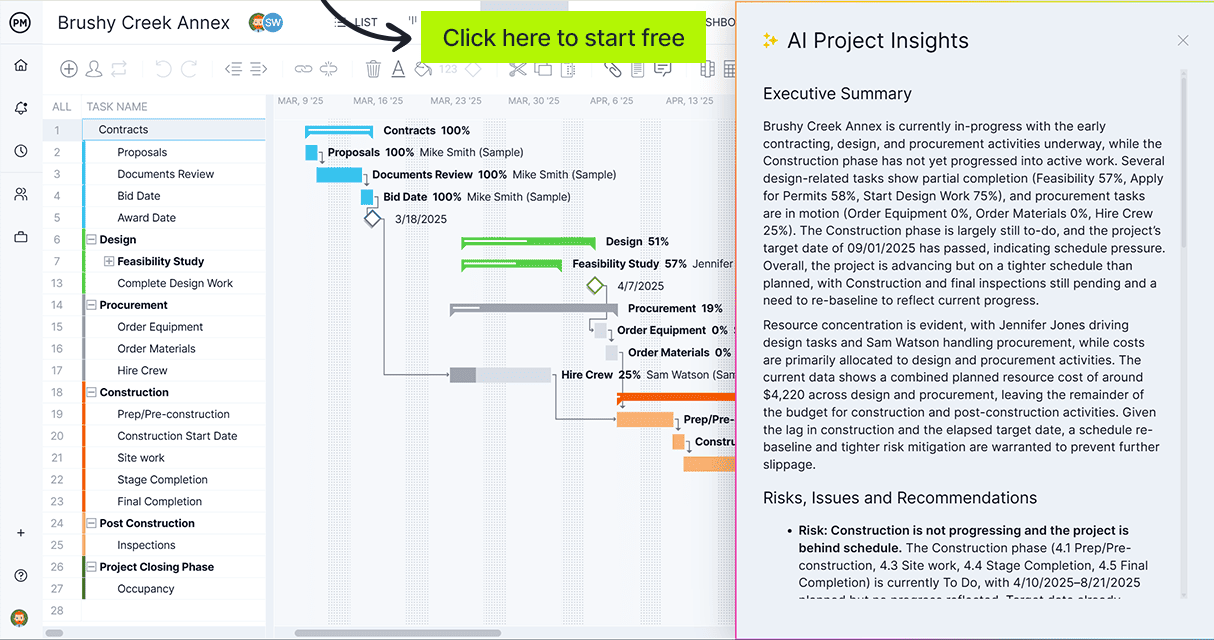
ProjectManager is online project management software with Gantt charts, real-time dashboards and task management built for teams turning strategic plans into measurable results. Try it free for 30 days.
Strategic Action Plan Components
Regardless of the objective it serves, a well-structured strategic action plan contains the same six core elements.
- Strategic objective — The specific goal from the strategic plan that this action plan is designed to deliver. One objective per plan keeps accountability clear and prevents scope creep from competing priorities.
- Action steps — The discrete tasks required to achieve the objective, sequenced so that dependencies are visible and parallel workstreams can run without conflicts.
- Task owners — The named individual responsible for each action step. Individual ownership — not team or departmental ownership — is what makes accountability real. A responsibility assignment matrix is useful when multiple departments contribute to the same objective.
- Timeline and milestones — Start and end dates for each task, plus two or three interim milestones that serve as checkpoints. Milestones allow course correction before the final deadline; a single end date without milestones creates a last-minute scramble.
- Required resources — Budget, tools, personnel, approvals or external vendors needed to complete each task. A resource plan built alongside the action plan surfaces conflicts before they stall execution.
- Success metrics — The specific, measurable criteria that confirm the objective has been achieved. Define these before the plan starts so there’s no ambiguity at the end of the period about whether the work delivered what it was supposed to.
Types of Strategic Action Plans
Strategic action plans take different shapes depending on the scope and time horizon of the objective they support.
Annual Strategic Action Plan
Built to execute a company-wide strategic objective over a full fiscal year. Typically spans multiple departments, with each department owning a subset of the action steps. Annual strategic action plans are reviewed quarterly and adjusted as circumstances change, but the objective and success metrics remain fixed unless a significant external change warrants a formal revision.
Departmental Strategic Action Plan
A single department’s execution plan for its contribution to a company strategic objective. Narrower in scope than the annual plan but directly tied to it — the departmental action plan is the mechanism by which a sales team, marketing team or operations team advances a specific strategic goal within its functional area.
Initiative-Level Strategic Action Plan
Built for a discrete strategic initiative: a new market entry, a product launch, a technology migration or an organizational restructuring. The objective is specific and time-bound, the team is often cross-functional, and the action plan serves as the governing document for the entire initiative from kickoff to completion. An implementation plan is closely related — it typically picks up where the strategic action plan leaves off, governing the delivery of a specific solution.
How to Write a Strategic Action Plan
The process is consistent across objective types and organization sizes.
1. Start With the Strategic Objective
Anchor the action plan to a single, specific objective from the strategic plan. That objective must already be written in measurable terms — “increase enterprise customer retention by 15% by end of Q3” is an objective; “improve customer experience” is not. If the strategic plan’s language is too broad, sharpen it before building the action plan beneath it.
2. Identify the Action Steps
Work backward from the objective. What must be true for that outcome to be achieved? List every task required, then sequence them by dependency. Use a work plan template to organize tasks by workstream if the initiative spans multiple departments. Flag dependencies early — a task that requires another team’s output should be treated as a milestone in that team’s action plan, not an assumption in yours.
3. Assign Individual Owners
Assign every action step to a named person, not a team, role or department. Strategic initiatives stall most often because everyone assumed someone else was moving a task forward. Named ownership eliminates that assumption and creates a clear point of contact when a step needs to be escalated or unblocked.
4. Set a Timeline With Milestones
Set start and end dates for each task. Then identify three or four milestones across the plan — points where you can verify the initiative is on track before the final deadline. For a quarterly action plan, a milestone every three to four weeks is reasonable. For an annual plan, quarterly milestones at minimum.
5. Map Resources and Dependencies
For each task, note what’s needed to complete it: budget allocation, system access, vendor contracts, approvals or contributions from other teams. If completing a task depends on another team, that dependency becomes an action item in its own right with its own owner and deadline. Surfacing these in planning prevents them from surfacing as emergencies during execution.
6. Define the Success Metric
Confirm the specific, measurable outcome that marks the objective as achieved. If multiple metrics apply, rank them — a primary metric that determines success, and secondary metrics that provide context. Agree on this before the plan starts so the end-of-period review is a factual assessment, not a negotiation.
7. Review and Adjust on a Fixed Cadence
Schedule a standing review for the duration of the plan — weekly for fast-moving initiatives, bi-weekly or monthly for longer ones. At each review, update task status, flag slippage and adjust downstream dates. Use a status report to communicate progress to leadership without rebuilding the update from scratch each time. When the plan needs to change materially, treat it as a formal revision, not an informal adjustment.
Strategic Action Plan Example
The following example shows how a leadership team would build a strategic action plan for a market expansion objective.
Strategic objective: Enter the enterprise customer segment and close 5 enterprise deals by December 31
Success metric: 5 signed contracts with ACV of $100K or above by Q4 close
Timeline: January 1 – December 31
| Action Step | Owner | Deadline | Resources |
| Define enterprise ICP and target account list (250 accounts) | VP Sales | Jan 31 | Sales Ops, CRM access |
| Develop enterprise pricing and packaging | Head of Product | Feb 14 | Finance, 2 weeks analysis |
| Build 3 enterprise customer case studies | Content Lead | Mar 31 | 2 design hours per study, customer sign-off |
| Complete SOC 2 Type II compliance audit | Head of Engineering | Apr 30 | External auditor, $40K budget |
| Hire 2 enterprise SDRs and complete onboarding | VP Sales | Mar 1 | HR, $180K salary budget, 6-week ramp |
| Launch outbound enterprise prospecting sequence | SDR Manager | Mar 15 | Outreach.io, case studies live |
| Develop RFP response template and security questionnaire library | Sales Enablement | Apr 15 | Legal review, 3 weeks |
| Monthly pipeline review: enterprise deals vs. 5-deal target | VP Sales | Monthly | CRM, executive attendance |
Milestones:
- March 31: Enterprise outbound live, SDRs ramped, case studies published
- June 30: First enterprise proposal submitted; SOC 2 audit complete
- September 30: Minimum 2 enterprise deals closed; pipeline sufficient for 5 by year-end
- December 31: 5 enterprise contracts signed
This structure connects the strategic objective to the specific work required to deliver it — each task has a named owner, a deadline and the resource requirements spelled out before the plan starts rather than discovered mid-execution.
Free Strategic Action Plan Template
Rather than building a strategic action plan from scratch, start from a structured format. A strategic action plan template gives you the framework already configured — enter your objective, action steps, owners and dates.
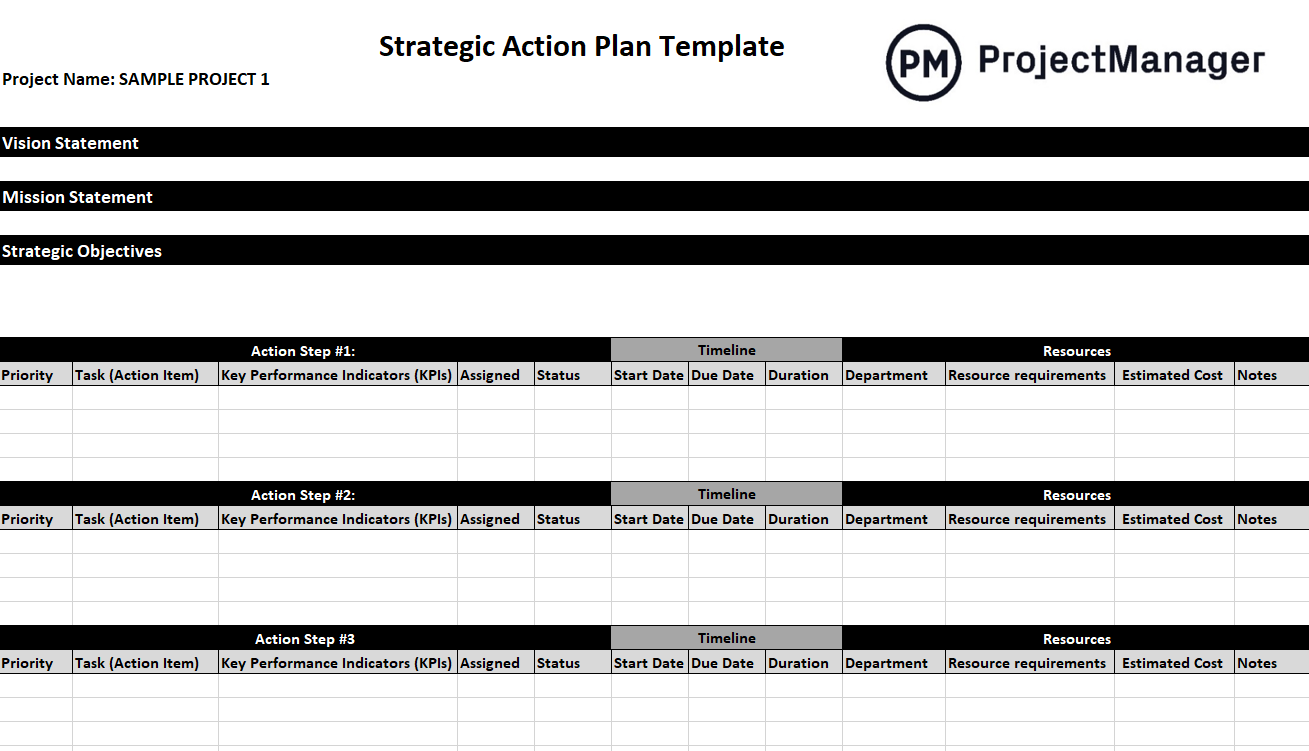
Download it free and adapt the structure to your objective. The same format works whether the plan covers a single department initiative or a company-wide strategic program.
Manage Your Strategic Action Plan With ProjectManager
A template gives your strategic action plan its structure. Executing it requires tools that connect the plan to the actual work — task tracking, schedule visibility, resource allocation and real-time progress data available without a status meeting.
Build and Schedule Action Plans on a Gantt Chart
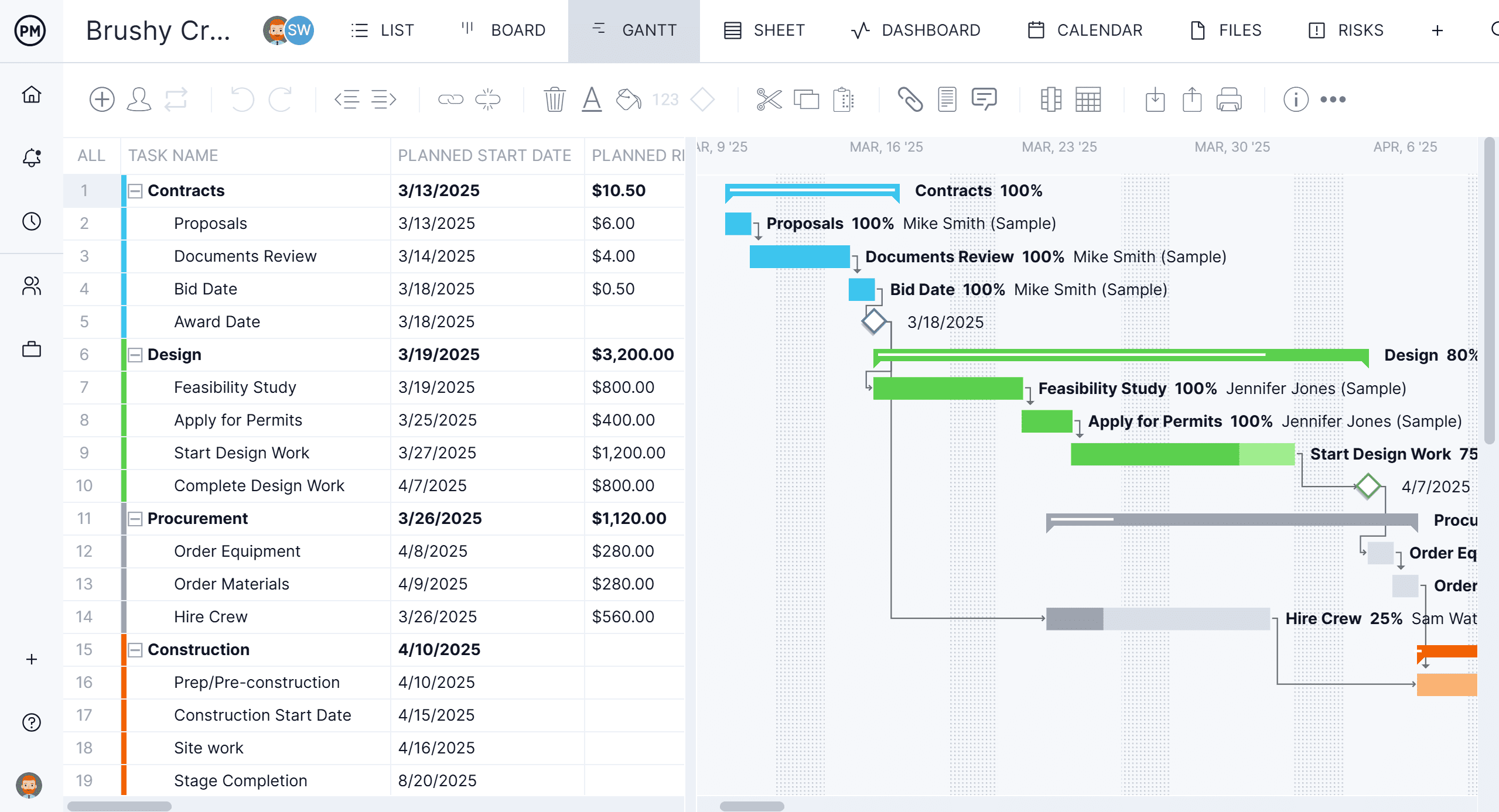
ProjectManager‘s Gantt charts let you translate your strategic action plan into a live project schedule. Add each action step as a task, assign it to the named owner, set start and end dates, and link task dependencies so the schedule reflects the actual sequence of work. Milestones appear on the Gantt as fixed checkpoints — when a task slips, the Gantt shows the downstream impact immediately.
Track Strategic Progress in Real Time
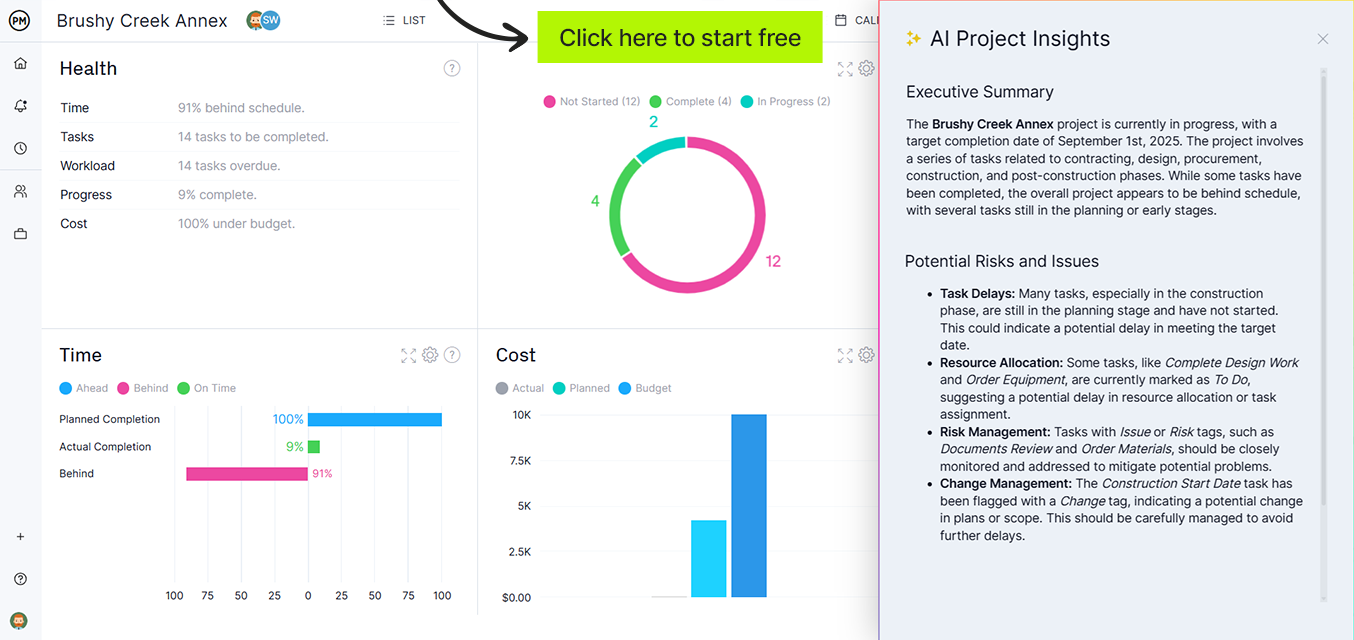
Leadership visibility into a strategic initiative shouldn’t depend on a weekly meeting. ProjectManager’s real-time dashboards pull live data from your project tasks and display completion rates, task health and budget status at a glance. Share a dashboard with stakeholders and the status update runs itself.
Related Content
- How to Write an Action Plan (Example Included)
- 12 Free Strategic Planning Templates for Excel and Word
- What Is an Implementation Plan? (Template & Example)
- 14 Free Work Plan Templates for Excel and Word
- 10 Free Resource Planning Templates for Excel
The post What Is a Strategic Action Plan? (With Example) appeared first on ProjectManager.


