This is a submission for the Google AI Studio Multimodal Challenge
What I Built
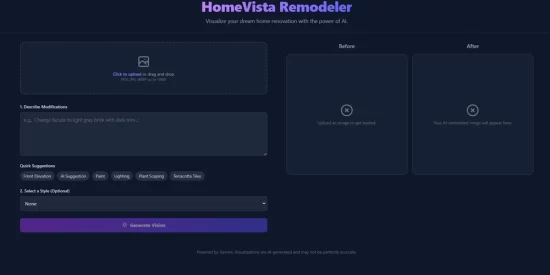
I built HomeVista Remodeler, an AI-powered design assistant that helps homeowners, real estate agents, and designers visualize home renovations instantly. The applet solves a common and often expensive problem: the difficulty of imagining how architectural or stylistic changes will look on a real property.
Users simply upload a photo of a house exterior or an interior room, describe the desired modifications in natural language (e.g., “Change the paint to sage green with white trim,” “add a modern porch,” or “give this living room a mid-century modern feel”), and the application generates a photorealistic “after” image. This provides a powerful, immediate, and inspiring way to explore design ideas, experiment with styles, and make confident decisions before committing to a costly renovation project.
Demo
How I Used Google AI Studio
HomeVista Remodeler is powered by the gemini-2.5-flash-image-preview model, accessed via the @google/genai SDK for TypeScript. This model was the perfect choice because of its strong multimodal capabilities for image editing.
My development process heavily relied on prompt engineering to ensure high-quality, realistic outputs. I crafted a detailed system prompt that instructs the model to act as an “expert architectural visualization assistant.” This prompt sets the context and provides specific rules, such as preserving the original perspective, simulating realistic lighting and shadows, and seamlessly integrating new elements.
The final prompt sent to the API is a dynamic combination of three parts:
- The base system instructions.
- The user’s specific modification request (e.g., “add a second-floor balcony”).
- The selected style theme (e.g., “Modern Industrial”).
This layered approach ensures that the model has all the context it needs to perform a sophisticated, context-aware image modification that aligns with the user’s vision.
Multimodal Features
The core of HomeVista Remodeler is its use of Gemini’s multimodal understanding and generation capabilities.
- Image + Text Input: The application’s primary feature is its ability to process a complex request that combines two distinct types of input: a visual context (image) and a textual command (text). The model doesn’t just generate a new image from text; it intelligently edits the source image based on the user’s instructions. This is a true multimodal task that involves understanding the spatial and architectural elements of the input image and applying the linguistic instructions to it.
- Context-Aware Image Generation: The output is a new image that directly reflects the combined inputs. The model generates a visually coherent and photorealistic result that serves as the “after” in the before-and-after comparison. The application is built to receive this image data, decode it, and present it seamlessly to the user.
This multimodal approach creates a powerful and intuitive user experience. It transforms a complex creative process into a simple, interactive dialogue between the user and the AI, bridging the gap between imagination and visualization.